

Breaking down the AI crash
My thoughts on the AI crash, catalysts, the gap between fundamentals and sentiment and interesting stocks to look at right now

Friday, many tech stocks experienced their largest decline since the COVID crash in 2022. Let's break down what happened, what it means for AI as an investment theme and which stocks could be interesting from here.
The spark
The Kobeissi Letter has the best breakdown of recent events I've come across so far, and I fully agree with it:
"One of the most likely catalysts is growing concern about a potential "ban" on AI, or at the very least, severe regulation of the industry. Over the last 24 hours, Democratic lawmakers have publicly called for restrictions on advanced AI development, including an outright "ban on artificial superintelligence." Frankly, an outright ban will not happen. Such a ban, if even possible to enforce, would effectively mean the US surrendering its position in the global AI race to China. Does this mean AI is "over" or today's stock market crash marks "the end?" Absolutely not. Rather, we believe we are witnessing a sudden shift in sentiment colliding with excessive levels of leverage, potentially triggering forced liquidations by several major institutional investors."
In short: a sudden shift in sentiment in a market with too much leverage. I won't be surprised if some major funds blew up yesterday and added more fuel to the fire.
On today's stock market crash:
— The Kobeissi Letter (@KobeissiLetter) November 5, 2026
As an investor, on days like today, you have to ask yourself one question: What fundamentally changed over the last 24 hours?
The shift in the fundamental backdrop cannot be attributed solely to the Midterm Election results; markets had already…
What's most interesting to me is the disconnect between market sentiment and fundamentals. What we see right now is a market selling the rumor and ignoring the facts. However, I do think some fears are valid, to an extent, which I'll cover in more detail further down.
1. How deep is the drawdown really?
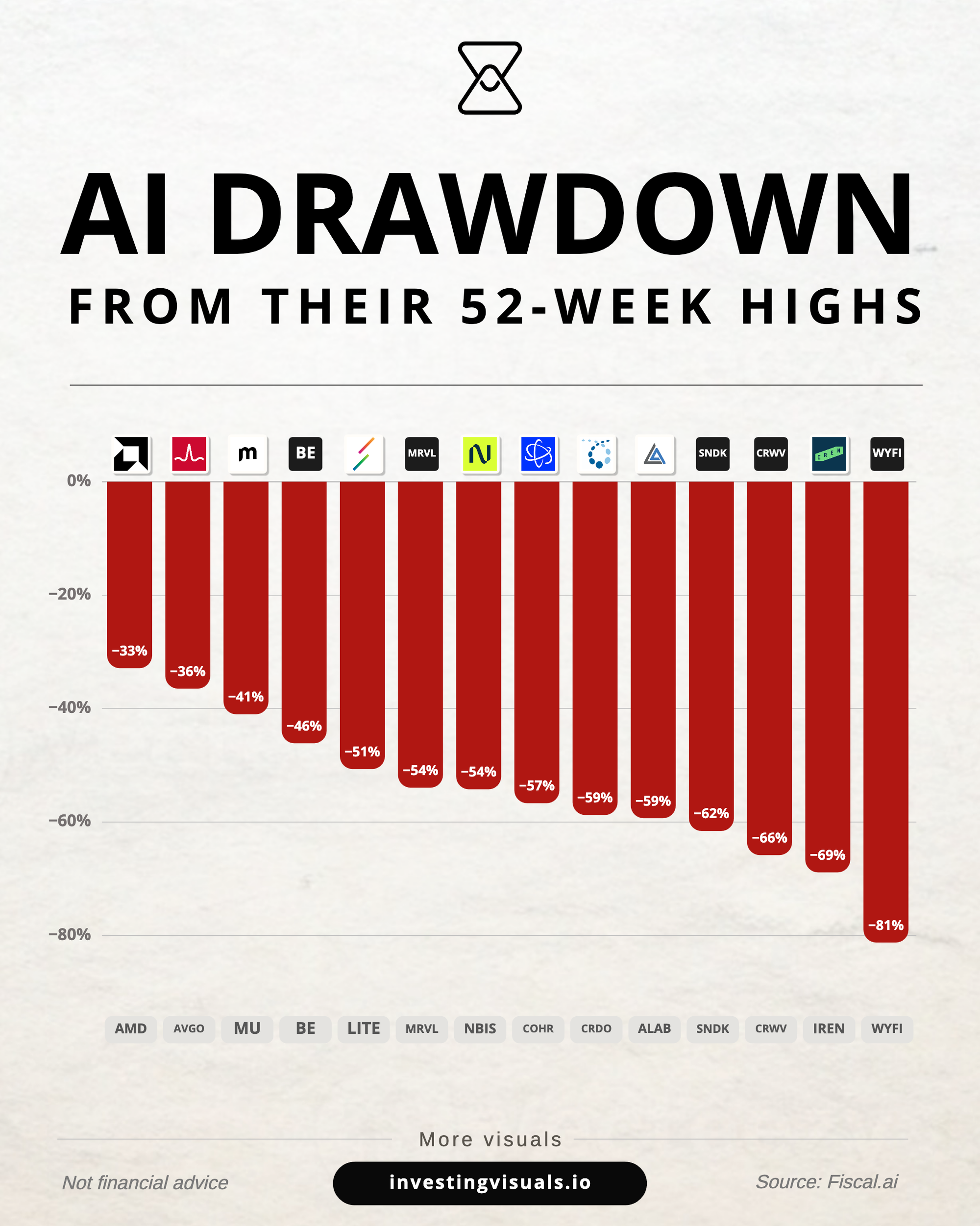
The majority of stocks are down 40-60%, with some, like SNDK, WYFI, CRWV & IREN, down >60%. It's fair to say we're in a very steep drawdown and these stocks are currently in a bear market.
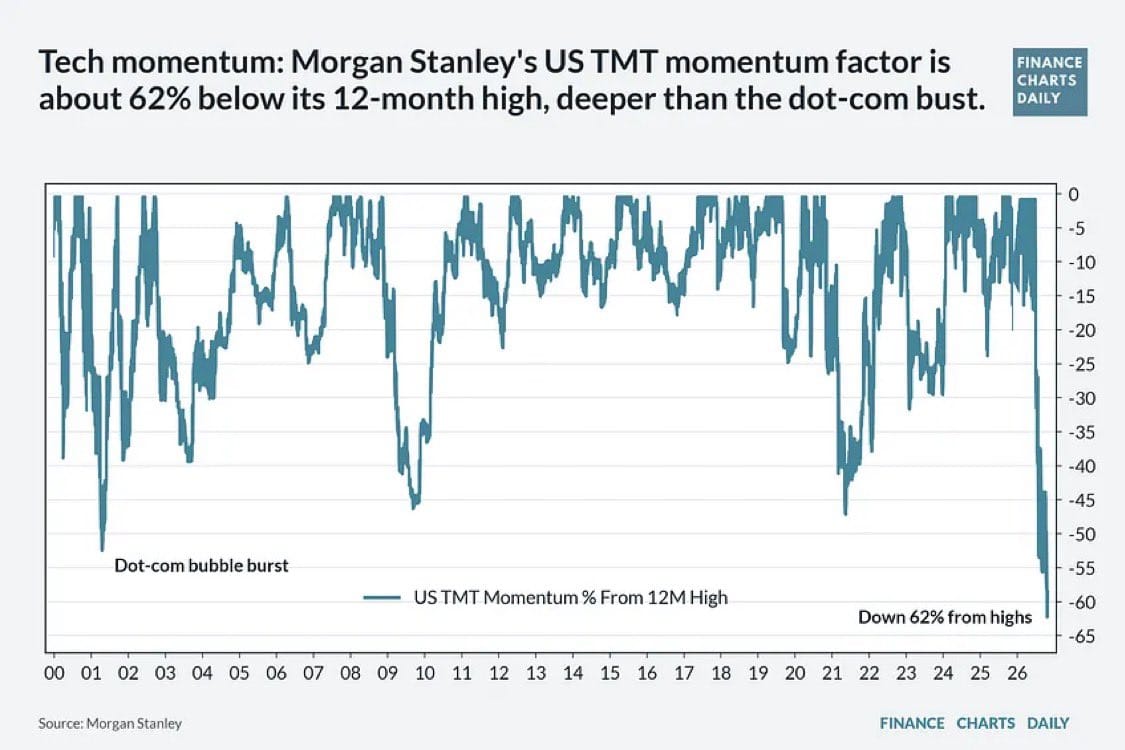
The Morgan Stanley chart below adds another perspective. Its US technology, media and telecom momentum factor is roughly 62% below its trailing high, a decline larger than that during the dot-com bust.
Just let that sink in for a bit. The dot-com bust was one of the most violent tech sell-offs in recent history and we're topping that in terms of momentum. It tells you how bad sentiment really is.
2. What is the market worried about?
2.1 The bill for the AI buildout
AI infrastructure is expensive. Chips, memory, buildings, power and networking all have to be paid for before the full revenue arrives.
That makes the cost and availability of capital part of the investment thesis. A project can have interested customers and still produce disappointing returns if financing becomes more expensive, construction overruns occur or the hardware needs replacing sooner than expected.
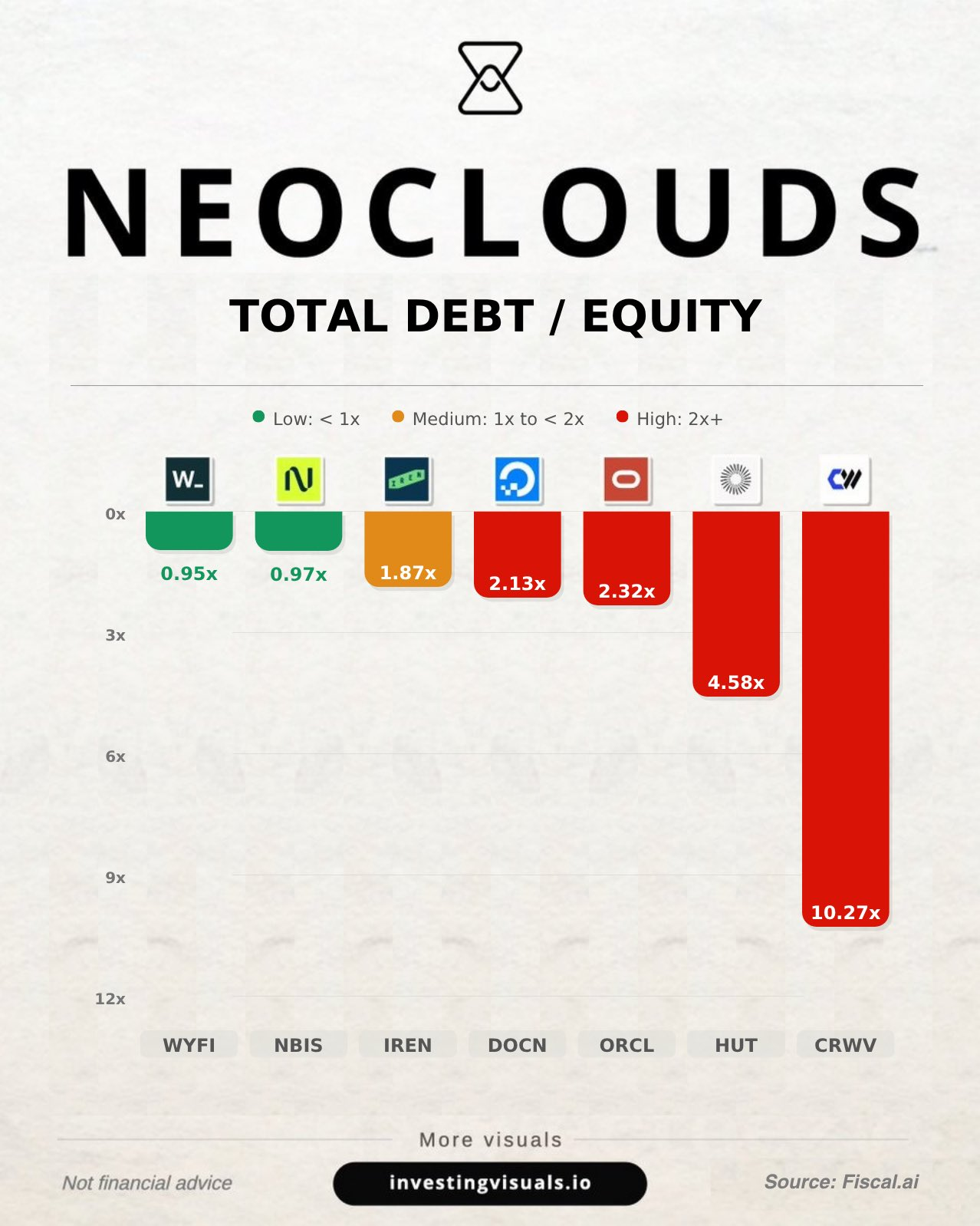
I would take the debt concern seriously. When a company overleverages (takes on too much borrowed money), things could get out of hand really quickly. The most important thing from an investing point of view is to focus on companies with healthy balance sheets.
Names I'd personally avoid are ORCL and CRWV given their enormous level of debt. Here's an overview of neoclouds (though I like to call NBIS an AI cloud) and their debt/equity ratios:
2.2 The election and the pace of the buildout
In the intro, I already touched upon the fear of an "AI ban" or a slowdown in the buildout. Interestingly, the correction was already well under way before the vote this week.
The Democrats' victory in both chambers of Congress (which was already expected) added just another layer of fear: tougher AI scrutiny and slower data center development.
In our community, I earlier shared my view that demand doesn't just evaporate because the Democrats have been elected.
An election result is not itself a canceled customer contract or a nationwide construction ban. Federal policy, state decisions, local permits and grid connections are separate things. They can impact the speed of the buildout through slower approvals for locations and investments, for example. Whether that happens, and how much it matters, still needs evidence.
But the market is front-running that and is already discounting the worst scenario: 25-45% of data centers getting delayed. I personally don't think that's a viable scenario, especially given the 'AI war' between the US and China.
If states do indeed impose a 'ban' on new data centers, hyperscalers will simply look for other sites given the opportunity they see ahead of them. But that's just my read of the current situation. It remains to be seen how things actually evolve from here.
2.3 The fear that AI spending has run ahead of its returns
This concern goes beyond politics. Investors are asking whether the customers paying for all this compute can eventually earn enough to justify it.
That is a fair question. Growing usage, growing revenue and attractive returns on invested capital are different things. If the industry builds too much, prices could weaken. If customers cannot monetize their products, their ability to keep spending could weaken too.
The capital expenditure (capex) chart below shows the scale of the ambition. It also shows why the market is nervous. On the flip side, free cash flow is expected to explode as well once peak capex is reached.
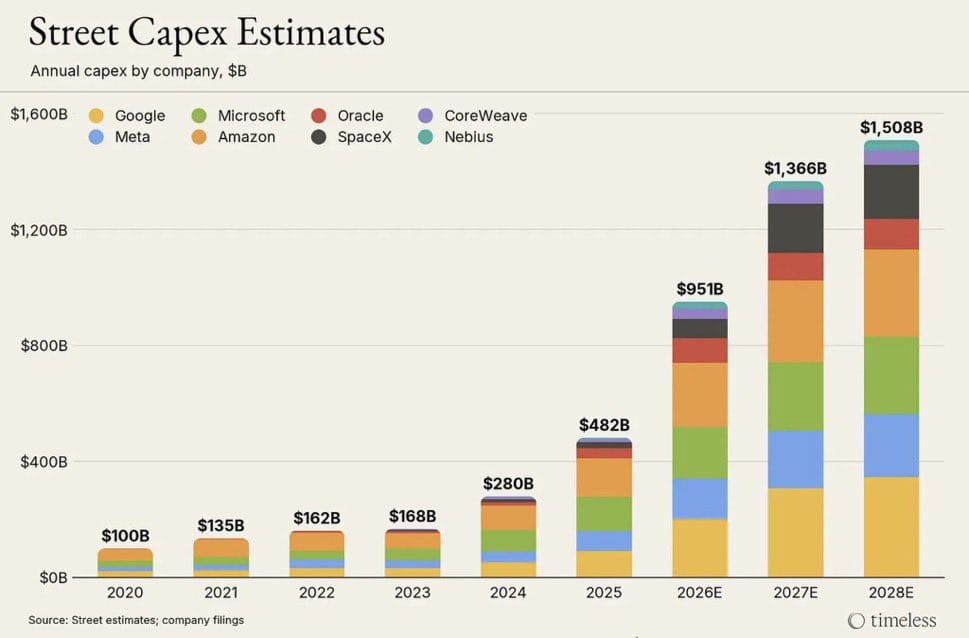
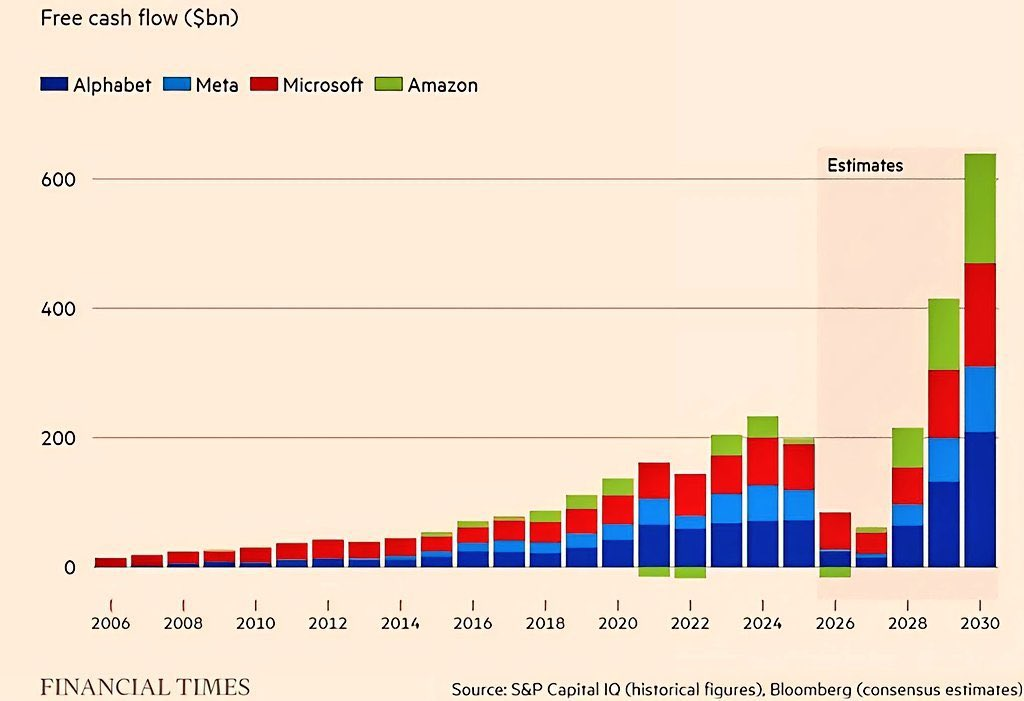
Note: The later bars are forecasts so read this as a picture of expectations.
3. What are the tech leaders saying?
Microsoft: growth despite delivery delays
Azure revenue grew 48% in Microsoft's September quarter. The company also disclosed delays in third-party capacity deliveries.
“Accelerating demand led to us adding 24 new data centers across five continents this quarter.” ~Satya Nadella, Microsoft CEO
CFO Amy Hood said customer demand continued to exceed available supply. I see that as evidence of a capacity constraint. But it's also not a guarantee that every supplier will deliver on time or earn an attractive margin.
Alphabet: bringing more capacity online
Google Cloud revenue grew 103% to $30.7B in Q3. Cloud operating income reached $11.1B. TPU system sales contributed to growth, so I would not treat the headline as a pure measure of recurring AI services. Even so, the operating progress is substantial.
“We are working hard to bring more capacity online to meet this long-term demand.” ~ Sundar Pichai, Alphabet CEO
Amazon: strong demand, heavy cash spending
AWS revenue grew 39.3% to $46.0B in Q3, with $17.8B of segment operating income.
“Overall demand for AWS capacity remains exceptionally strong.” ~ Andy Jassy, Amazon CEO
At the same time, Amazon's free cash flow over the trailing twelve months was an outflow of $42.4B, with the company pointing to higher property and equipment spending, primarily for AI.
Here, both sides of the debate have numbers to point to: the business is growing quickly but the investments are consuming a lot of cash too.
AMD and NVIDIA: the suppliers
AMD reported Q3 revenue growth of 45%. Its Data Center revenue reached about $8.5B, up 97%, while GAAP operating income rose to $2.8B.
“Demand for our Instinct and EPYC products continued to strengthen” ~ Lisa Su, AMD CEO
NVIDIA's latest reported quarter is a little older but still relevant: Data Center revenue was $89.0B, up 117%, and Jensen Huang said, “The AI infrastructure buildout is at full steam.”
4. The disconnect between fundamentals and sentiment
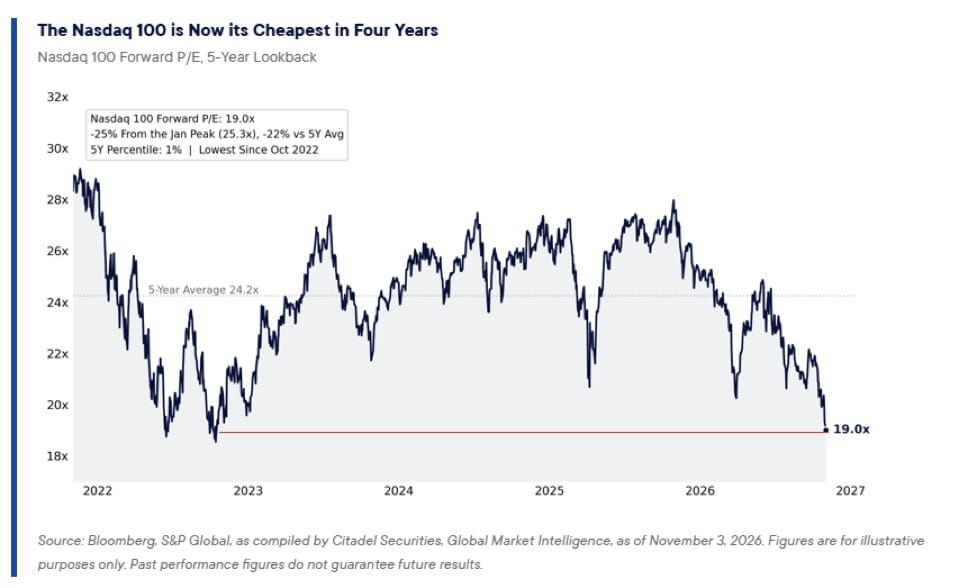
A stock can fall while its business improves. The market may be lowering the multiple it is willing to pay, questioning future margins, or deciding that previous expectations were too ambitious.
Citadel Securities' November update clearly shows that disconnect. Since June 30, its AI infrastructure group had seen forward earnings estimates rise 31%, while its forward valuation multiple contracted 36%. Note: these are analyst expectations, which can still change.
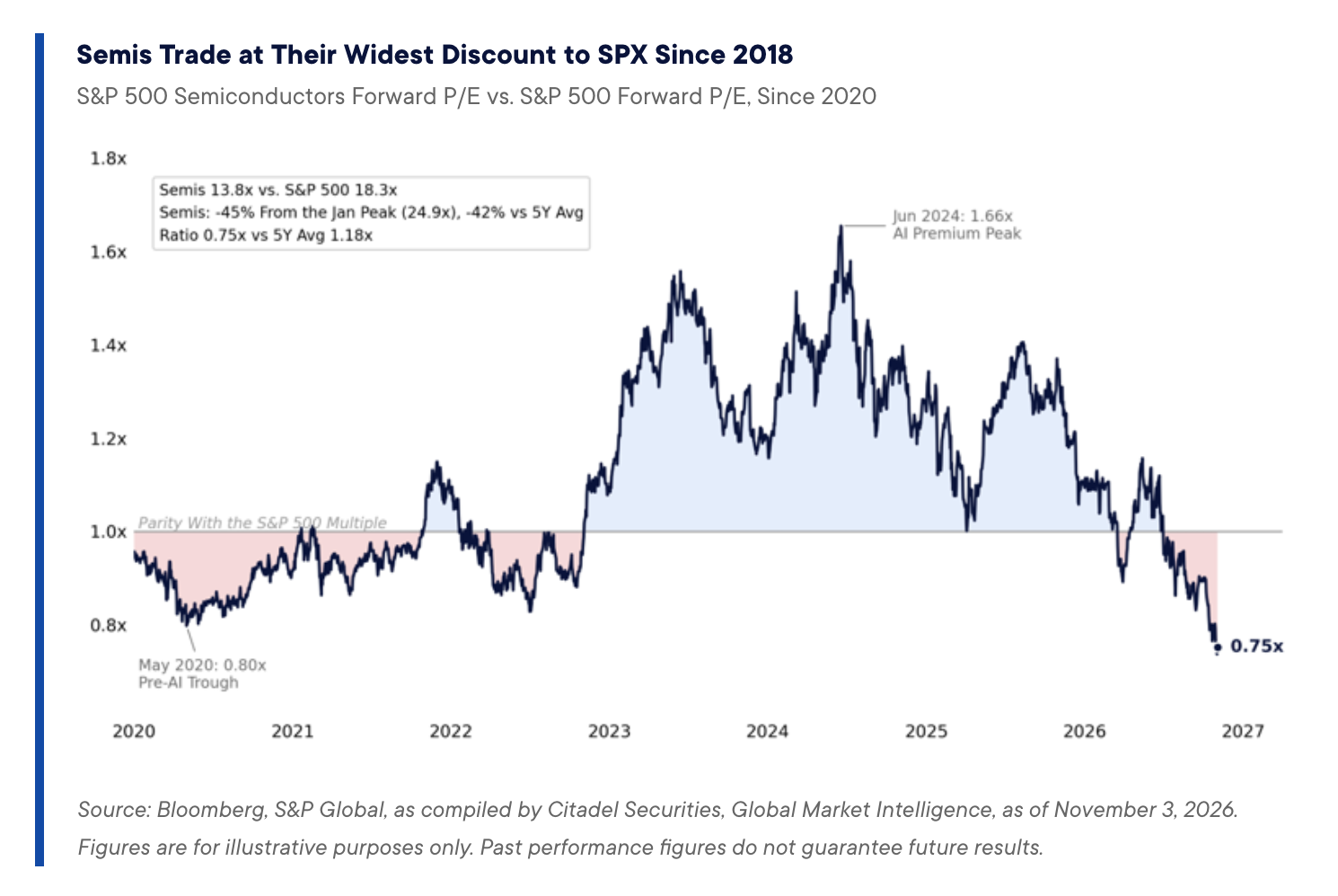
Another interesting chart: semis now trade at their widest discount to the S&P 500 since 2018. The discount is even worse than during the COVID crash back in 2020 and the bear market in 2022.
5. Delayed capacity can make available capacity more valuable
So, here's something interesting I think many are missing.
If demand remains strong while new supply arrives more slowly, existing capacity becomes scarcer. Providers with working infrastructure may have more leverage when selling uncontracted capacity or negotiating new contracts.
A slower near-term buildout could also spread investment over more years. That is a potentially longer growth runway. It is not extra demand created by the delay.
For Nebius, for example, I see the potential benefit in capacity it can actually deliver, and in sites where power, permits and financing are sufficiently advanced.
The same logic applies across the industry. Oracle, CoreWeave and the hyperscalers can benefit from available supply being scarce, while also suffering if their own deliveries slip, financing becomes harder and debt keeps piling up.
There are limits to the pricing argument, though. Capacity already committed at contracted prices cannot easily be repriced. Higher financing or power costs can absorb the benefit, and customers may improve efficiency or move workloads elsewhere.
So I would put my view this way: if demand persists, companies with funded, deliverable capacity may be better positioned under either a fast buildout or a slower one.
6. Has the AI thesis changed?
My read is that the evidence still supports strong and ongoing AI demand and a tangible return on investment. The latest results from Microsoft, Alphabet, Amazon and AMD do not look like customers collectively walking away (at all).
I am more cautious about calling all of this short-term noise, though. A more expensive funding environment can permanently change the economics for some businesses, even while the industry grows.
For me, the useful distinction is between volatility in the share price and deterioration in the conditions the business needs to succeed and in its underlying fundamentals.
I would watch:
- Whether signed contracts convert into delivered capacity, revenue and cash collections
- Whether customers cancel, reduce commitments or simply move delivery dates
- Whether utilization and realized compute pricing support the demand story
- Whether new debt, interest costs and dilution leave attractive returns for shareholders
- Whether AI usage becomes durable customer spending with sustainable economics
If those indicators weaken together, the structural case for AI deserves a harder rethink. If demand, utilization and cash conversion improve while stocks remain under pressure, the disconnect becomes even more interesting.
All in all, I am personally still very bullish on the AI buildout, but I'm also realistic. Some projects may take longer. Some companies may struggle to finance their ambitions. The winners still have to execute, and the price we pay still matters.
But as I said earlier, a delay is not a cancellation. A lower valuation is not a broken business. And the election result, by itself, does not erase the demand that is already there.
That is where my focus is: follow the demand, follow the cash and keep verifying.
7. Companies worth looking into
Here's my list of companies I believe are fundamentally very strong and are oversold right now:
- Credo (CRDO)
- Astera Labs (ALAB)
- Broadcom (AVGO)
- Bloom Energy (BE)
- SiTime (STIM)
- Nebius (NBIS)
Honorable mentions: SK Hynix, Micron, Marvell and Vertiv. Happy hunting!
Up and onward,
Jan
Written by

Subscribe to keep up to date
Subscribe to get regular updates. No spam, unsubscribe anytime.







Member discussion