

members only
WhiteFiber investment thesis
Why WYFI has moved to the top of my watchlist, how the business model works, and the key milestones that need to fall into place for the investment thesis to play out.

Introduction
WhiteFiber (WYFI) is a company that's been on my watchlist for a while, but I had never done any real research into them. Until now. In this article, I will share my investment thesis and why I think it's such an interesting company worth knowing about.
I'll cover:
- What WhiteFiber does
- How they make money
- The management team running the business
- The future potential
- If it's attractively priced
- What I'll be doing
What they do in a nutshell
Build and operate the infrastructure needed to run AI. We can break their business into three core segments:
- Rent customers a place for their high performance compute
- Rent customers computing power
- Get paid to operate equipment funded by someone else
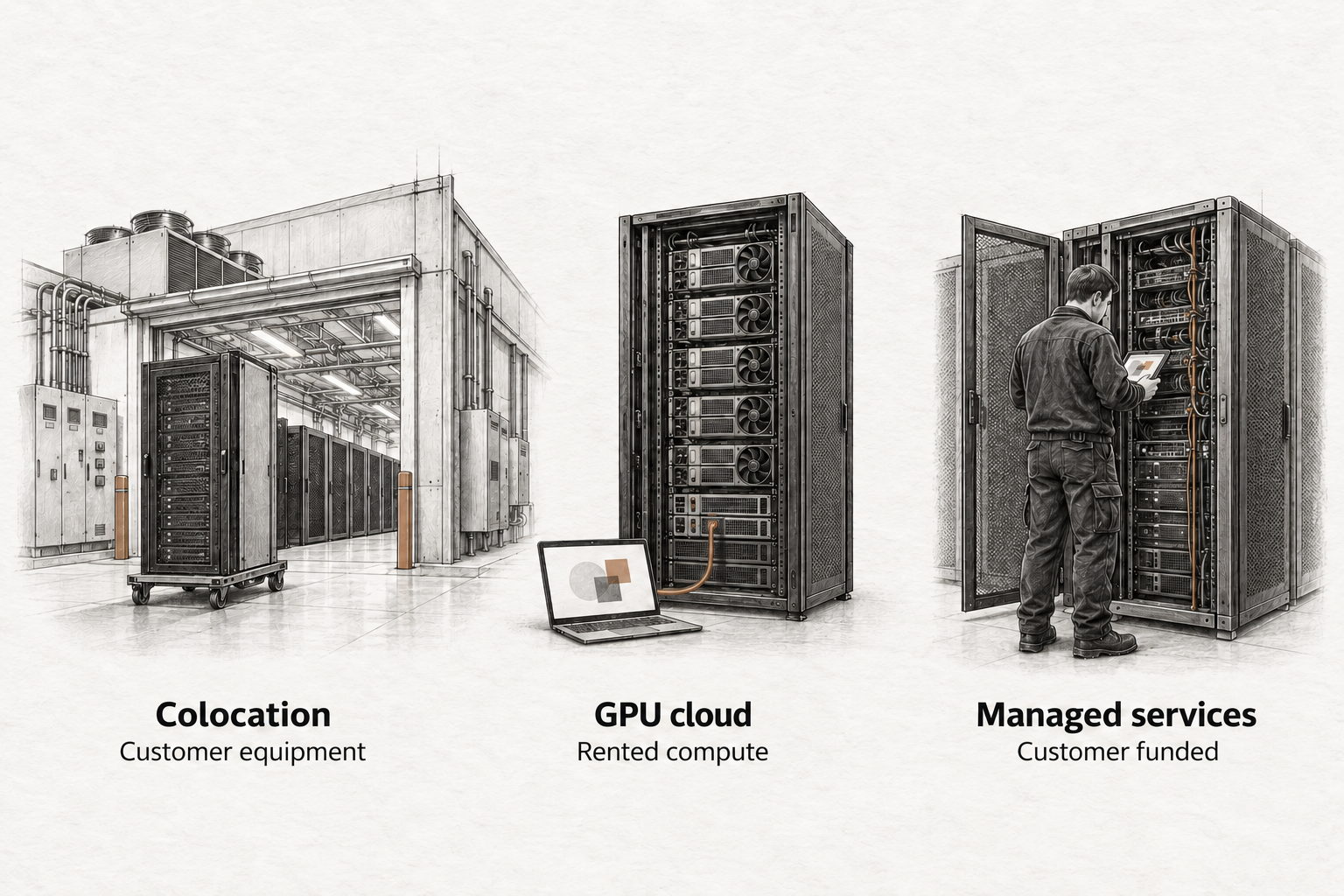
Those who invest in Nebius might wonder: "Isn't that what Nebius does as well?" True, to some extent. Here's how both companies compare:
| Question | WhiteFiber | Nebius |
|---|---|---|
| What does the customer buy? | Data center capacity, GPU computing, or infrastructure operation | AI computing capacity and the cloud platform around it |
| What role do buildings play? | A distinct business that can earn revenue from external tenants | Infrastructure supporting delivery of its AI cloud |
| What role does software play? | Helps deploy, connect, and operate infrastructure, including Continuum | A central part of the customer product, alongside hardware |
| Can it grow using other people’s assets? | Yes, through partner facilities and customer funded deployments | Yes, through infrastructure partnerships |
Nebius and WhiteFiber primarily compete (if you can even call it that because they serve different types of customers) on GPU cloud services and managed infrastructure. You can see it like this: WhiteFiber is more of a niche specialist, whereas Nebius is the large-scale generalist.
1 - How they came into existence
- 2023: WhiteFiber’s roots go back to late 2023, when Bit Digital (primarily a Bitcoin mining company) established a cloud computing business to support AI workloads. The idea: give customers access to powerful computing hardware without requiring them to build the infrastructure themselves
- 2024: Commercial cloud services started in January. The company that would become WhiteFiber was incorporated in August, initially under the name Celer. In October, Bit Digital acquired Enovum, a Canadian data center developer and operator. This brought together the two foundations of today’s business: renting computing power and providing the facilities that house it
- 2025: Bit Digital transferred its AI infrastructure business into WhiteFiber in exchange for approximately 27 million shares. WhiteFiber began trading on Nasdaq as WYFI on August 7. An important nuance: this was an IPO that sold new shares to investors, rather than a distribution of WhiteFiber shares to existing Bit Digital shareholders. Bit Digital retained majority ownership and owns 59.9% of WhiteFiber as of today.
- 2026: WhiteFiber operates through subsidiaries across cloud computing and data center services, including Enovum. Bit Digital remains its majority shareholder while pursuing its own Ethereum treasury and staking strategy. Buying WYFI therefore gives investors direct exposure to WhiteFiber’s AI infrastructure business; buying Bit Digital combines indirect WhiteFiber exposure with its cryptocurrency activities
2 - What WhiteFiber does, and why customers need them
WhiteFiber combines two businesses: data center colocation and GPU cloud services.
💡
Colocation means providing the facility where someone else’s computers operate. WhiteFiber supplies the building, electrical infrastructure, cooling, connectivity, and ongoing operations. The customer brings the computing equipment.
Colocation
When looking into them, I wondered if WhiteFiber also owns the land like IREN does. While they are increasingly moving in that direction, they currently have a hybrid model.
They own some real estate and still lease certain facilities. I personally prefer a wholly owned AI colocation stack, from land to building to power. So it's encouraging to see that WYFI is moving in that direction.
Cloud services
The other part of their business is GPU cloud services, meaning they provide access to the computing equipment itself. Customers pay WhiteFiber to deploy and operate GPU infrastructure without having to assemble every part of that operation themselves.
On the August earnings call, management described customers struggling to coordinate access to GPUs and power as separate problems. WhiteFiber’s opportunity is to make that coordination easier and deliver infrastructure ready for the customer’s workload.
WYFI is basically a one-stop shop, like a contractor you hire to oversee the construction of a house. You don't have to manage the plumber, electrician, carpenter, etc. yourself. You just let the contractor handle that.
3 - How they make money
The two businesses share an industry, but their economics differ quite materially.
In colocation, WhiteFiber commits capital to developing a facility and earns revenue through customer contracts. The flagship example is its North Carolina campus, NC1, where Nscale signed a ten-year agreement for 40 megawatts of IT capacity.
💡
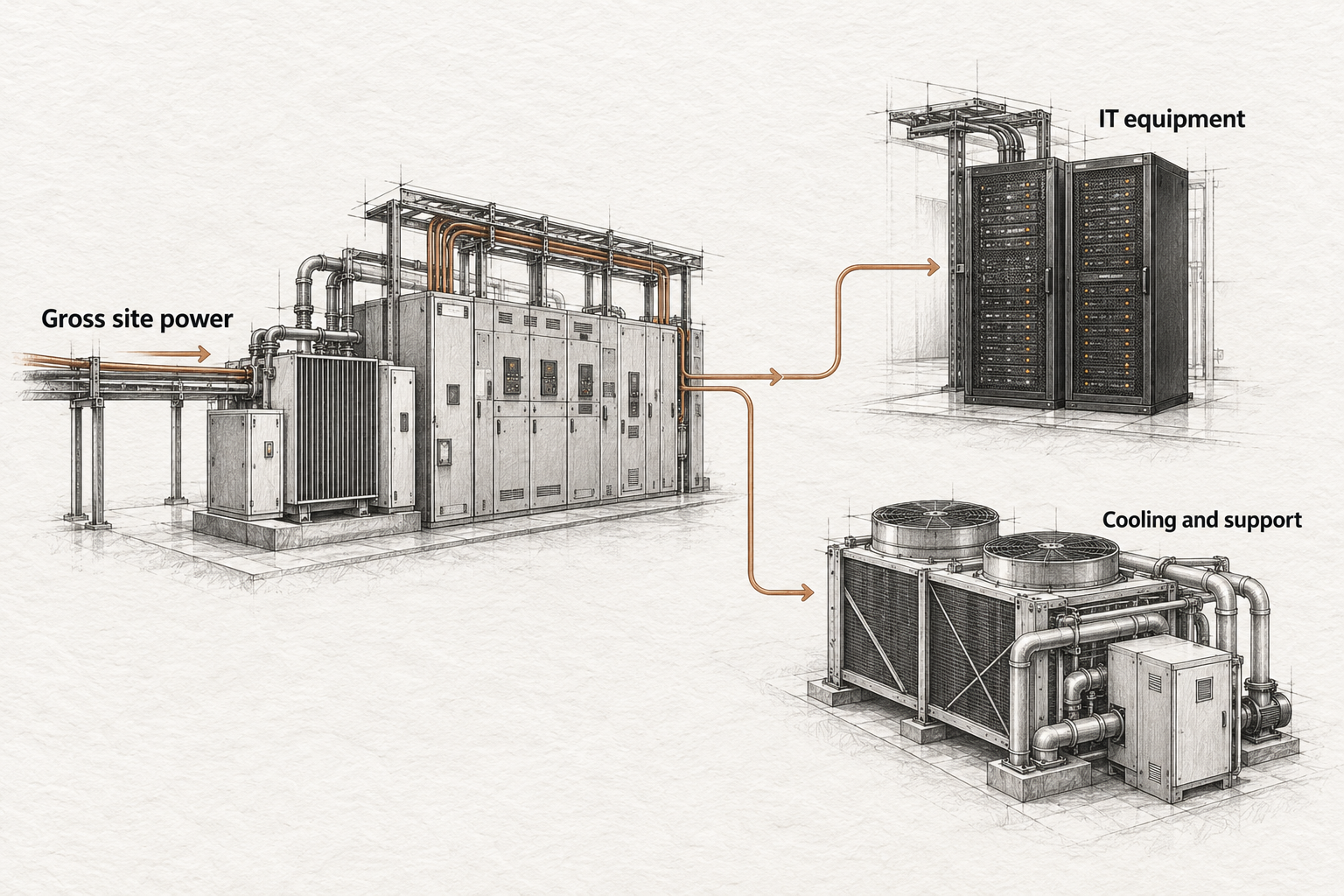
A megawatt, or MW, measures power. IT capacity is the power available to the computing equipment. Gross capacity also includes cooling and other facility needs. At NC1, the initial 40 MW of IT capacity corresponds to 54 MW of gross power.
The Nscale contract has approximately $865M of total value, including contractual price increases and certain installation and development charges. That value covers ten years. It is neither annual revenue nor cash already collected.
WhiteFiber describes the agreement as a lease with certain expenses passed through to the customer. Its eventual profitability still depends on construction costs, operating costs, and financing.
Cloud services have a different cost base. WhiteFiber must source, deploy, and operate GPUs, either from its own fleet or through financed arrangements and outside facilities. Hardware economics and the terms of each customer contract are the most important factors here.
Management is moving toward longer customer commitments, prepayments, and equipment financing to reduce the upfront capital WhiteFiber supplies. It is also pursuing managed services, where customers fund the equipment and capacity while WhiteFiber earns money deploying and operating them.
These models can overlap, but integration is selective. Management explicitly said its cloud customers will not all move into WhiteFiber facilities.
4 - The appeal of converting existing buildings
WhiteFiber’s development approach starts with existing industrial properties that can be converted into data centers.
That sounds straightforward at first glance, but it isn't in practice. The difficult part is identifying buildings with suitable infrastructure, access to power, and a realistic delivery schedule, then installing the systems an AI customer requires.
Its Montreal facility serving Cerebras provides an early example. According to their September 2026 presentation, WhiteFiber converted a former mattress factory (I kid you not) into a data center in approximately six months. The site supports 5 MW of IT capacity under a five-year customer agreement.
The cooling system brings liquid directly to the computing hardware. The facility also uses backup systems and a design that allows maintenance without shutting down the entire operation.
Retrofitting
Management estimates retrofit development costs of approximately $8M to $10M per gross MW, although costs vary by site and customer requirements. Those are facility development estimates, not the cost of buying the GPUs as well.
The larger and more important test is their NC1 facility. Initial customer deployment and billing had begun by the August earnings call. The September presentation still made the full revenue ramp conditional on deployment, commissioning, and customer acceptance.
💡
Commissioning means testing that the completed infrastructure actually works as intended. A building reaching that stage does not automatically mean every contracted megawatt is already generating full revenue.
In short
WhiteFiber’s strongest potential advantage is the ability to repeatedly turn suitable industrial sites into reliable, revenue-generating infrastructure faster than customers could obtain it elsewhere. The first successful projects support that already. Repeating it across a larger portfolio is the next test, with the main focus on their NC1 facility.
5 - Who is running it?
Before I invest in any company, I like to know who is running it. So let's go through the key figures:
- Sam Tabar leads the data center business. He has more than twenty years of industry experience, founded Netintelligent Hosting Services, and subsequently worked at eStruxture. The Enovum team supplies the development expertise behind WhiteFiber’s retrofit strategy
- Billy Krassakopoulos leads the data center business. He has more than twenty years of industry experience, founded Netintelligent Hosting Services, and subsequently worked at eStruxture. The Enovum team supplies the development expertise behind WhiteFiber’s retrofit strategy
- Justin Zhu is the CFO and began in audit at PwC, became a senior manager at EY, joined Bit Digital’s finance leadership in 2021, and later served as WhiteFiber’s chief accounting officer before becoming CFO in August 2026
- Michael Francisco leads the US cloud business. He held partnerships and growth roles at Microsoft, Amazon, GitHub, Sumo Logic, Common Room and Liquibase before joining WhiteFiber as head of marketing in February 2025 and subsequently becoming Vice President of WhiteFiber Cloud
6 - Their future ambition
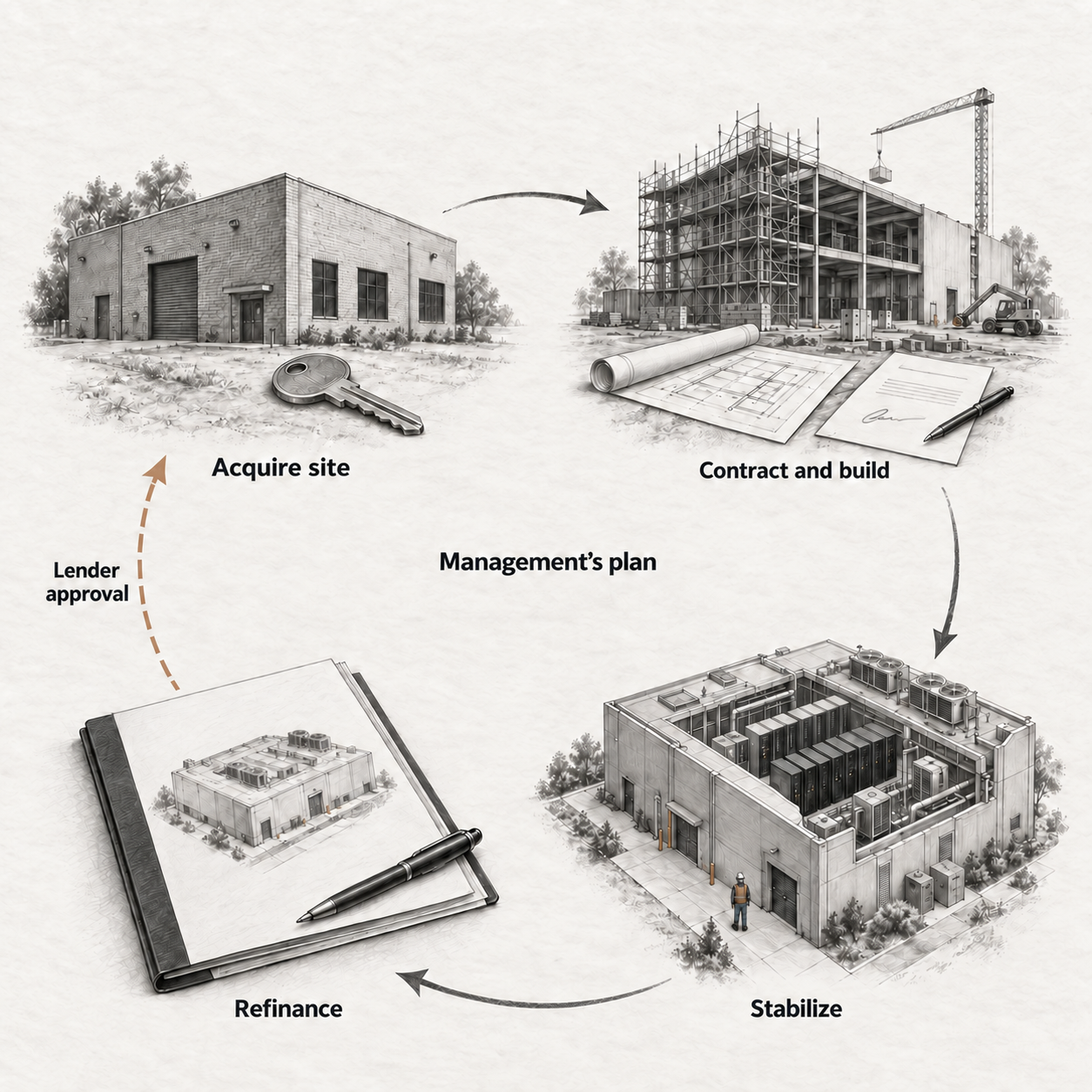
Management wants to make the development process repeatable: acquire a suitable site, secure a customer, build and stabilize the facility, then obtain financing against that operating asset. The aim is to release some of the capital invested and put it toward the next project.
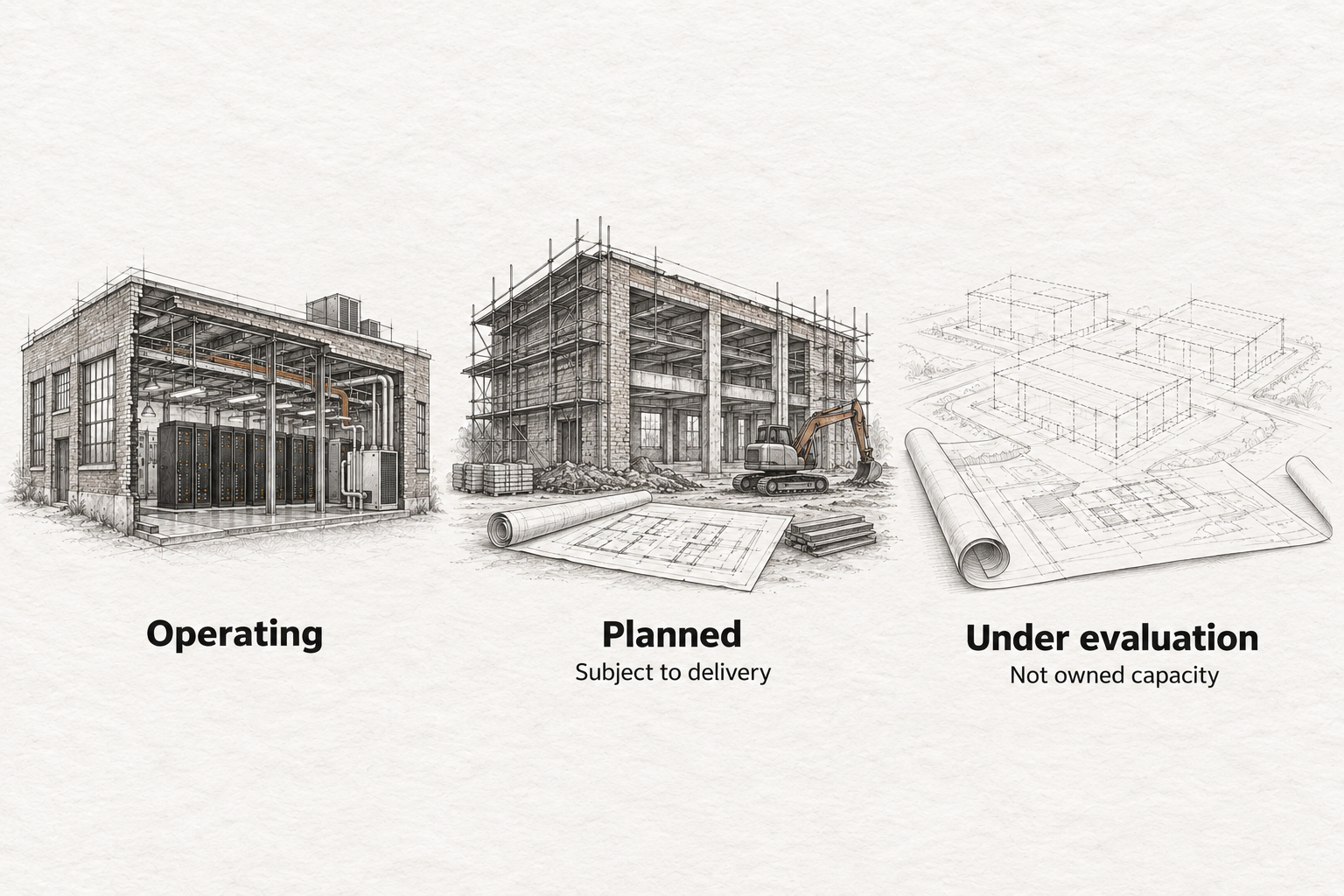
That is how management intends to fund repeated expansion. It depends on lenders being comfortable with both the completed facility and the customer contract. The three core buckets of their business right now:
- Operational sites
- Planned sites
- New sites that are under evaluation
Capacity estimates & pipeline
In their September investor presentation, they target approximately 70 MW of gross data center capacity online by the end of 2026, rising to 175 MW by the end of 2027. Note: both figures are management estimates.
Expansion includes additional capacity at NC1 and two proposed North Carolina acquisitions, NC2 and NC3. WhiteFiber signed an agreement to buy those properties for $60M, with closing expected in the fourth quarter of 2026.
Together, they are expected to offer at least 60 MW of initial gross capacity. The target for initial service is the third quarter of 2027, subject to the acquisition and development conditions.
The company also describes a roughly 1.5 GW pipeline. That is a pool of sites available for acquisition and under evaluation, not capacity WhiteFiber already owns or operates.
Doing the math
The NC1 site they signed with Nscale has a ten-year agreement for 40 megawatts of IT capacity. The total contract value is $865M, which translates to $2.16M in annual revenue per MW. If we use this number for their 175 MW target by 2027, we get $378M in annual revenue.
For context, WYFI's last-twelve-month revenue is $95M, meaning they could 4x revenue if they deliver on their 2027 colocation target.
Cloud expansion
On top of its colocation business, WhiteFiber is expanding its cloud operations, which can also be deployed in other operators’ facilities. Its KRAMBU partnership is intended to provide capacity beginning in 2027, supporting growth beyond WhiteFiber’s own buildings.
AAIG’s article offers a very useful interpretation: owned data centers form the financial foundation, while partnerships, customer-funded hardware, and managed services allow the cloud business to expand.
💡
I highly recommend giving AAIG's article a read if you want to go deeper into the business and particularly the direction management is aiming for.
On September 23, WhiteFiber announced commercial availability of Continuum, connecting two facilities 83 kilometres apart with technology from partners including DriveNets and WEKA.
If this works commercially, smaller sites with available power could become more useful when connected together. That would fit WhiteFiber’s development approach.
7 - The numbers show a business in transition
WhiteFiber reported $79.2M of revenue in 2025 and $94.5M over the twelve months through June 2026. Cloud services generated most of that revenue.
- Revenue was $28.8M, up 54.5% from a year earlier
- Adjusted EBITDA was $5.5M
- The net loss was $15M
- Cash and cash equivalents were $56.1M at June 30
An important nuance is that revenue included approximately $12.3M associated with a customer termination. Removing that amount leaves approximately $16.5M. This means revenue would have been down 31% this quarter without the termination fee.
The termination also generated approximately $4M of related lease expense and $2.2M of bad debt expense. The fee was increased to $15.7M after the quarter and remained outstanding when the quarterly filing was published.
Termination details
WhiteFiber calls it its “Initial Customer”, a GPU cloud customer signed in late 2023. The initial agreement covered 2,048 GPUs and was expected to generate more than $50M annually.
On the March 2026 earnings call, Sam Tabar said the customer had elected to exit its H100 agreement, with service ending that month. Its B200 agreement had already ended during the first quarter.
Management described the transition but didn’t explain the customer’s underlying commercial reason.
WhiteFiber redeployed the equipment. Management described an approximately $50M replacement H100 contract over two years, plus two replacement B200 arrangements.
Forward contract base
The forward contract base is considerably larger. In their Q2 earnings presentation, they highlighted a total cloud contract value of $550M, including deployments for Prime Intellect and a major inference platform. On the August call, management expected signed cloud contracts to generate more than $200M of annualized revenue once fully deployed.
💡
Total contract value (TCV) is the total revenue a contract is expected to generate over its full agreed duration. So if a customer agrees to an annual contract of $50M for four years, the total TCV is $200M.
Note: this is future revenue rate, not guidance for revenue to be recognized during 2026. Deployment dates extend into 2027, and total contract value covers services delivered over several years.
8 - Their financial position
WhiteFiber ended June with $56M cash and a Q2 net loss of $15M. First half infrastructure purchases and deposits reached $345M, versus $89M operating cash flow.
August’s refinancing provided approximately $180M of additional cash after fees and the exchange of existing debt. It involved $310M of new convertible debt at 5%, which has to be repaid in 2032, while the company also issued approximately 6.3M shares to existing noteholders.
In short: Liquidity improved, but expansion still depends on external financing. Higher debt and shareholder dilution make converting contracted demand into profitable cash flow essential.
9 - Valuation
If we look at the revenue estimates for WhiteFiber:
- $138M in 2026
- $304M in 2027
- $555M in 2028
Note that these are analyst forecasts, not company guidance, with only one analyst covering 2028. But if we look at their current partnerships and disclosed agreements, I think the $555M target is fair while I've used in my bear, base and
WhiteFiber currently trades at an enterprise value of $1B, which implies forward EV/Sales multiples of 7.4x, 3.3x and 1.8x, respectively. These figures adjust June balances for August’s refinancing, excluding subsequent spending.
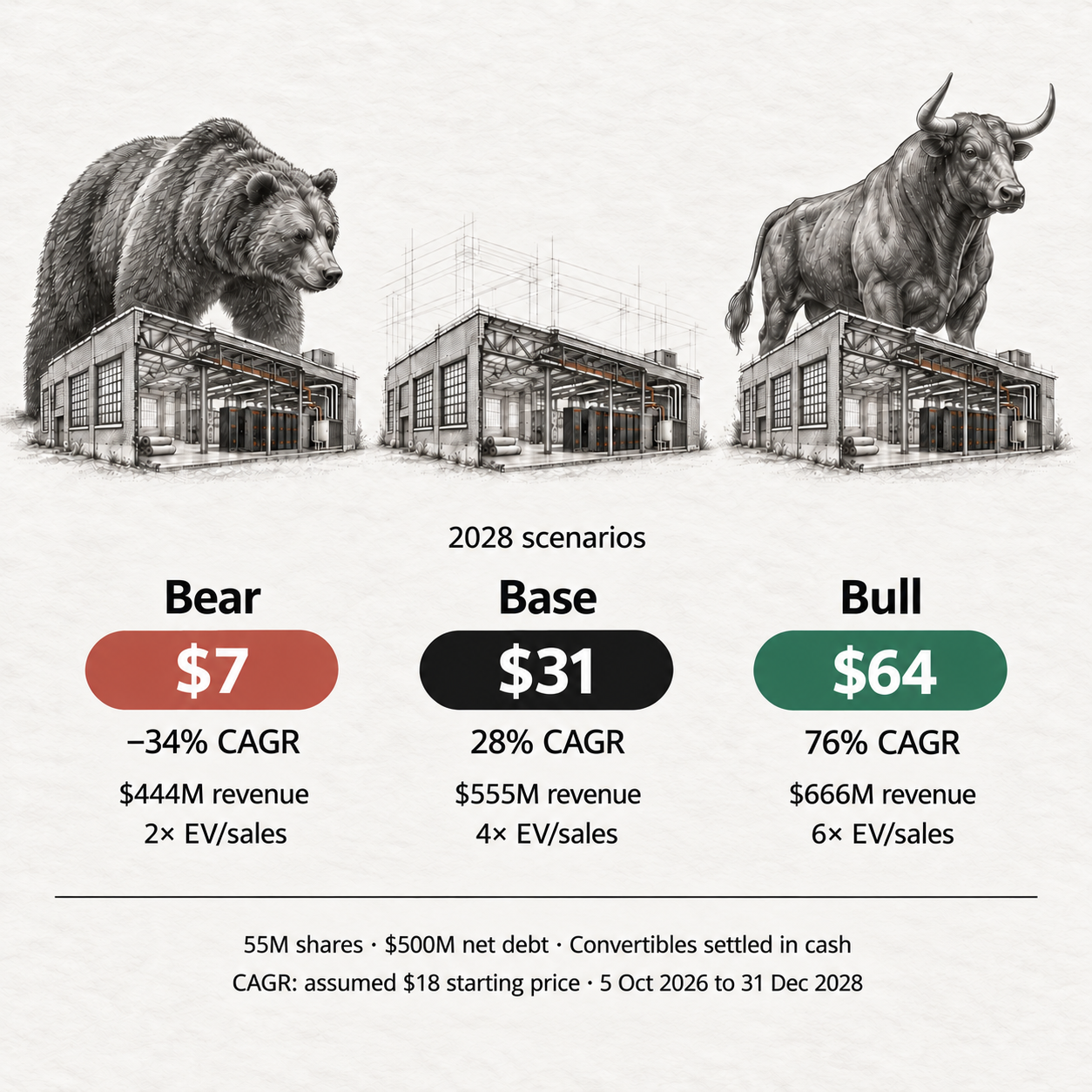
If 2028 revenue reaches $555M, and we assume 55M shares and $500M in net debt, with convertible obligations settled in cash:
| Scenario | 2028 revenue | EV/2028 sales | 2028 target | Stock CAGR |
|---|---|---|---|---|
| Bear | $444M | 2x | $7.05 | Down 34% |
| Base | $555M | 4x | $31.27 | 28% |
| Bull | $666M | 6x | $63.56 | 76% |
10 - Investment thesis
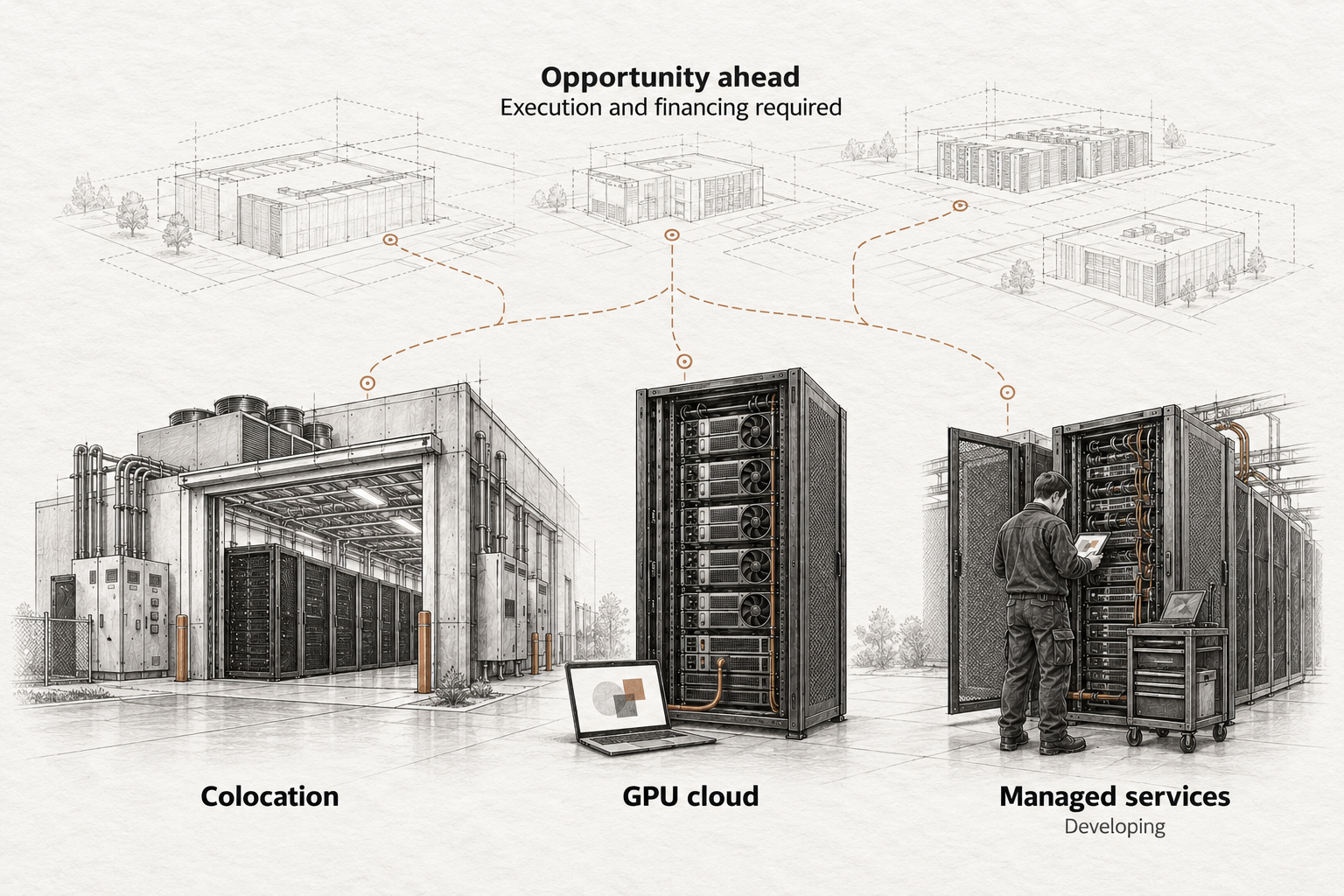
WhiteFiber addresses an important bottleneck in AI: turning available power and buildings into infrastructure customers can use. Its approach of converting existing industrial sites aims to deliver capacity faster and at lower cost, while long customer contracts provide revenue visibility.
The opportunity combines expanding colocation capacity with GPU cloud services. Customer-funded deployments could also allow WhiteFiber to grow without financing every piece of equipment itself.
If management can repeatedly deliver facilities, secure financing and convert contracted demand into cash flow, WhiteFiber could build a substantially larger business from today’s small base. They have already laid the foundation, and their execution moving forward will determine the business trajectory from here.
The test is whether the current foundation eventually translates into durable growth and long-term value per share. Delays, customer losses, rising debt and dilution can undermine the outcome.
Closing remarks
Now that I - and hopefully you as well - have a better understanding of what WhiteFiber does exactly, what they've built so far, and what their future could look like, it has moved to the top of my watchlist.
I haven't initiated a position yet, but I think there's quite a lot of potential here looking ahead to 2027 and 2028 that I believe isn't priced in yet. It all comes down to execution though.
WhiteFiber already has a track record of successful colocation sites that it can build upon, along with a promising pipeline of deals. Important milestones to follow from here are progress on the NC1 site and its revenue ramp, the delivery of new cloud contracts, the financing terms, and the cash those projects ultimately produce.
I hope this write-up gave you a better idea of what this interesting business does and helps you decide whether it's worth your money or not.
~ Jan
Disclosure: As always, none of this is financial advice. Do your own due diligence and make sure it fits your risk tolerance and time horizon.
Written by

Subscribe to keep up to date
Subscribe to get regular updates. No spam, unsubscribe anytime.







Member discussion