

members only
SiTime Q3 2026 recap: AI growth & acquisition tuck-in
Core revenue grew 154% as TPD expanded SiTime's timing portfolio. My take on AI demand, the Q4 outlook and more
SiTime's revenue grew 257% in Q3. An acquisition explains part of that, but there's plenty of growth in the business it already owned: 154% year over year.
The first full quarter with Renesas' Timing Product Division, or TPD, gives us a better look at what the combined company can become. Revenue reached $298.7M, adjusted gross margin passed 70%, and the Q4 outlook points to another strong quarter.
1. What SiTime does
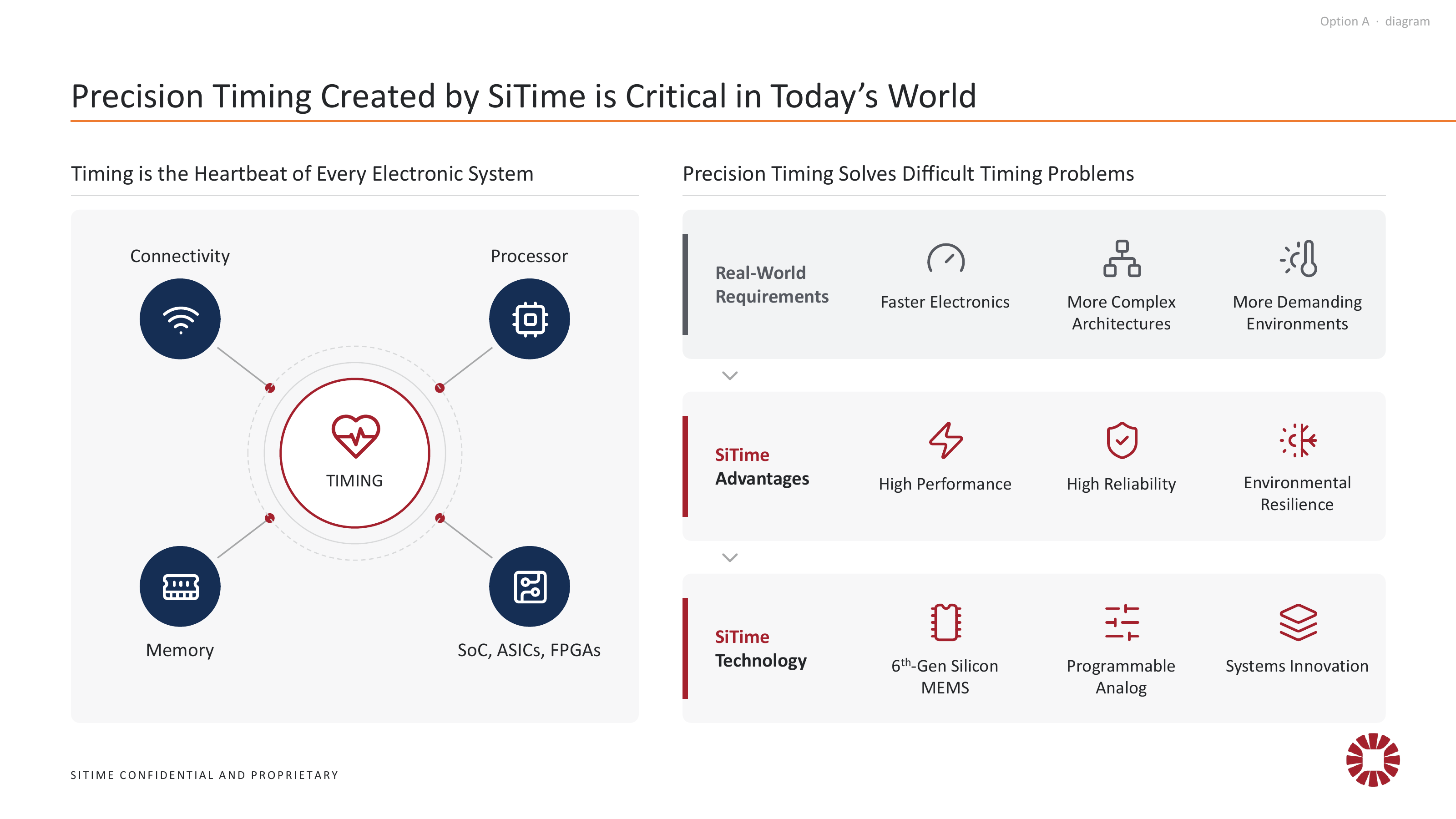
SiTime makes the timing components that keep electronic systems working together. An oscillator creates a steady electrical rhythm. Clock chips generate and distribute the signals that processors, memory and networking components follow.
Think of data moving through an AI server and out across an optical network. The components need to agree on when to send, receive and process it. As speeds rise, small variations in that rhythm, called jitter, become harder to tolerate.
SiTime combines tiny silicon mechanical structures, known as MEMS, with analog circuitry and software to keep that timing stable under demanding conditions. Customers pay for precision, resilience and the engineering work needed to make the whole system function reliably. The TPD acquisition expands the clocking side, giving SiTime more of that system to sell.
If you like to go into more detail, you can read my SiTime deep dive here:
SiTime: A hidden gem in the AI scaleout
A company crucial for modern tech to work, holds a near monopoly in their respective market, yet is barely covered.
 Jan (Investing Visuals)

2. Key numbers
- Revenue: $298.7M, up 257% year over year and 90% sequentially
- Core SiTime revenue, excluding TPD: $212.4M, up 154% year over year
- TPD revenue: $86.3M, up 67% versus the business under Renesas a year ago
- Non-GAAP gross margin: 70.7%, versus 58.8% a year ago and 67.1% in Q2
- Non-GAAP operating income: $129.5M, a 43.4% margin, versus 18.5% a year ago
- Non-GAAP diluted EPS: $4.01, versus $0.87 a year ago
- GAAP results: 51.6% gross margin, $8.3M operating income and $0.14 diluted EPS
- Operating cash flow: negative $6.6M
- Cash and short-term investments: $324.4M at quarter end, alongside $1.35B of convertible debt principal
Revenue beat the top of management's previous $285M to $295M range.
The acquisition makes the headline growth rate a little hard to compare, but the core business is doing really well. Its communications, enterprise and data center revenue grew 202% to $127.3M. Those figures exclude TPD. The acquired business brings additional exposure to those markets.
Adjusted margins improved because SiTime sold a richer mix of higher-value products, added TPD and spread manufacturing costs over more revenue. The CFO specifically noted the improvement came from the products being sold rather than price increases.
3. Outlook
- Q4 revenue: $331M to $341M, with both core SiTime and TPD expected to grow sequentially
- Midpoint: $336M, up approximately 12.5% from Q3
- Non-GAAP gross margin: approximately 70%, plus or minus 1 percentage point
- Non-GAAP operating expenses: roughly flat with Q3
- Non-GAAP EPS: approximately $4.76 at the revenue midpoint, using around 32.8M diluted shares
SiTime also announced a three-for-one stock split, with split-adjusted trading expected to begin December 7. All EPS, share counts and prices in this recap are on the current, pre-split basis. The split itself doesn't change the value of the business.
4. Business highlights
More "timing content" as optics moves closer to compute
SiTime can benefit when customers build more AI infrastructure, but also when each system needs more timing components or a higher-performance version.
Management gave a concrete example: a gigahertz oscillator might sell for $6 to $8, compared with roughly $1 to $2 for a megahertz product. Faster optical links need lower jitter, which creates demand for those more valuable components. Making SiTime very well positioned for the shift into photonics in 2027 and beyond.
Moving optics closer to processors creates additional opportunities. Management described up to twice the oscillator content in near-package optics and up to three times the timing content in co-packaged optics. SiTime has design wins in both, although a design win still needs to become a shipping customer product before it generates revenue.
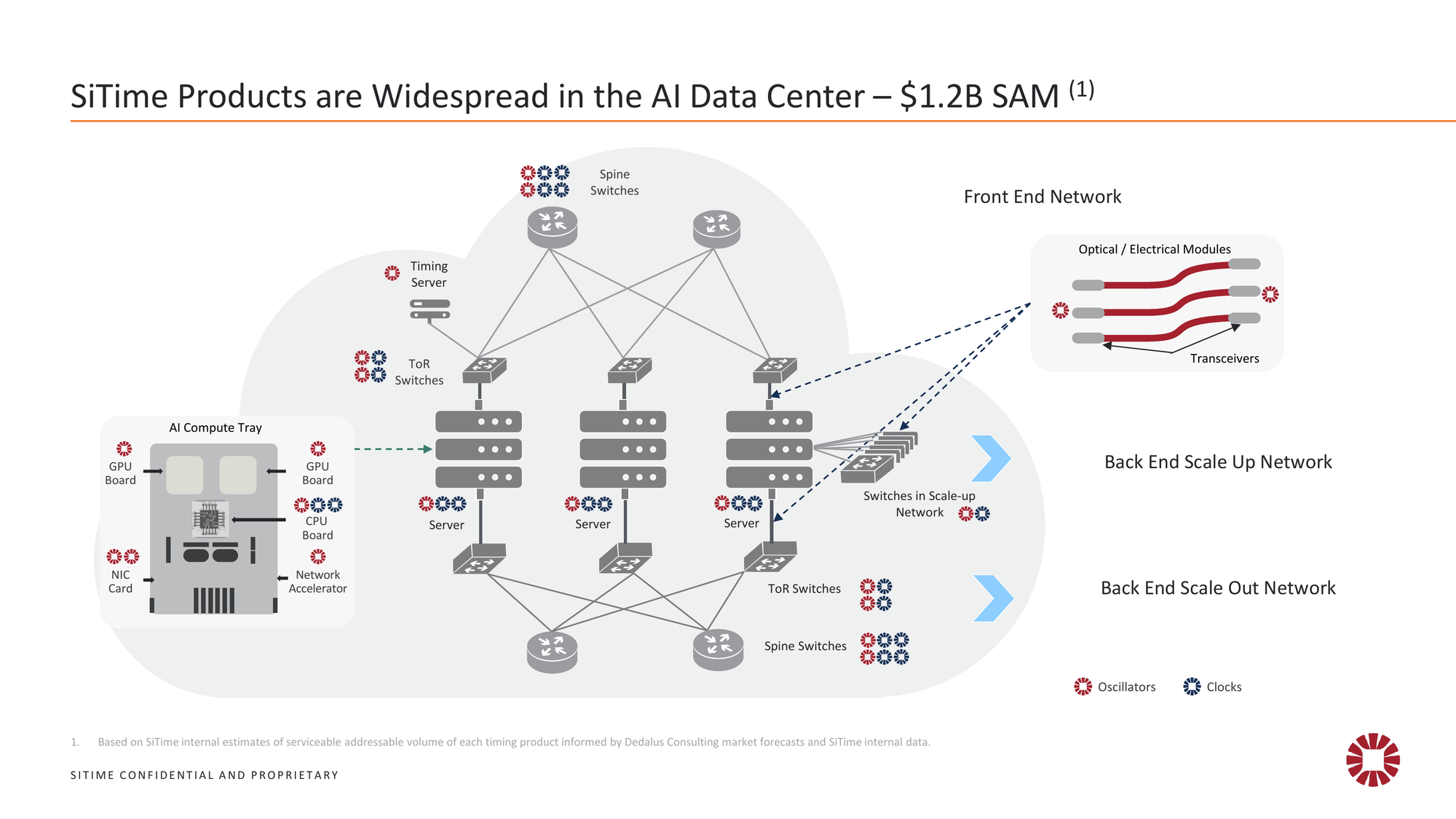
The diagram below shows why SiTime has several places to participate: compute trays, switches, network cards and optical modules all need timing. It doesn't depend on winning only the chip at the center of the rack.
TPD adds more than revenue
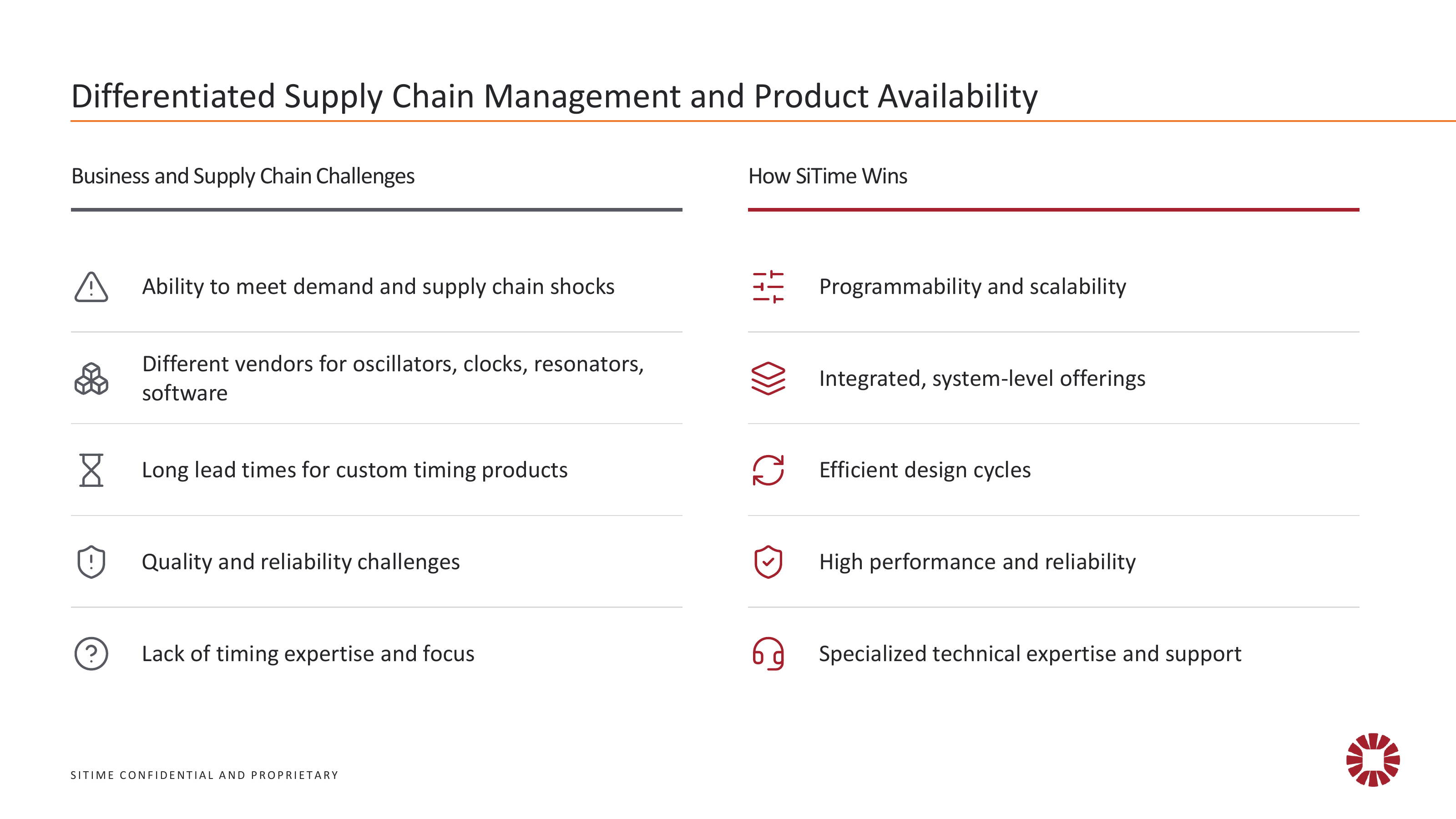
The strategic benefit is fairly straightforward: A customer buying an oscillator also needs clocking products. Bringing those products together gives SiTime cross-selling opportunities withing their customer ecosystem.
Management said cross-selling is already happening in both directions. TPD brings customer relationships where SiTime previously had less exposure, while the original SiTime business can introduce TPD's clocks into its own accounts. Really encouraging to hear!
Growth beyond data centers
Core automotive, industrial and aerospace-defense revenue grew 76% to $35.5M. Mobile, IoT and consumer revenue rose 133% to $49.5M, including $42.7M from the largest consumer customer.
5. Management commentary
CEO Rajesh Vashist : “more bandwidth requires more precision timing.”
He also described a $10B opportunity funnel, including more than $4B tied to semiconductor companies. Management clarified that much of the semiconductor opportunity starts ramping in 2028 and 2029. Signaling a long runway of growth.
6. My take
This was a very strong quarter on the product and demand side. Core growth of 154% is impressive on its own, and TPD adds another layer on top of that already strong growth. The combination looks increasingly valuable as optics moves deeper into AI systems.
The part that needs to improve is cash conversion. Operating activities used $6.6M, and capital spending, including purchased intangibles, was approximately $11.2M. Together that is roughly $17M of cash use, by my calculation, before acquisition spending.
There is also a more leveraged balance sheet now: $324M in cash against $1.35B of convertible principal. The notes have a 0% cash coupon and mature in 2031, which helps near-term financing costs. It is still something to be aware off and closely monitor.
For me, the quarter strengthens my belief in the business. More timing content per system, a broader portfolio and strong core growth are all moving in the right direction.
What I'm watching
- Q4 collections translating adjusted earnings into free cash flow
- Core growth and TPD cross-selling as the company moves to combined reporting
- Wafer availability and customer deliveries through the TPD transition
- Margins holding around the guided level as support costs and the share count grow
Final verdict: excellent growth and a great strategic fit with the acquisition.
Written by

Subscribe to keep up to date
Subscribe to get regular updates. No spam, unsubscribe anytime.

Member discussion