

members only
Palantir Q3 earnings recap: commercial takes the lead
Palantir grew revenue 96% and earned more than $1B from operations. A closer look at customer expansion, sovereign AI, contract growth and the price investors are paying.
Introduction
Palantir grew revenue 96%, its U.S. commercial business grew 148%, and GAAP operating income crossed $1B. Those are exceptional numbers for a software business already generating more than $2B in quarterly revenue.
What I find particularly interesting is how much of that growth is coming from customers doing more with the platform. U.S. commercial revenue has now overtaken U.S. government revenue for the first time. There’s a lot to like here, although the contract numbers and valuation deserve a closer look. Let’s walk through the quarter.
1. What Palantir does
Palantir builds software that helps organizations use their own data to make decisions and get work done. Foundry is its commercial platform, Gotham supports government work, and AIP lets customers bring AI into those operations.
Think about a manufacturer dealing with a supplier delay. Knowing that a shipment is late is only the start. The company needs to work out which orders are affected, what can be produced instead, who can approve a change, and then actually make it. Palantir’s Ontology connects the data, business rules and available actions so that people and AI can work through that process together.
Their sovereignty pitch is about keeping control of what makes your business valuable. Customers can train and improve models using their own operational data, keep control of those models, and put them to work inside the business. The more the system is used, the more data it has to improve the next decision. That’s the loop Palantir wants to build.
2. Key numbers
- Revenue: $2.313B, up 96% year over year and 20% sequentially, versus $2.171B expected
- Adjusted diluted EPS: $0.44 versus approximately $0.41 expected. GAAP diluted EPS was also $0.44
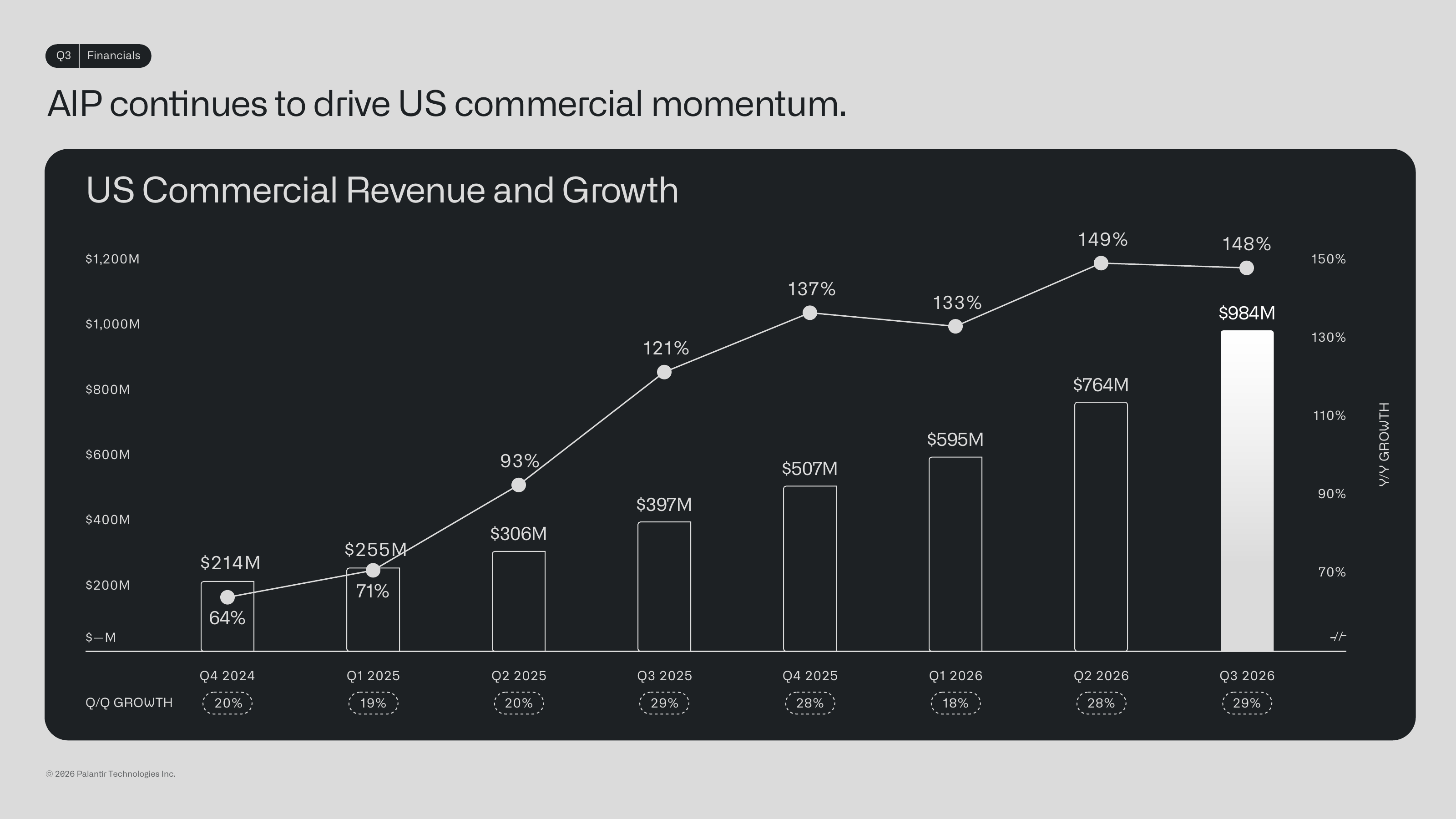
- U.S. commercial revenue: $984M, up 148% year over year and 29% sequentially
- U.S. government revenue: $953M, up 96% year over year and 18% sequentially
- International commercial revenue: $184M, up 21%. International government revenue: $192M, up 31%
- GAAP operating income: $1.085B, a 47% margin, versus 33% a year ago
- Adjusted operating income: $1.427B, a 62% margin, versus 51% a year ago
- Operating cash flow: $1.205B. Adjusted free cash flow: $1.216B, a 53% margin
- Net dollar retention: 165%, up from 157% last quarter
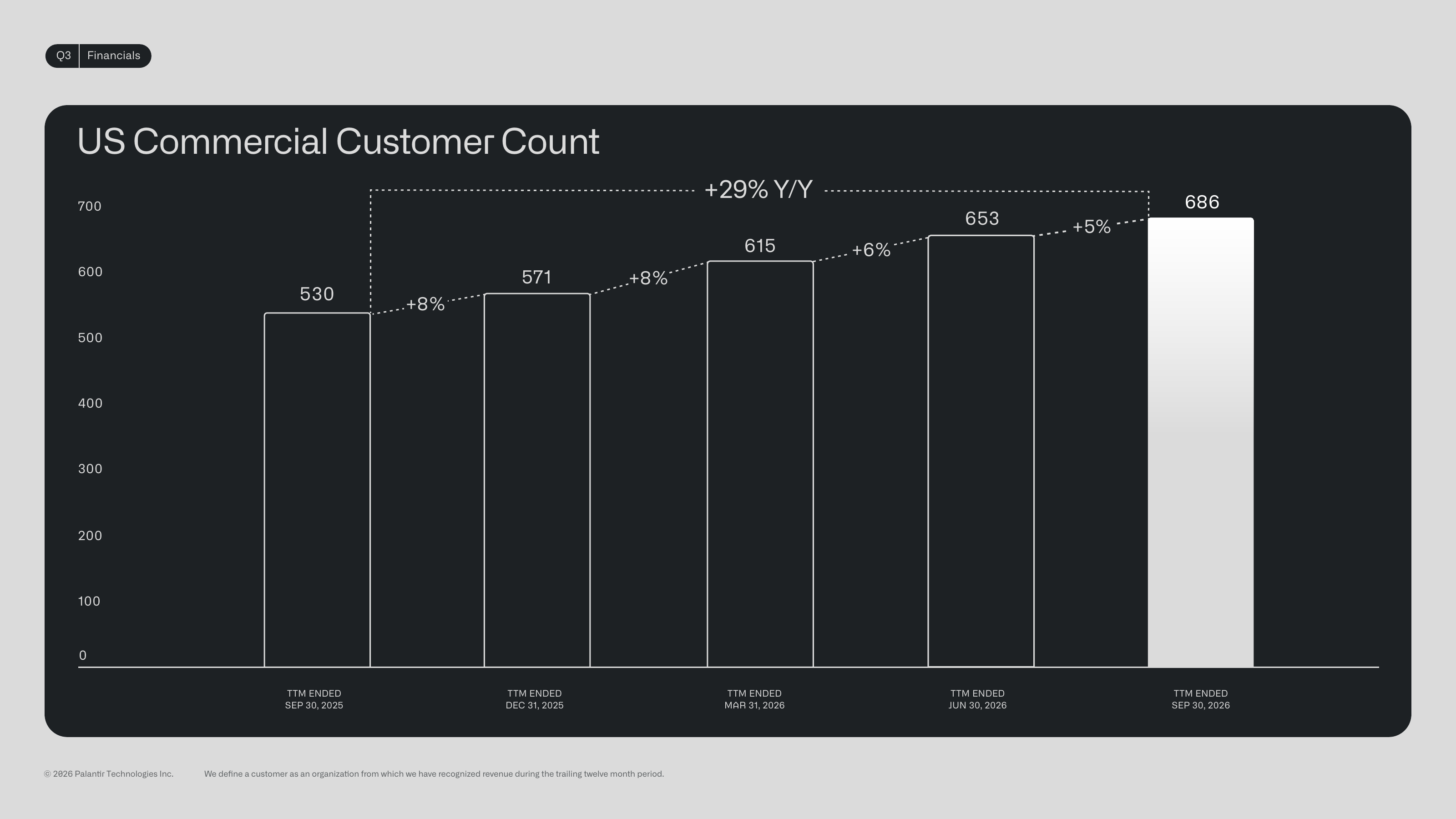
- U.S. commercial customers: 686, up 29% year over year and 5% sequentially
- Total contract value: $2.918B, up 6%. U.S. commercial TCV: $1.463B, up 11%
- Cash, cash equivalents and U.S. Treasury securities: $10.4B, with no debt
The combination of growth and profitability is remarkable and top tier. Revenue is nearly doubling, while almost half of it becomes GAAP operating income. And this is happening with U.S. government revenue nearly doubling as well. The commercial business has become the larger of the two without needing the government business to slow down.
3. Outlook
- Q4 revenue guidance: $2.649B to $2.653B, versus approximately $2.446B expected
- Q4 adjusted operating income: $1.640B to $1.644B
- Full year revenue guidance: $8.530B to $8.534B, up from $8.150B to $8.158B
- Full year U.S. commercial revenue: above $3.559B, representing at least 143% growth
- Full year adjusted operating income: $5.245B to $5.249B
- Full year adjusted free cash flow: $4.8B to $5.0B, up from $4.5B to $4.7B
Management raised the full year revenue midpoint by another $378M, taking expected growth from 82% to 91%. Q4 guidance is about 8.4% above the pre-release consensus and implies roughly 15% growth from Q3.
So even after a quarter with 96% revenue growth, management is guiding to another substantial increase in sales. Keeping that pace gets harder as the revenue base grows. So far, Palantir keeps finding more room to expand.
4. Business highlights
Customers keep expanding
Net dollar retention sits at a staggering 165%. It means the existing customer cohort generated 65% more revenue over the trailing comparison period. For comparison, a 125% retention is already considered very strong.
Within U.S. commercial, customer count grew 29%, while average trailing revenue per customer grew 88%. Customers are clearly spending more as they use more of the platform.
AI nuggets: improving the model with your own business
The examples management shared help explain what customers are actually paying for. At Tampa General, management said model performance improved 7% and latency improved by a factor of 22, while sensitive processing stayed local.
What I find interesting is where Palantir sits in this process. It helps connect the workflow, collect the data from using it, improve the model and put it back to work. Better and cheaper models can make more of those jobs worth doing. Palantir benefits if customers keep using its platform to manage them.
The contract numbers are softer
Now for the part that needs a bit more attention. U.S. commercial revenue grew 148%, but its total contract value grew only 11%. Overall TCV grew 6%, and remaining performance obligations, a narrower measure of noncancelable contracted sales that excludes short contracts, were roughly flat sequentially at $4.9B.
Management said several initial sovereign AI agreements were shorter than usual. That makes a difference because TCV (total contract value) measures potential sales over the contract’s full life. A shorter agreement can have a lower TCV even if the customer is spending more each year. TCV also includes options and agreements that customers can terminate, so it measures potential sales.
Palantir is prioritizing going to production quickly, prove the value, and expand from there. The customer examples and retention numbers show that Palantir can do this.
But it also means there’s more work to do before those shorter agreements become the larger, longer relationships management expects. This is something I’d keep a close eye on over the next few quarters.
5. Why the stock moved
The stock dropped 3% which I think is mainly due to valuation. They traded at 32x forward sales so the market is already expecting a lot. The slower contract growth gives investors something to question, even with revenue and guidance coming in above expectations.
6. Management commentary
CTO Shyam Sankar said, “The fundamental unit of the enterprise is the workflow.” That gets to the part of the AI story I find most compelling for Palantir. Making someone faster is useful, but the business benefits when an order gets fulfilled, a claim gets processed or a production problem gets resolved. Palantir is building around that whole process and is ingrained into the very core of businesses.
CFO Dave Glazer said management expects “both the duration and size of these contracts to increase.” That’s the statement I will keep a close eye on in the quarters ahead. The revenue numbers already show customers using more of the platform and I'm confident this will continue into the future.
7. My take
I think this was another elite quarter. The sovereignty pitch seems to work and businesses have good reasons to want control over their own data and models. The retention rate, customer expansion and profitability show that Palantir is turning that pitch into a business customers are willing to pay a lot more for.
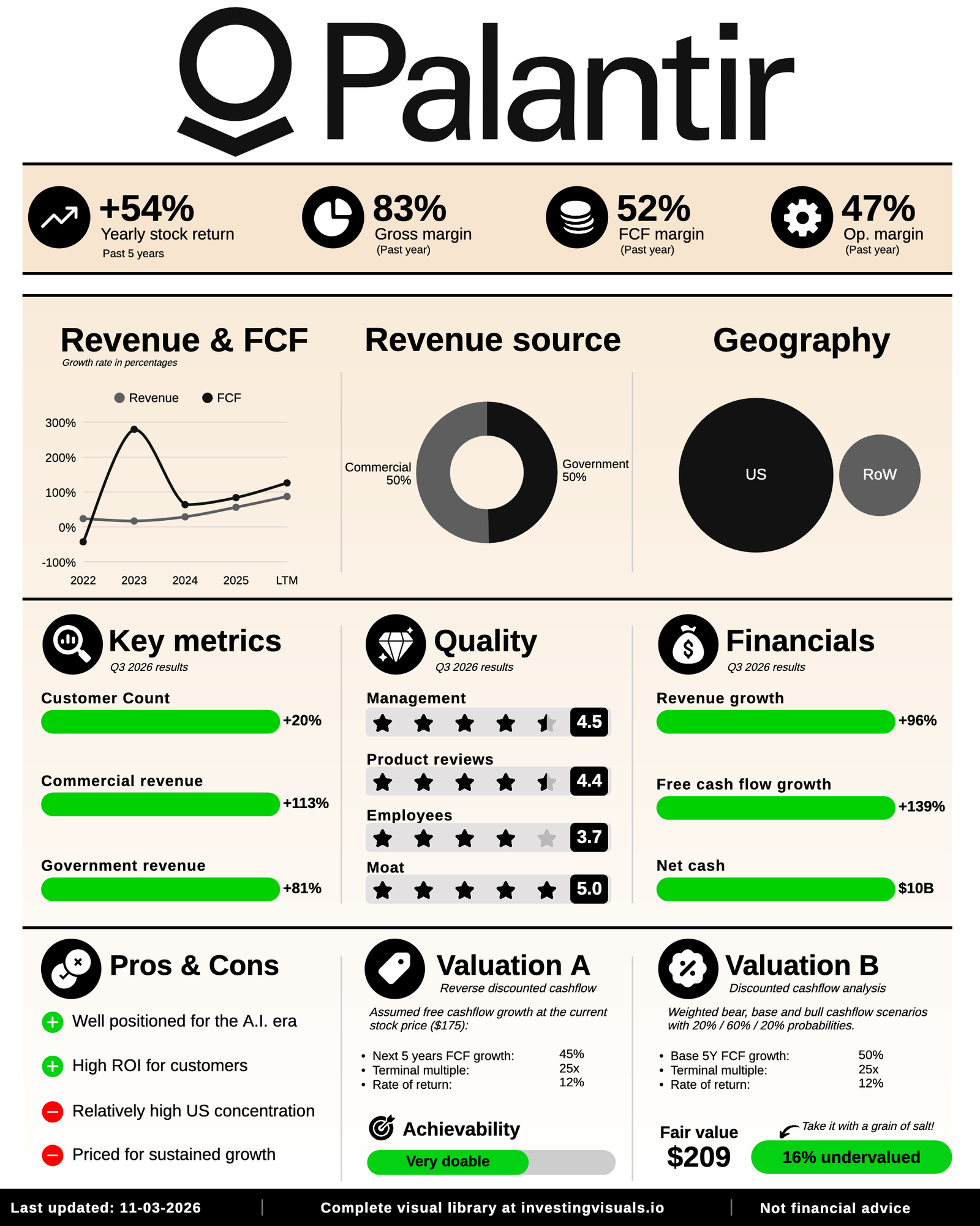
Now onto valuation. In absolute terms, Palantir is trading at a high valuation. However; if we factor in their growth, it's actually very reasonable. Especially given the opportunity ahead of them and their execution so far. My fair value for Palantir is around $209, making it undervalued at today's price.
What I am watching next
- Whether shorter sovereign AI agreements expand into larger, longer contracts
- Whether U.S. commercial customers keep increasing their spending at anything close to this pace
- Whether gross margin stabilizes and cash generation per share continues to grow
- Whether the valuation leaves enough room for a good return if growth slows
Overall, Q3 gives us more evidence that Palantir has built something unique that customers are finding increasingly useful. The commercial business taking the lead is a major milestone. This quarter had everything you'd hope for as a shareholder.
Written by

Subscribe to keep up to date
Subscribe to get regular updates. No spam, unsubscribe anytime.

Member discussion