
members only
Ouster Q3 2026 recap: Cameras take off & Rev8 ramps
Record camera shipments, a Rev8 production ramp and a smaller adjusted loss. My take on Ouster’s Q3 results
Introduction
Ouster is my favorite physical AI company and I've been adding significantly to my position during the recent tech sell-off. They posted a great quarter and the stock is up +11% at the time of writing this recap. Let's break this quarter down!
In Q3 Ouster shipped more than 20,000 cameras, alongside over 7,000 lidar sensors. The Stereolabs acquisition is also starting to show up in a much bigger way.
Revenue reached a record $59.3M, up 50% year over year, while the adjusted EBITDA loss narrowed to $3.4M. Cameras are already scaling, Rev8 is moving through its first production ramp, and BlueCity is winning larger deployments.
There's plenty to like here.
1. What Ouster does
In simple terms, Ouster builds the sensors and software that help machines understand the world around them. Lidar measures distance to create a 3D view. Cameras add visual information, while its AI computers and perception software help turn that information into something a machine can act on.
Think of a robot moving through a warehouse. It needs to recognize a pallet, judge how far away it is, and avoid the person who has just stepped into its path. Ouster sells different combinations of those building blocks to robotics developers, industrial customers and transportation agencies.
2. Key numbers
- Revenue: $59.3M, up 50% year over year and 9% sequentially, versus approximately $56.2M in pre-release Zacks consensus
- Product revenue: $56.0M, up 42% year over year and 6% sequentially, the 15th consecutive quarter of product revenue growth
- Royalty revenue: $3.3M, reported separately from product revenue
- Sensors shipped: more than 27,000, including over 7,000 lidar sensors and 20,000 cameras
- GAAP gross margin: 42.6%, versus 42.1% a year ago and 48.9% in Q2
- Non-GAAP gross margin: 46.6%, versus 47.4% a year ago
- GAAP net loss: $14.2M, compared with $21.7M a year ago
- Adjusted EBITDA loss: $3.4M, compared with $8.4M a year ago and $4.5M in Q2
- Cash, cash equivalents, restricted cash and short-term investments: $421M at quarter end
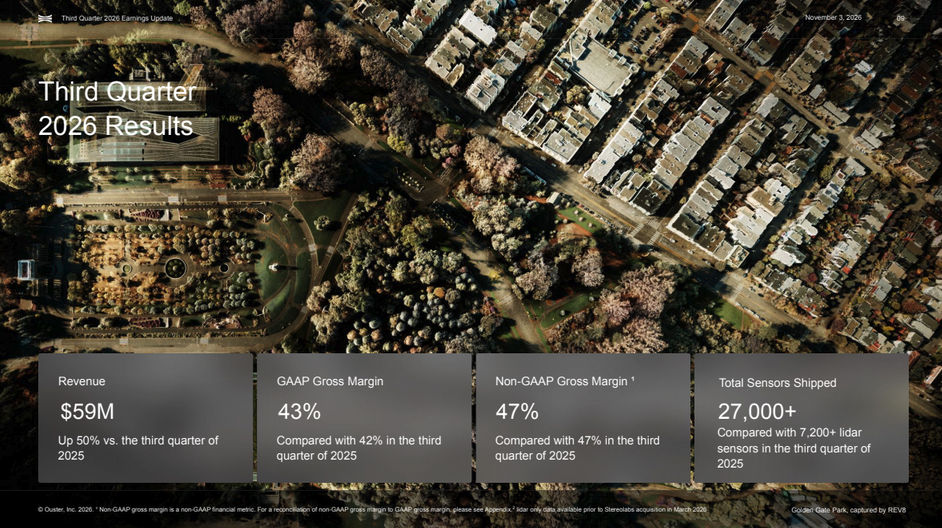
Revenue came in about 5.6% above consensus and above the top of management's previous $54.5M to $57.5M guidance. That's a good result.
The gross margin comparison needs a little context. Q2 included a $5.4M tariff refund that lifted that quarter's margin. Its absence explains much of the sequential decline. A 42.6% GAAP margin in Q3 is encouraging, although management still plans around a longer term gross margin range of 35% to 40%.
Cameras made up most of the units shipped. The revenue mix is harder to judge because cameras and lidar have different prices, and reported product growth includes Stereolabs. I'd keep an eye on both the unit growth and the revenue those units generate.
3. Outlook
- Q4 revenue guidance: $61M to $64M, including approximately $3M of royalties
- Midpoint: $62.5M, up about 5% sequentially and close to the approximately $62.7M in pre-release Zacks consensus
- Full year product revenue growth: approximately 48% at the midpoint of Q4 guidance, excluding royalties
- Full year operating expense growth: 5% to 8%, excluding the favorable employment tax refund and one-time acquisition costs
The outlook points to another record quarter, with Rev8 becoming more meaningful as production increases. Management expects the ramp to continue through 2027. Here's also a great breakdown of some back-of-the-envelope math on how OUST is scaling.
@ousterlidar just reported its 15th consecutive quarter of revenue growth.
— ppdd (@usppdd) November 4, 2026
Let me tell you why $OUST is the kind of company you buy, hold, and let compound over the next 5–10 years.
1. lidar shipments: 7,290 units
At first glance, this is flat compared with the same period… pic.twitter.com/9fb0jMucwQ
4. Business highlights
Rev8 moves from hundreds to thousands
I'd like to spend a little more time on Rev8, because this remains one of the most important parts of Ouster's next few years.
Rev8 captures native color together with 3D data. A machine can use color to read a traffic light or a road sign, alongside the depth information it needs to navigate. That gives customers more context from one sensor and can also help them train their perception models.
Management said hundreds of customers have selected Rev8, with many thousands of sensors in backlog. The CFO described production moving from hundreds of Rev8 units in Q3 to thousands in Q4.
The expanded Benchmark partnership gives Ouster room to grow, with annual lidar production capacity intended to exceed 100,000 units by the end of 2027. Actual shipments will depend on customer demand.
Stereolabs gets its production ramp
The camera business had a breakout quarter. Management said Stereolabs more than doubled production sequentially, helping camera shipments exceed 20,000.
What I find interesting is the variety of places those cameras can go. One robot might need vision in its head, another at its wrist to guide a gripper. Different sizes, power requirements and prices call for a family of products rather than one camera that supposedly does everything.
Ouster is adding compute alongside those sensors. Its ZED Box 2 family uses NVIDIA Jetson Orin and Thor platforms and supports up to eight sensors. The benefit is less work for a customer trying to connect cameras, lidar and processing hardware into a functioning machine. Whether that leads customers to buy more of the stack is worth following.
BlueCity customers are expanding
Management reported a multimillion dollar BlueCity contract covering 100 additional intersections for an existing transportation customer. That's a great example of the expansion model discussed last quarter: prove the system in one deployment, then earn a larger rollout.
The software is becoming more capable too. Ouster says Gemini can now combine data from up to 100 lidar sensors on one server, more than double its previous capacity. That helps customers track objects across larger sites without adding a separate server for every small group of sensors.
5. Management commentary
Pacala was clear about why Ouster is adding manufacturing capacity: it wants “more capacity than we are shipping”. The aim is to accommodate demand spikes. On funding, CFO Ken Gianella said:
This post is for subscribers only
Subscribe to continue reading
Written by