
Micron: the king of AI memory

This week's newsletter as a special about Micron, which posted a mind blowing quarter on Wednesday that reminded me of NVIDIA back in 2023.
Here are some of their financial highlights:
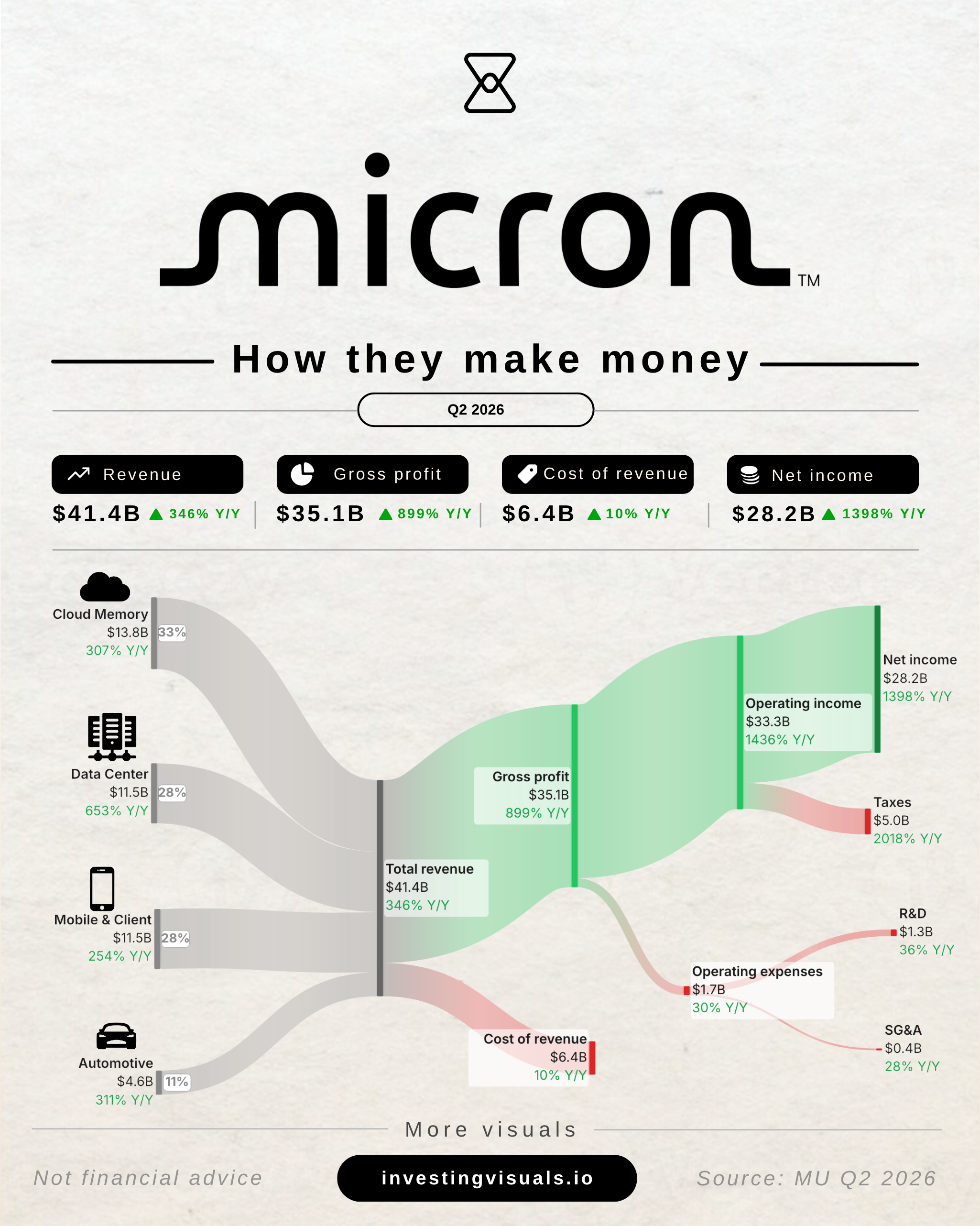
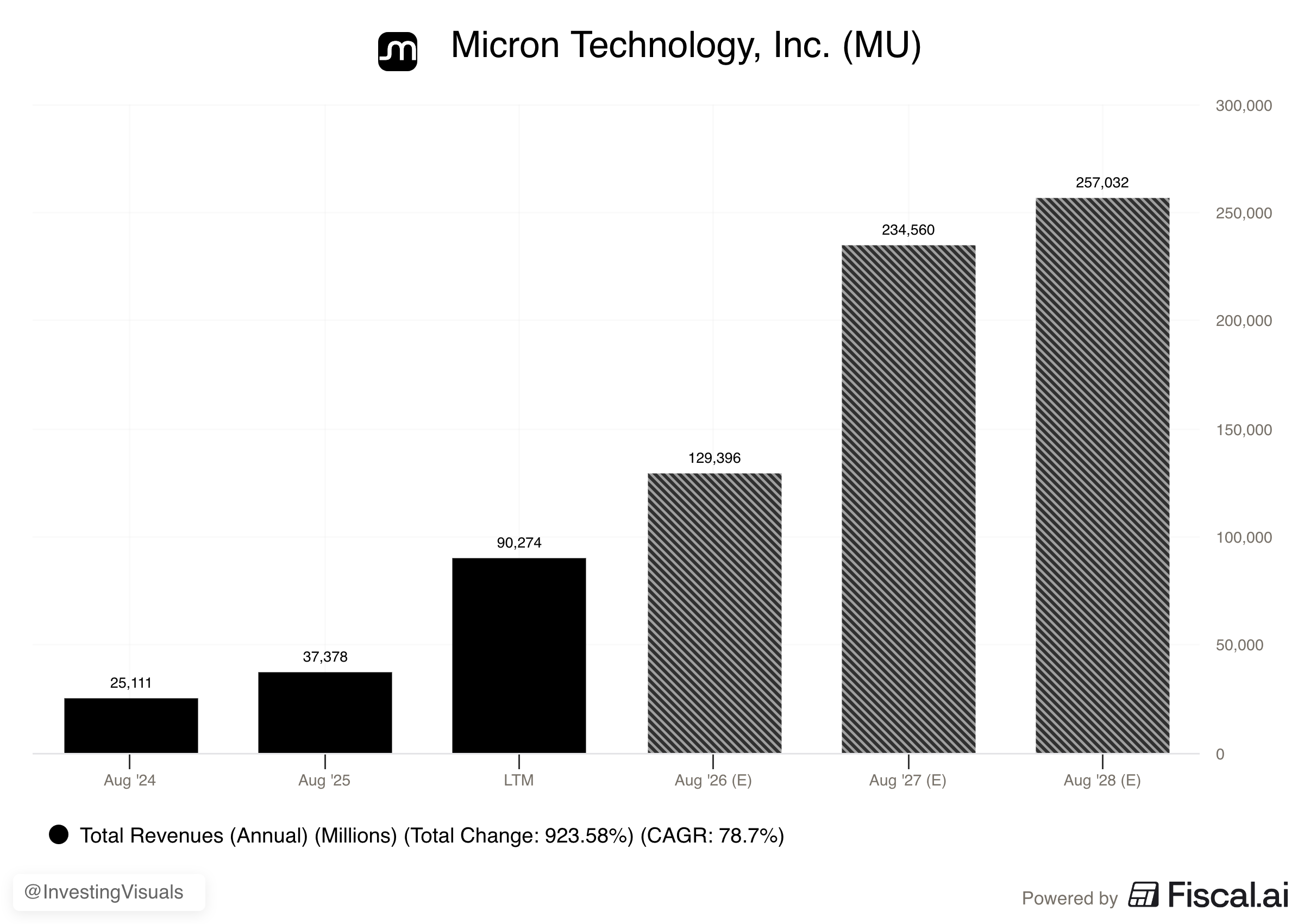
- Record Revenue: Total revenue reached $41.5 billion, a 74% sequential increase and 346% year-over-year growth
- Operating Margin: Achieved an operating margin of 81.2%, up 54 percentage points year-over-year
- Gross Margin: Consolidated gross margin hit a record 84.9%, more than doubling from the prior year
- Earnings Per Share: Non-GAAP diluted EPS was $25.11, representing a 106% sequential increase
- Cash Position: Ended the quarter with record cash investments of $30.2 billion and a net cash balance of $24.4 billion
If you're new to Micron, you can read more about what they do in this stock analysis, but in short: they are one of only three big memory chipmakers worldwide and the only major US based one.
They make DRAM (fast working memory), NAND flash (long term storage), and HBM (high bandwidth memory for AI). These chips power phones, PCs, cars, and AI data centers. This is how they make money:
1 - Their founding story
Micron was founded in October 1978 by four engineers in Boise, Idaho. A small team that believed they could build DRAM (dynamic random access memory) chips cheaper and more precisely than the Japanese manufacturers who controlled the market at the time.
For the first decade, it was a tough grind. They survived brutal downturns that took out most of their peers. They kept reinvesting though. And they did it all from Idaho, which in semiconductor terms is about as far from the center of gravity as you can get.
What I find most interesting about that history is what it tells you about their culture. Micron was built by people who had to be lean by necessity, not by choice. That operational discipline did not disappear when the company grew. It became their core DNA.
2 - Micron's core segments
Micron makes two things: DRAM and NAND. DRAM is fast, expensive, and volatile: it holds data only while powered. NAND is slower, cheaper, and persistent, it's the technology behind SSDs and flash storage.
Together they power everything from your phone to AI data centers running the world's largest AI models.
The revenue mix from as of Q3 FY2026:
- Cloud Memory — $13.8B, up 78% sequentially
- Core Data Center — $11.5B, up 103% sequentially
- Mobile and Client — $11.5B, up 49% sequentially
- Automotive and Embedded — $4.6B, up 71% sequentially
All four segments are at record levels in the same quarter. And most interestingly; without shipping a lot more chips, so nearly all of it is due to increased pricing.
CEO Sanjay Mehrotra on the Q3 call:
"The memory industry has been structurally transformed by the proliferation of AI. We are only in the early innings."
3 - The rise of HBM
High Bandwidth Memory, or HBM, is a specialized type of DRAM that sits directly on top of AI chips to feed them data fast enough to keep pace with the compute. Every new GPU generation needs dramatically more of it:
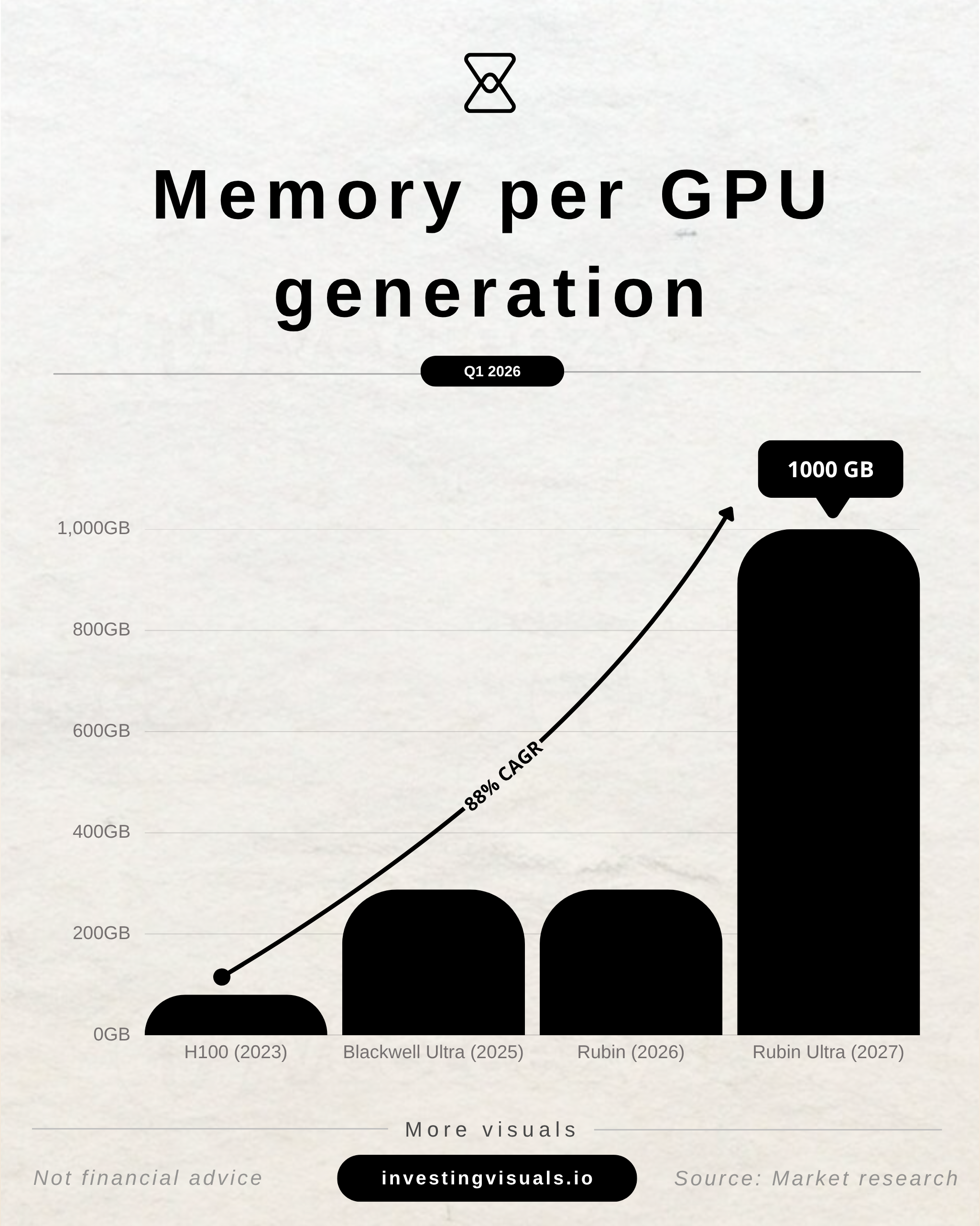
I like to think of it like a highway into a city. The city keeps doubling in size every two years. The chips get faster, but none of that matters if the road feeding them cannot move enough traffic. HBM is that road.
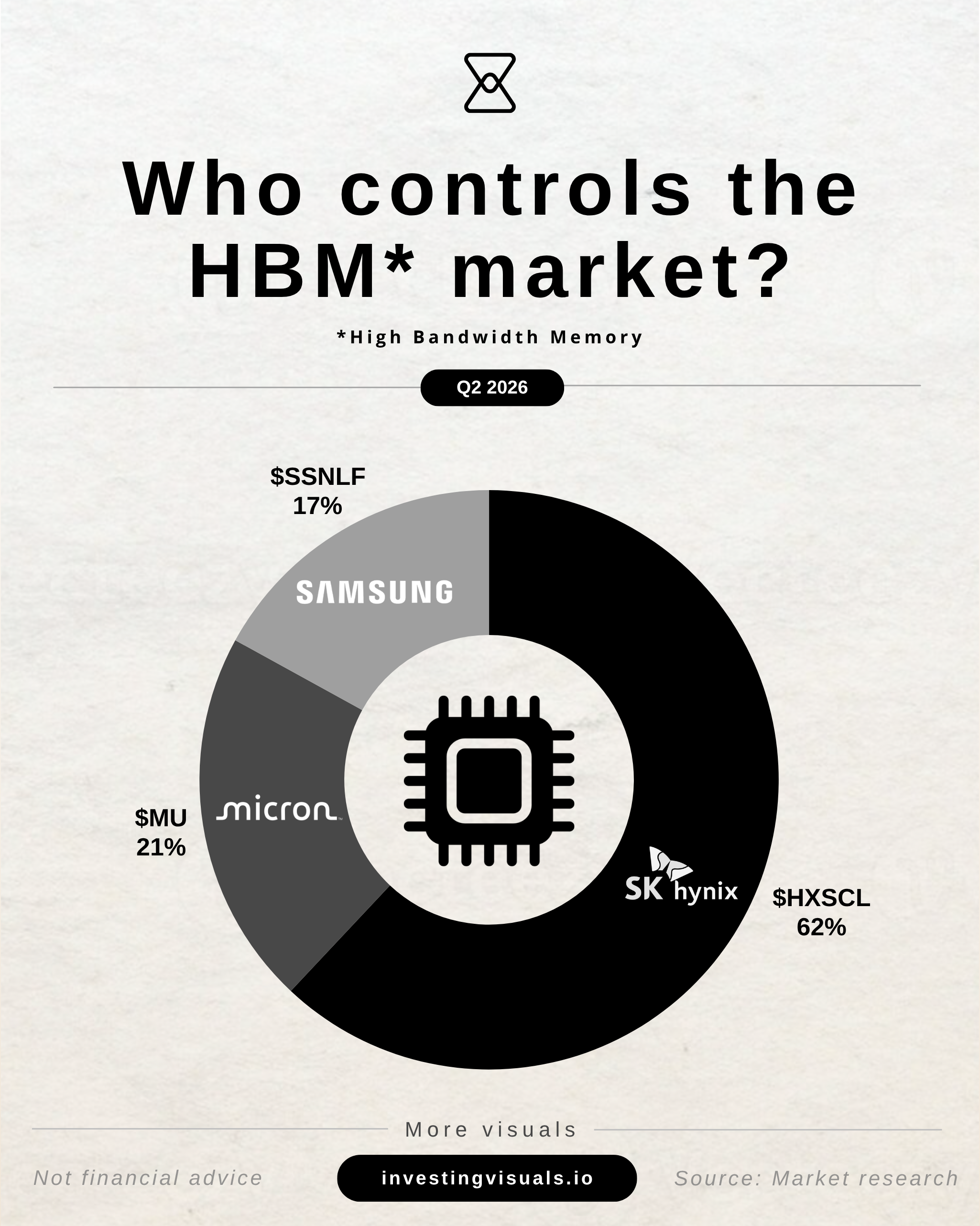
And right now, there is nowhere near enough of it being built and supply is concentrated with just three businesses with Micron controlling about 21% of the market.
Mehrotra on the Q3 call:
"Memory process technology, which is among the most advanced to develop and manufacture in semiconductors, is getting more complex with every new node. These factors, taken together, mean supply is structurally constrained in its growth and ability to meet industry demand."
As of Q4 2025, SK Hynix holds 62% of the HBM market, Micron sits at 22%, and Samsung at 17%. Micron came into this race rather late. But it qualified HBM3E into Nvidia's Blackwell platform, started shipping HBM4 at volume in Q3, already crossing $1B in HBM4 revenue, and locked in a partnership with TSMC to manufacture the logic base for HBM4E, targeted for 2027.
4 - Is this time different?
Memory has always been a cyclical price-taking business. Companies build capacity, sell into the spot market, prices fall when supply catches up with demand, everyone takes the hit. It caused Micron's stock to drop from roughly $98 in early 2022 to around $49 by late 2022 for example.
So when I wrote my memory deep dive, a key question I ask myself: "is this time really different versus every previous cycle?"
In my view, there are three things worth noting:
First, the contracts change the model. Micron has signed 16 Strategic Customer Agreements, or SCAs, take-or-pay deals, most running from 2026 through 2030, with pricing bands that have a floor and a ceiling.
Fourteen of those carry $100B in minimum contracted revenue at floor pricing. Customers have committed $22B in deposits and financial guarantees. Mehrotra on the floor price: "For our SCAs with price bands, the floor price enables a very robust gross margin for Micron, well above our peak quarterly margins in any past cycle." So in this cycle, we're seeing a contractual floor the business has never had like this before.
Second, the demand curve is widening. Mehrotra on the Q3 call: "L2+ and above vehicles, which feature progressively increasing levels of autonomy, have over five times the memory and storage content of an average vehicle.
The mix of L2+ and above vehicles is more than doubling this year to over 20% and is expected to exceed 40% by 2030. Humanoid robots carry 10 times the amount of memory as an average L2+ vehicle, and we expect a sustained, substantial, multi-decade memory demand cycle to begin in the latter part of this decade."
Third, supply cannot simply be built faster. New memory fabs take years. Greenfield projects face long equipment lead times, skilled labor shortages, permitting delays, and energy infrastructure gaps.
Mehrotra about this topic: "Even as we expect industry supply to improve gradually in 2028, we currently do not have line of sight as to when memory supply will be able to catch up with increasing demand." That sentence, to me, is the memory thesis in one paragraph.
5 - The Risks
These are the two things I am watching closely when it comes to Micron:
Taiwan concentration. Most of Micron's DRAM production still runs through its Taiwan fabrication facilities. The $200B domestic buildout across Idaho, New York, and Virginia, backed by CHIPS Act funding, is a great step in the right direction to low geopolitical risk.
The Idaho ID.1 fab is on track for first wafer output in mid-calendar 2027. But the transition takes years, and the geopolitical exposure is still there in the meantime.
The cycle is dampened, but not dead. The SCAs cover roughly 40% of revenue at floor pricing once all agreements are in place. The remaining 60% stays exposed to market pricing. If AI capex slows or new capacity comes on faster than the models expect, spot price pressure will return. I do think the depth and duration of any correction would be much smaller than past cycles though, given the insatiable demand that's only possibly easing in 2028.
6 - So is it a buy?
The stock trades around $1,133 right now. My DCF fair value in the infographic below sits at roughly $1,520, implying about 25% upside from here. Assuming an average free cash flow growth of 40% for the next 5 years, 25x multiple for a 15% annual return.
Analyst consensus sits around $1,398, with high-end targets at $2,000. I personally believe Micron is still undervalued despite the stock being up 258% year-to-date, simply because the stock is following earnings growth. I do always treat DCFs as directional, so please take it with a grain of salt.
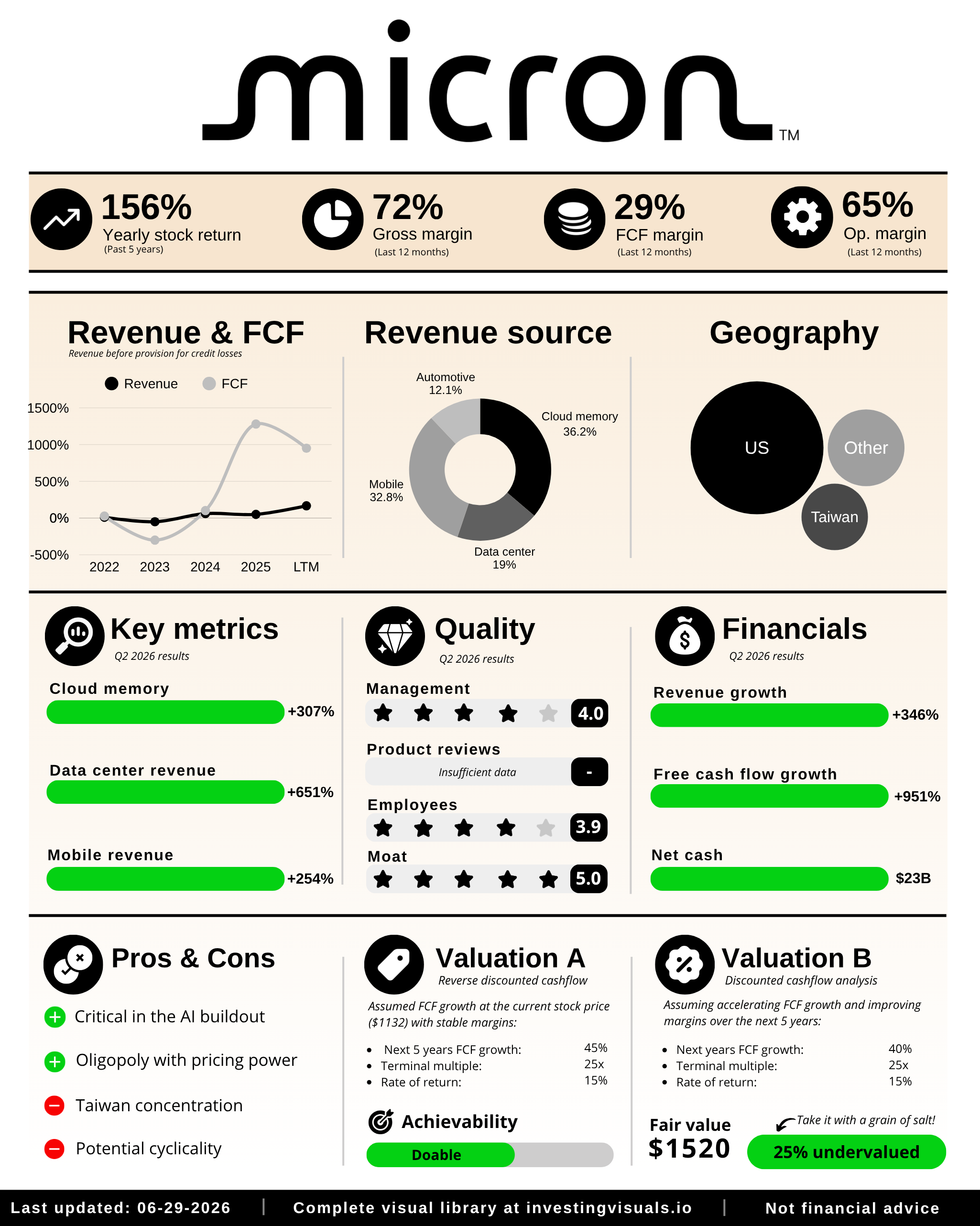
What matters more to me is the earnings trajectory. Q4 is guided to $50B revenue and $31 EPS. Data center revenue is already running at a $100B annualized pace. If the numbers land anywhere close to that, the current price looks very reasonable.
I personally do not own Micron at this point though, because I opted to go for another memory name instead, which I covered in much more detail in this portfolio update.
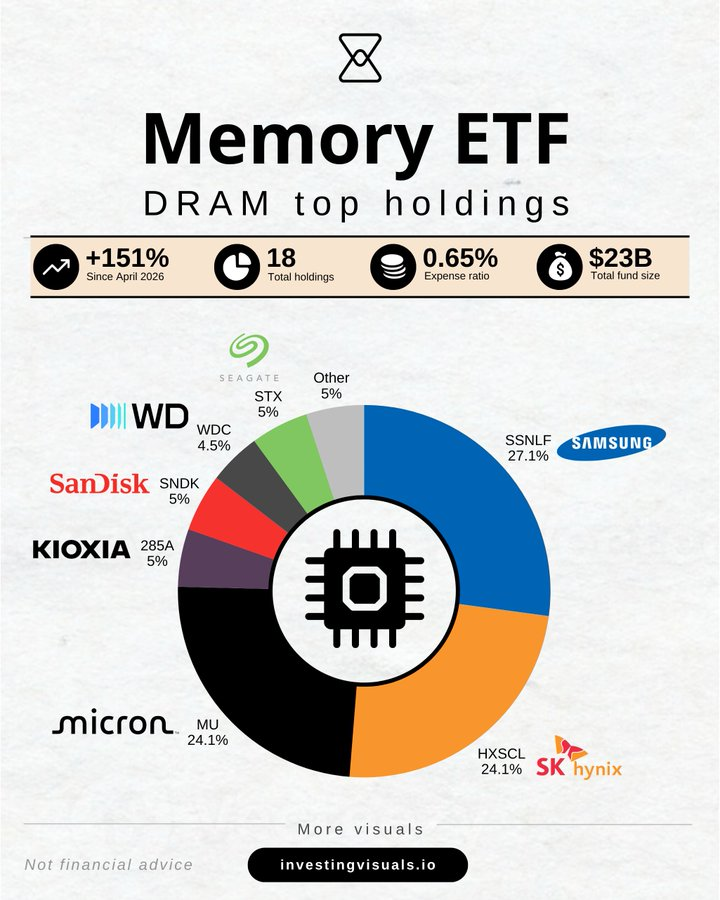
Also worth noting: If you're not really into picking individual stocks, the DRAM ETF could be worth a look as well. It hold all major memory players, as you can see in the visual below.
And with that being said, it's time to conclude this week's newsletter! I hope you found it helpful.
In case you missed the latest published visuals; you can find them here, which includes $MU, $AVGO, $PLTR, $NOW, $ZETA & SK Hynix.
Up and onwards
Jan - Investing Visuals

A weekly newsletter for visual learners to help you invest better

Member discussion