

Don’t let this market scare you out
Tech is taking a beating. Again. Here’s what I’ve learned from past crashes. If you’re a tech investor too, I hope it helps you get through this one.
Lately, I've been seeing more and more posts from tech investors who sound like they're ready to throw in the towel and wave the white flag. As a tech investor myself, I've lived through the COVID crash and the 2022 drawdown and come out stronger.
In this article, I'd like to put this drawdown into perspective, share some if my personal experiences and thoughts on how to get through it all.
First and foremost, I hope this article will help you stay grounded and not get scared out of the market.
Reflections on this market
The current market, especially for tech stocks, can be incredibly frustrating, maybe even depressing if this is your first serious drawdown. You see high-quality companies sell off 5% on back-to-back days on no news. While being down 50% or more from their prior peaks already.
Sentiment toward anything AI-related is at an absolute low point. But ask yourself this. What has actually changed about the businesses in the past two months?
The most significant change is stock prices. Fundamentally, many businesses are doing great. Demand is as strong as ever, and major tech leaders point to a continuation of the AI buildout.
In a market downturn, there are always reasons to sell. And these voices get louder as stocks continue to drop. It's like a self-reinforcing loop with negative news on top of negative news. Up until a point where negative narratives completely take over and make you wonder if stocks will ever recover.
But if history is of any guide, prior market drawdowns have often been the worst moments to sell. When the market tumbles, you'll hear the loud voices calling for a much larger drawdown. And they can scare you out of the market, which is completely understandable.
The opposite is true for market euphoria. When stocks peak, you're told they will go much, much higher.
The best thing you can do at this point, in my opinion, is not to get scared out of the market. Learn from what you're experiencing right now. It'll be an invaluable lesson for the rest of your investment journey. Trust me, I've been there.
Zooming out: how bad is it, actually?
So, before I get into my own experiences, how bad is this drawdown compared with previous ones? To be fair, I think we're in the midst of a historic drawdown right now.
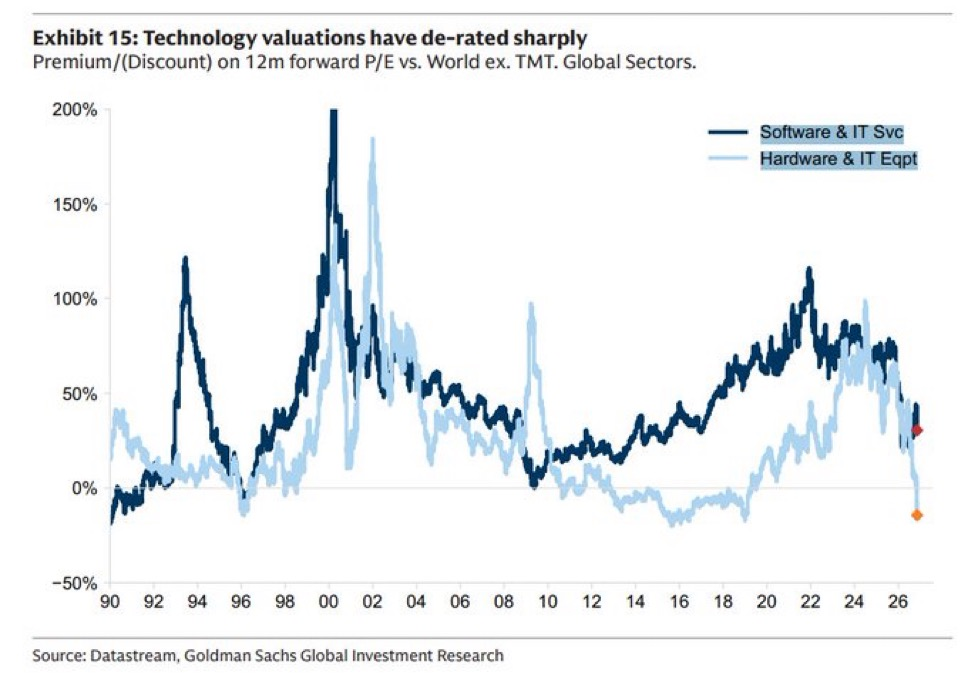
It obviously all depends on what you own, but for this article, I'll focus on semiconductor and software stocks specifically, as they've seen the largest drawdowns so far.
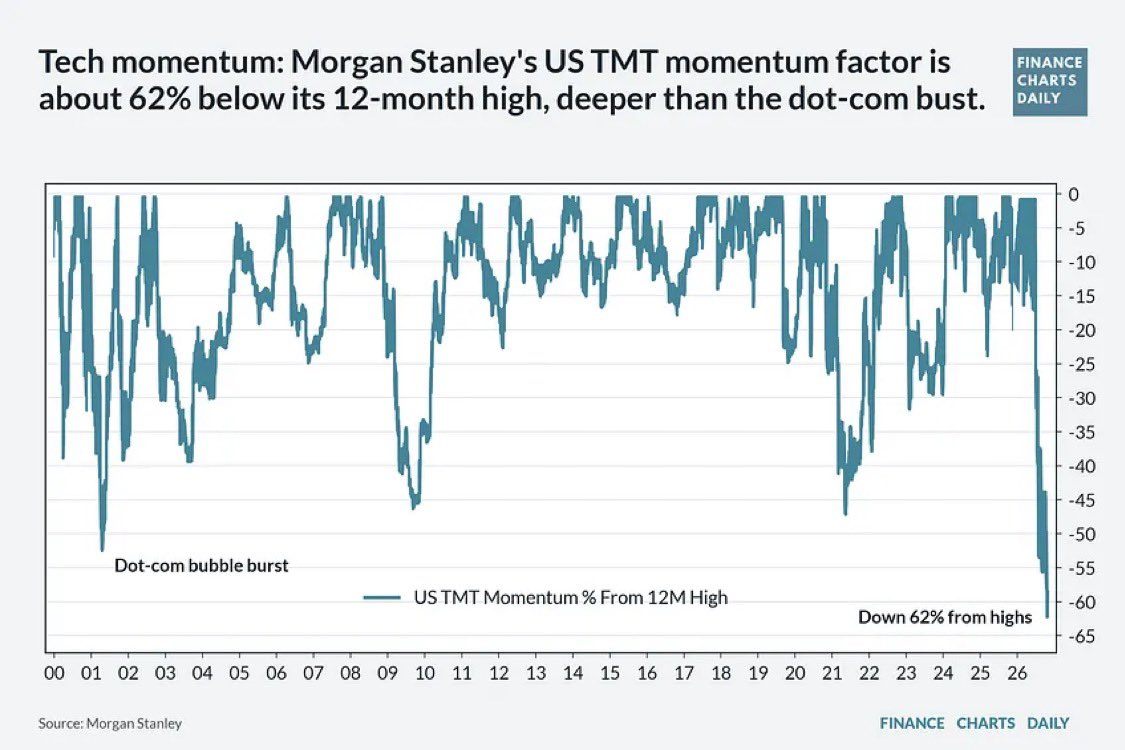
In late October, Morgan Stanley's momentum factor was about 62% below its 12-month high, a deeper drawdown for that particular measure than during the dot-com bust. I look at it as a measure of how violent the current drawdown is.
In 2022, we saw tech drop throughout the year. Today, we're seeing the same thing happen in a matter of weeks, making it much more intense.
Why the moves can feel so random
In a November 11 note, Morgan Stanley wrote that the hedge fund deleveraging since October had been brutal. Here’s how the note described the selling.
"Levered institutional hedge funds have acted as ‘chickens with their heads chopped off’ (IMO), moving daily stock prices around at nonsensical speeds."
Here's how that can happen:
- A fund borrows to hold bigger positions
- When the stocks fall, the same debt sits against a smaller pool of equity
- The fund may have to cut risk or post more collateral, so it raises cash by selling what it can
- If a bunch of funds own the same names, they can all be trying to get out at once
- The stock can keep falling while the company is having a perfectly ordinary Tuesday
I think what we're seeing right now is in large part a deleveraging event that kicked things off, sparking a much broader sell-off.
deleveraging event: A period when individuals, companies, or entire financial systems rapidly reduce their level of borrowed money (leverage) by paying off debt, selling off assets, or closing leveraged trading positions
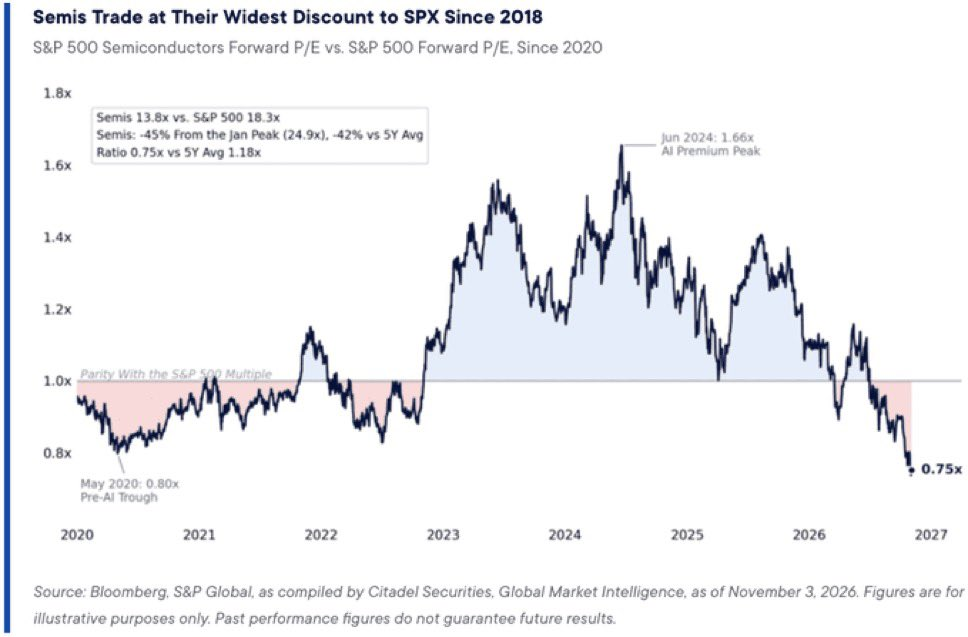
This puts tremendous selling pressure on tech stocks. Everybody runs out of the gate at once. As a result, semi stocks now trade at their widest discount to the S&P 500 since 2018.
The great rotation
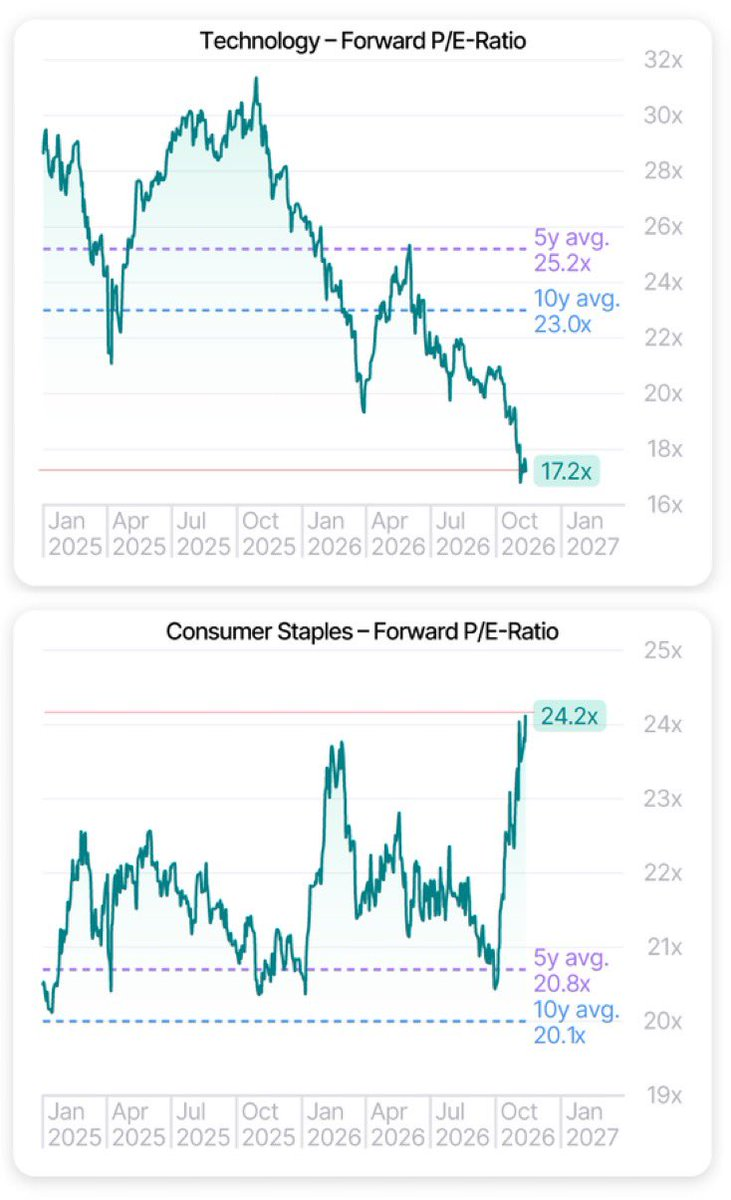
We're currently experiencing an unprecedented rotation from tech into consumer staples. It seems funds and investors are looking for what they might see as 'safe havens'.
Except, judging by their valuations, these 'safe havens' are approaching bubble territory, with valuations this high last seen in 1999. Personally, I think it'll be a matter of time before we see a rotation the other way around, from consumer staples into tech as sentiment improves (at some point).
What I learned from 2022
I sold out of a positions I had high conviction in because I thought it would only go lower. Even though I did the work on the business, I still ended up acting on emotion and a gut feeling.
As sentiment improved, money rotated back into tech, and I watched some of them stock become a multibagger in the year that followed.
Oh well. It's easy to write that now. And truth be told, there's a certain relief in getting out. You can stop watching the stock for a bit and tell yourself you'll get another chance to buy lower or move into stocks or ETFs that better suit what you're comfortable with.
But in fact, most people end up buying back the stock at a higher price than they sold it for, rotating into stocks that drop even more, or missing out on the best days in the stock market because they went all cash right about when the market turned around.
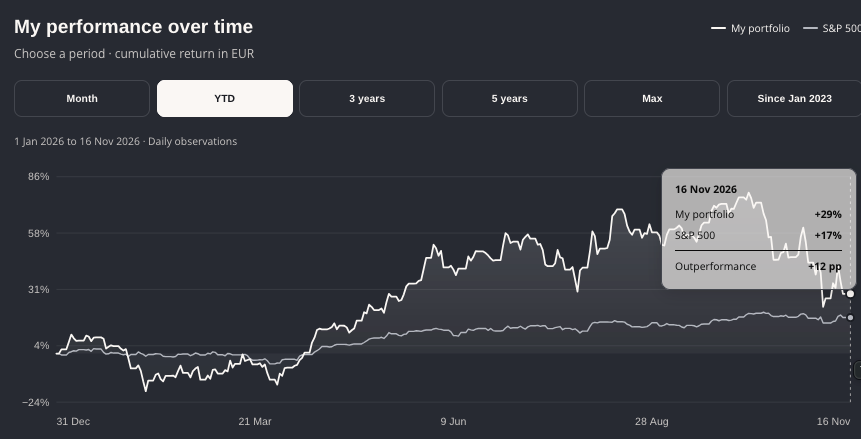
This time around, I trimmed some high-flying positions near the peak and started putting that cash back to work slowly as the drawdown continued. However, this still did not prevent a very steep drawdown in my tech-heavy portfolio, as this drawdown has been much more intense and violent than I anticipated.
As a result, my year-to-date return dropped from +78% at its peak to +29% today. I'll do a longer write-up about my personal lessons learned later on.
If you're close to throwing in the towel
I guess the thing I most want to pass on from 2022 is that a drawdown can teach you more about your process, who you are as an investor, and what you're comfortable with than a year of watching everything go up.
Maybe you bought more than you could comfortably hold. Maybe you did not trim enough on the way up or your top positions all rely on the same theme. Whatever it is, there's always something you can learn in drawdowns like this.
If all I've got is a falling stock price and a feed full of people who sound sure it'll get worse, I like to revisit my investment thesis, look at the facts as they are, and zoom out to see the bigger picture.
My time horizon is 20+ years. Not days, weeks or months.
I also try not to act out of emotion and always give myself time to think things through before acting. If I see things that would make me change my mind about the business, I will act. If it's 'just' falling stock prices, I see it as an opportunity to add or, if I'm out of cash, a great time to sit back and take my mind off the stock market for a bit.
There's more to life than stocks!
If you're in a position to stick around, I hope you do. Give yourself a chance to use what you're learning right now and live to fight another day.
You got this!
~ Jan
As always, none of this is financial advice. Do your own due diligence before making an investment decision that fits your own risk tolerance and time horizon.
Written by

Subscribe to keep up to date
Subscribe to get regular updates. No spam, unsubscribe anytime.







Member discussion