

members only
Axon Q3 2026 recap: Software accelerates, but guidance comes down
Software & Services grew 43%, but federal Dedrone delays lowered Axon's outlook. My take on AI, Skydio, margin pressure and cash flow.
Axon's Software & Services revenue grew 43% in Q3, and AI passed $100M in annual recurring revenue. Yet the company cut its full year revenue and free cash flow outlook.
The reason sits largely in a different part of the business: three large federal counter drone deployments that Axon no longer expects to recognize this year. Add higher component costs, more inventory spending and a $1.2B investment in Skydio, and there's quite a bit to unpack.
I still find the combination of hardware, software and AI compelling and think the 16% drop in the stock is overblown. Let's unpack the quarter.
1. What Axon does
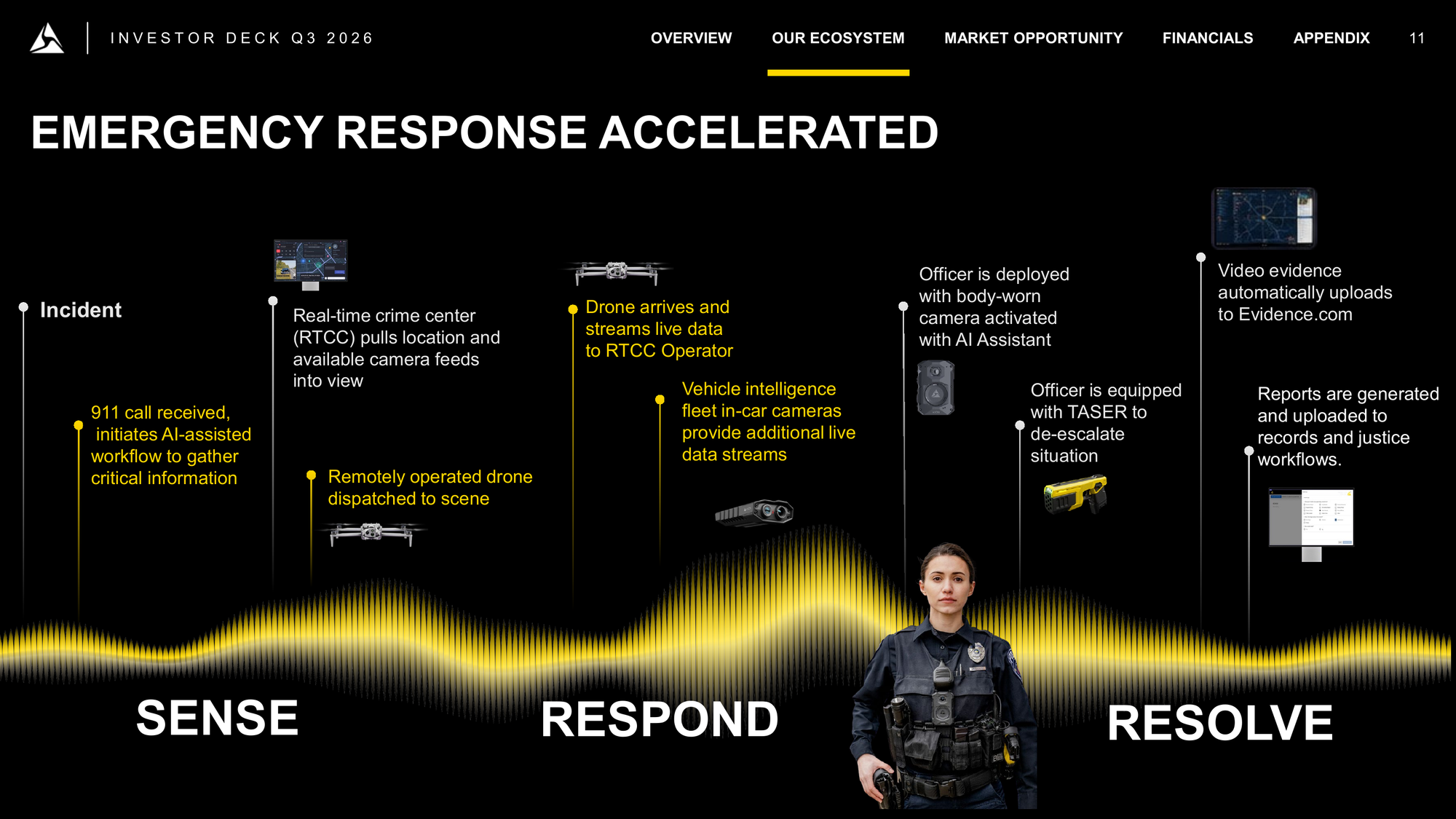
Axon started with TASER devices and has expanded into body cameras, digital evidence, emergency call handling, drones and the software connecting them.
Picture a 911 call. A drone can reach the scene first, a control room can see its video through Axon Fusus, and an officer arrives wearing an Axon body camera. The recordings then feed into evidence storage, report writing and court workflows. Every additional connection gives a customer another reason to use more of Axon's products.
That's also what I like most about them: they already have the devices and customer relationships through which it can distribute new software.
2. Key numbers
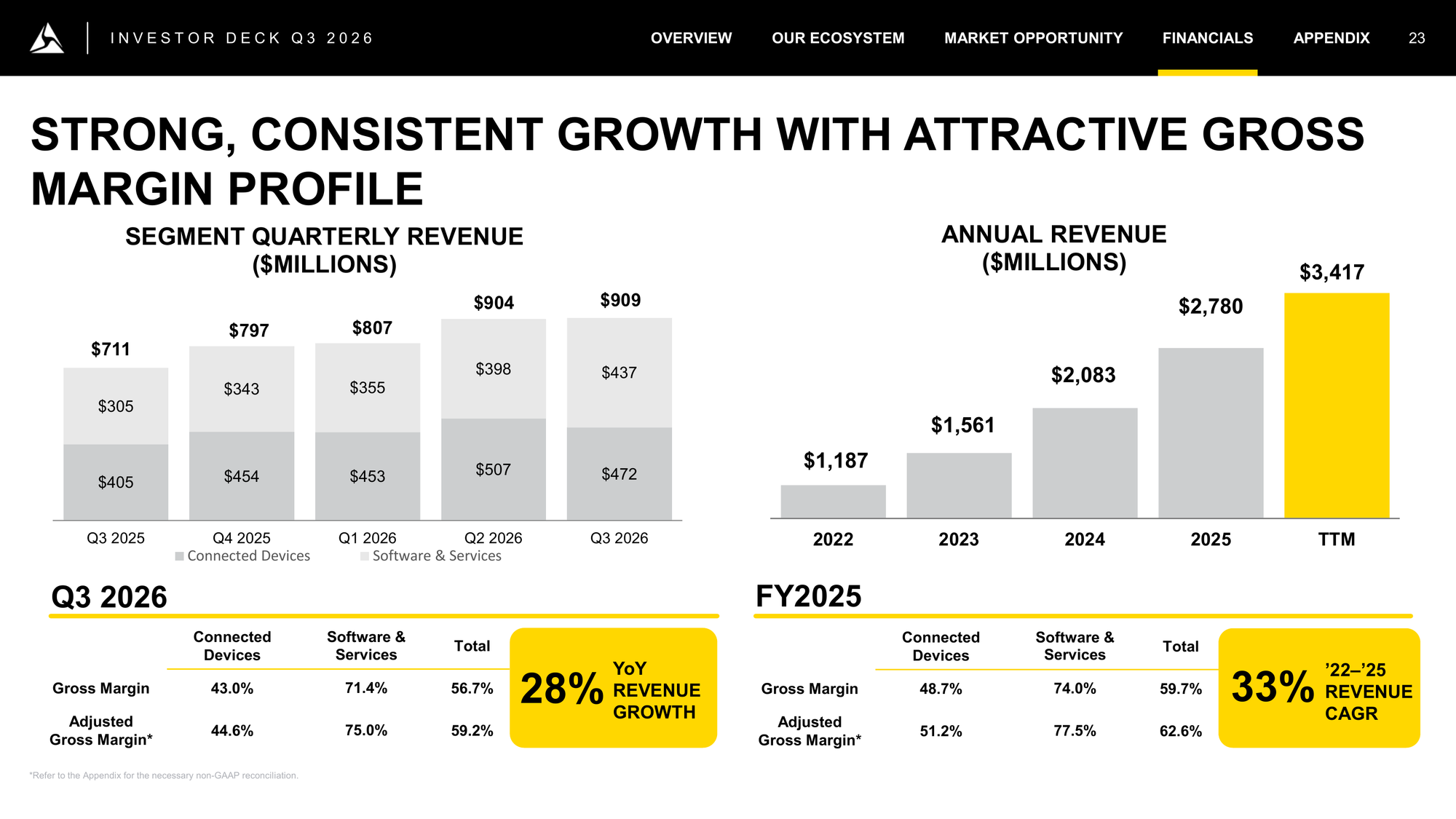
- Revenue: $908.6M, up 27.8% year over year, versus $931.1M in pre-release Zacks consensus
- Software & Services: $437.0M, up 43.2% year over year and 9.9% sequentially
- Connected Devices: $471.5M, up 16.3% year over year
- Annual recurring revenue: $1.75B, up 40%, with net revenue retention of 126%
- Future contracted bookings: $15.8B, up 39% year over year
- GAAP gross margin: 56.7%, versus 60.1% a year ago and 60.4% in Q2
- Adjusted EBITDA: $235.7M, up 33%, at a 25.9% margin
- GAAP net income: $57.0M, or $0.68 per diluted share, versus a $2.2M loss a year ago
- Non-GAAP diluted EPS: $1.72, versus approximately $1.90 in pre-release adjusted EPS consensus
- Free cash flow: an $18.9M outflow, versus a $33.4M inflow a year ago
Revenue missed expectations by about 2.4%, while non-GAAP EPS was about 9.6% below consensus. Software was the clear strength. It's now 48% of revenue, compared with 43% a year ago.
The margin decline came from more counter drone equipment in the mix, higher memory costs and newer products still scaling. Software & Services gross margin was 71.4%, down from 73.8% a year ago, but essentially stable from Q2. Software alone still carries gross margins above 80%; professional services and the wider segment mix bring the reported figure down.
The $15.8B bookings balance is broader than remaining performance obligations and includes optional or cancellable amounts. It also counts gross partner orders where Axon may record only its net share as revenue, so that balance isn't guaranteed future Axon sales. New bookings, normalized to five year terms, grew 25% year to date.
3. Outlook
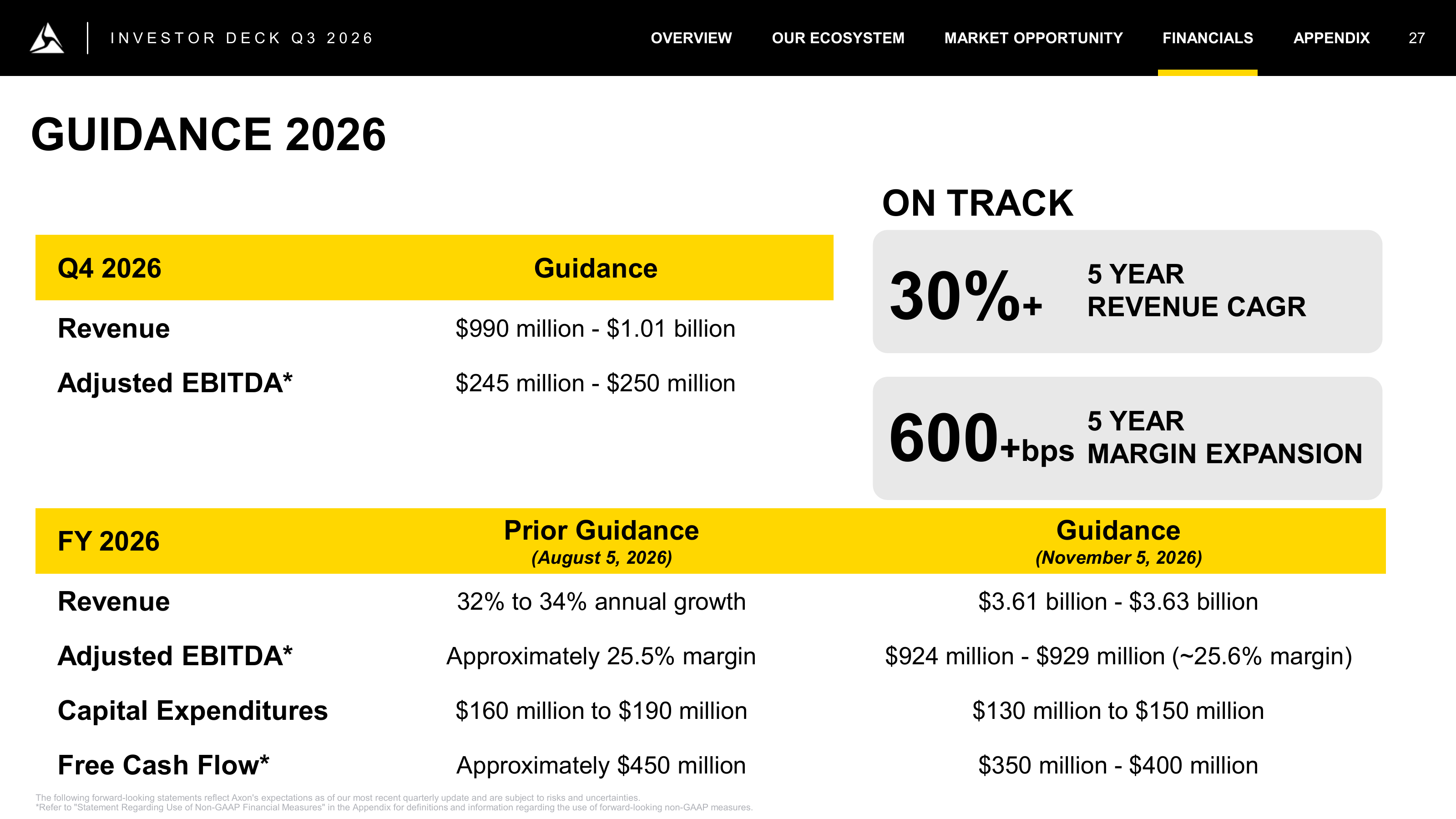
- Q4 revenue: $990M to $1.01B, with the $1B midpoint about 3.9% below pre-release consensus
- Q4 adjusted EBITDA: $245M to $250M
- Full year revenue: $3.61B to $3.63B, approximately 30% growth, versus prior guidance for 32% to 34%
- Full year adjusted EBITDA: $924M to $929M, implying a 25.6% margin, slightly above the prior 25.5% target
- Full year free cash flow: $350M to $400M, down from approximately $450M
- Full year stock based compensation: $570M to $600M, with CapEx of $130M to $150M excluding investment in the new headquarters
Three expected federal Dedrone deployments account for approximately $130M of revenue removed from the outlook. One $30M deployment had been expected in Q3, with another $100M in Q4. Management pointed to procurement, approvals, installation requirements and hardware availability affecting timing.
Axon will include the large projects in guidance when it has more confidence in their shipment timing. So the main reason for the miss is a timing issue, it doesn't mean these contract are cancelled.
That's why I believe the stock reaction is overblown: if they could've recognized this revenue in Q3 and Q4 they would've beat expections by 2% and the outlook by 3%. Instead, the market sees a double miss and decides growth is decelerating and take the stock to the woodsheds.
4. Business highlights
AI is becoming a meaningful business
AI ARR crossed $100M in less than two years. More broadly, real time operations, Records, AI, Axon 911 and Dedrone software together reached an annual revenue run rate approaching $500M, more than double a year ago. Which is really impressive.
A state Department of Corrections signed a $258M AI Era Plan and body camera expansion, while another signed a $115M agreement covering OSP 10 Premium, AI and Fusus. These are multi year agreements, rather than revenue recognized all at once.
Axon 911 is also progressing. Management said its ARR has doubled since the end of last year, with dozens of emergency call centers won during 2026. It gives Axon an earlier entry point into an incident, before an officer or a camera reaches the scene.
A much bigger Skydio commitment
Axon announced an additional $1.2B investment intended to take its fully diluted Skydio stake to 37%, alongside exclusive public safety distribution rights in the U.S. and Canada. Management expects funding to be approximately 60% cash and 40% stock.
The fit is quite clear: Axon can sell drones through relationships it already has, connect the video to Fusus and Evidence, and share in Skydio's growth outside public safety through its ownership stake.
Axon will record its channel margin as Software & Services revenue, rather than the full drone selling price. It won't consolidate Skydio's revenue, and the CFO said the stake won't use equity method accounting either. Skydio's roughly $1B of expected bookings this year therefore isn't another $1B of Axon revenue.
5. Management commentary
CFO Brittany Bagley put the change in forecasting plainly: “we're resetting how we guide.” The larger hardware projects can move quarterly growth by several percentage points. The customer relationship may be durable while the timing of an individual shipment remains uncertain.
Rick Smith was equally direct about accepting that variability: “if everything we're doing is predictable, we are not stretching far enough.” Moving into drones and new customer groups creates opportunities that wouldn't exist if Axon stayed with its original products, so I can see not everything is predictable. If it come to $100M+ deals, I do hope they learned from this and not fall for the guidance issue again.
I'd still pay attention to what the CFO said about memory too. Higher costs are expected to remain a headwind through 2027 and 2028, even assuming prices stabilize. Cheaper components bought earlier only delay when the higher costs reach the income statement. Pricing, more software and tighter expense growth will have to help offset them.
6. My take
The software side gave us a lot to like this quarter. Growth accelerated, retention stayed at 126%, and newer products are becoming large enough to matter. Axon is getting more value from customer relationships it has spent years building. That's a strong position to be in.
They are also expanding and scaling their business into drones and AI which I think are two extremely interesting verticals to expand into and can help grow the business for many years to come.
I wouldn't brush aside the total stock based compensation though, which was $156.4M, or about 17% of revenue. Average basic shares rose 3.4% year over year, and the planned stock portion of the Skydio investment would add more dilution. This is one of the few parts I don't like about Axon and will keep a close eye on.
Overall, the customer and product story remains very strong. The financial story needs more patience and some closer attention. Over the next few years, I'd want the expanding software business to translate into cash that grows faster than the share count.
What I'm watching
- Federal Dedrone projects moving through approvals and into recognized revenue
- Software growth and margins as AI, 911 and newer products become a larger part of the business
- Inventory spending moderating in 2027 and collections supporting better cash conversion
- Skydio distribution economics and dilution from both compensation and investment funding
Final verdict: very strong quarter, everything point to sustained long term growth above 25%, software progress is really strong, but cash generation and stock based compensation deserve some attention. I believe the current sell-off is overblown and too much focused on just the headline numbers.
Written by

Subscribe to keep up to date
Subscribe to get regular updates. No spam, unsubscribe anytime.


Member discussion