
SK Hynix: the Korean memory giant

This weeks newsletter is a special about SK Hynix, the computer memory giant that started trading at the Nasdaq last Friday and raised $26.5 billion in its record-breaking American Depositary Receipt (ADR) offering.
It marks the largest U.S. listing ever completed by a foreign company, surpassing the previous record held by Alibaba. I like to spend a little more time on this businesses due to it's crucial position in the AI buildout and the tremendous pricing power they have.
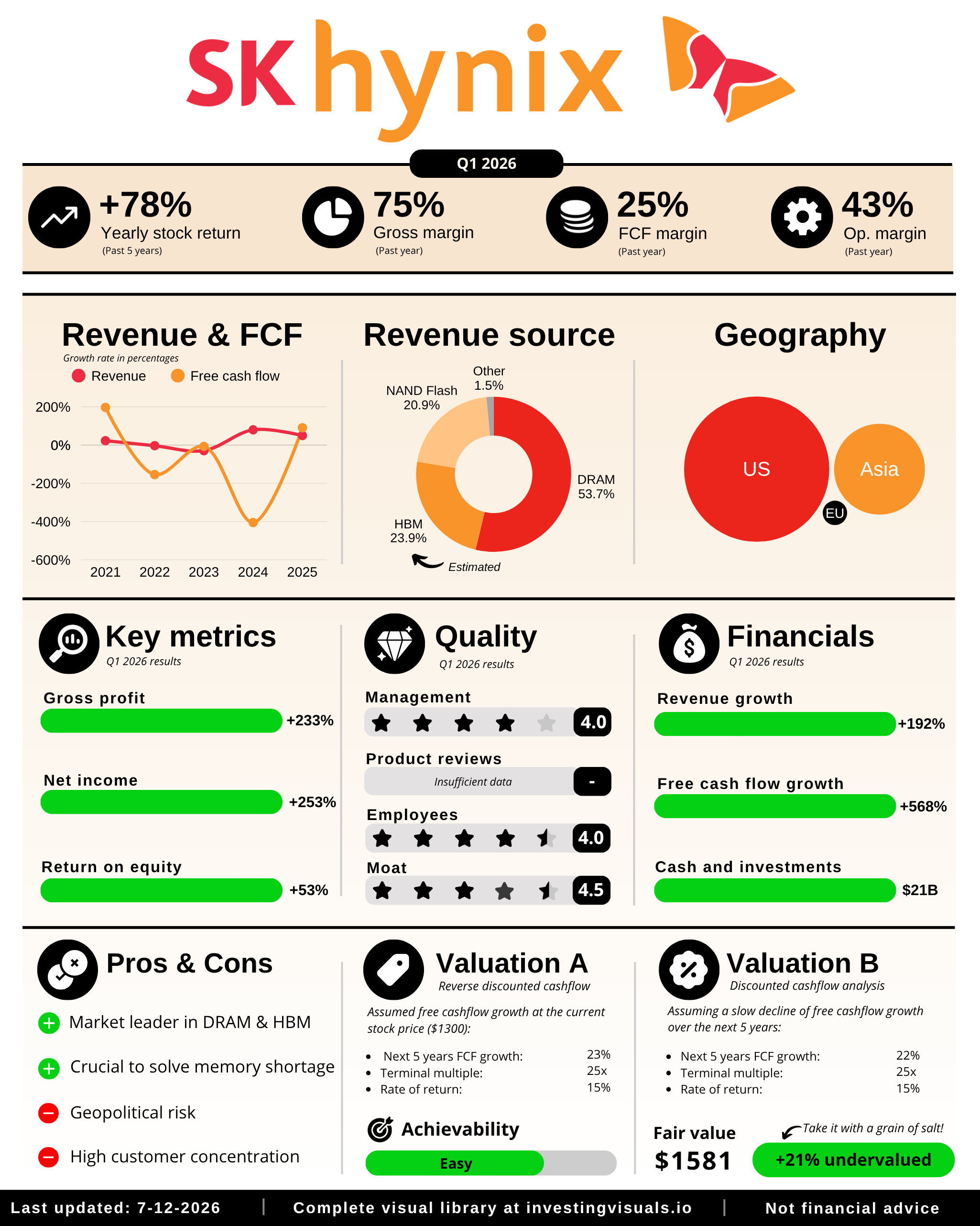
Rumor has it that SK Hynix gross margins could surpass 90% this year. A semiconductor with gross margins that outpaces the margins of software businesses is truly mind blowing.
1 - So what do they do exactly?
Today, SK Hynix makes three core product families:
- DRAM (Dynamic Random Access Memory): fast, volatile working memory used in servers, PCs, and phones. Think of this as short-term working memory for computers.
- NAND flash: persistent storage, the foundation of SSDs. This is the longer-term memory: slower, cheaper, non-volatile.
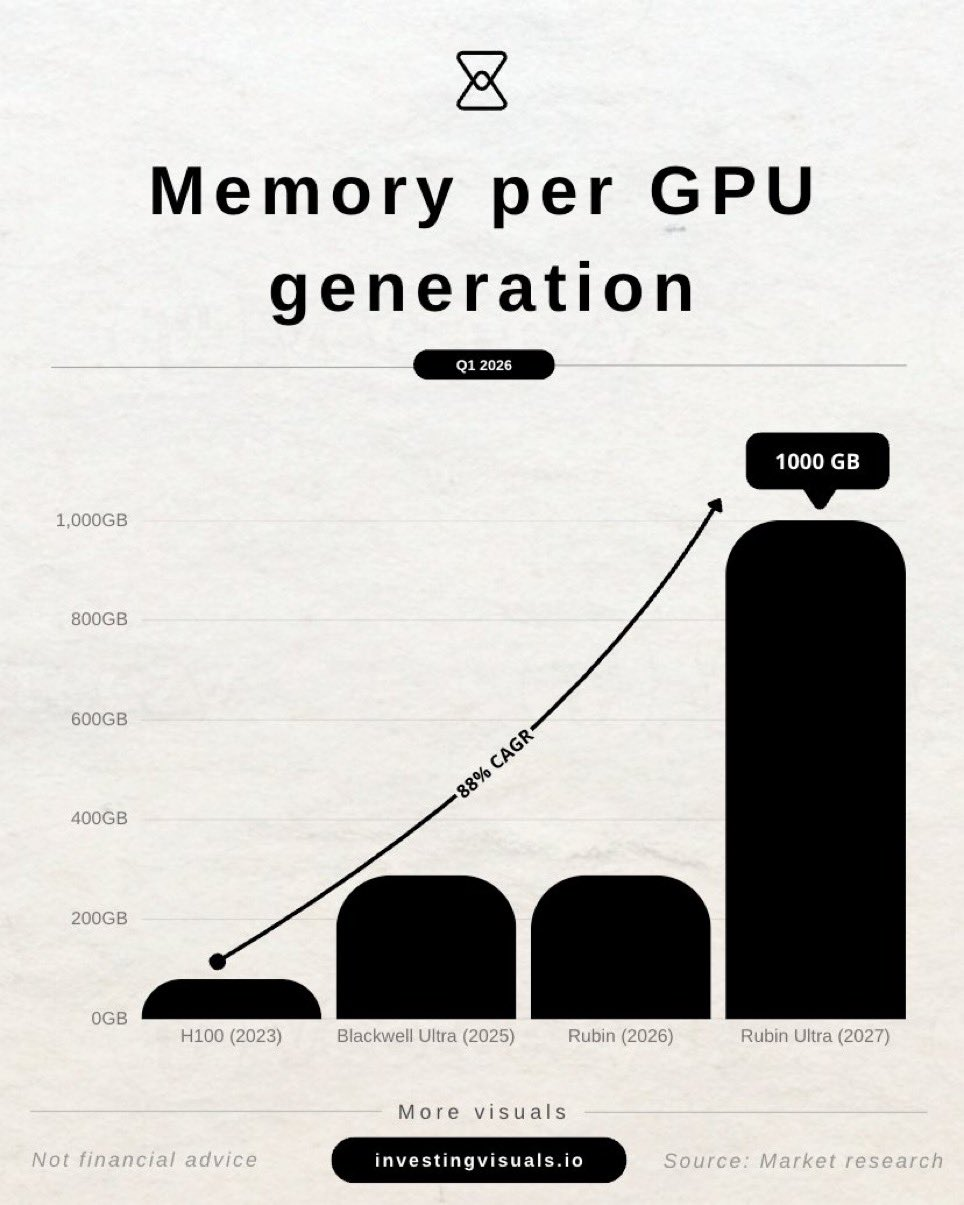
- HBM (High Bandwidth Memory): a specialized, premium form of DRAM. Multiple layers of DRAM stacked vertically and placed physically next to an AI chip to feed it data fast enough that the GPU never has to wait. This is the product that makes SK Hynix such a crucial business in today's memory hungry GPU's. In fact, that hunger will only increase in the years ahead, as you can see in the visual below
2 - An analogy
Think about a highway into a city. The city keeps doubling in size every two years. The roads can only expand so fast and at some point, it does not matter how fast the city's engines are running. The bottleneck is the road feeding them.
In AI computing, HBM is that road.
Modern AI chips, like Nvidia's H100 and the new Vera Rubin series, are extraordinarily fast at computation. But they need to be fed data continuously to stay active. If memory cannot deliver data fast enough, the GPU sits idle. HBM solves this by stacking 12 to 16 layers of DRAM into a vertical tower and placing the whole assembly directly next to the processor on the same chip package.
3 - How durable is demand?
Memory has always been cyclical: Prices go up, companies build capacity, supply catches up, prices collapse. So does this AI cycle has structural characteristics that the prior ones did not?
I think it does. Let me explain:
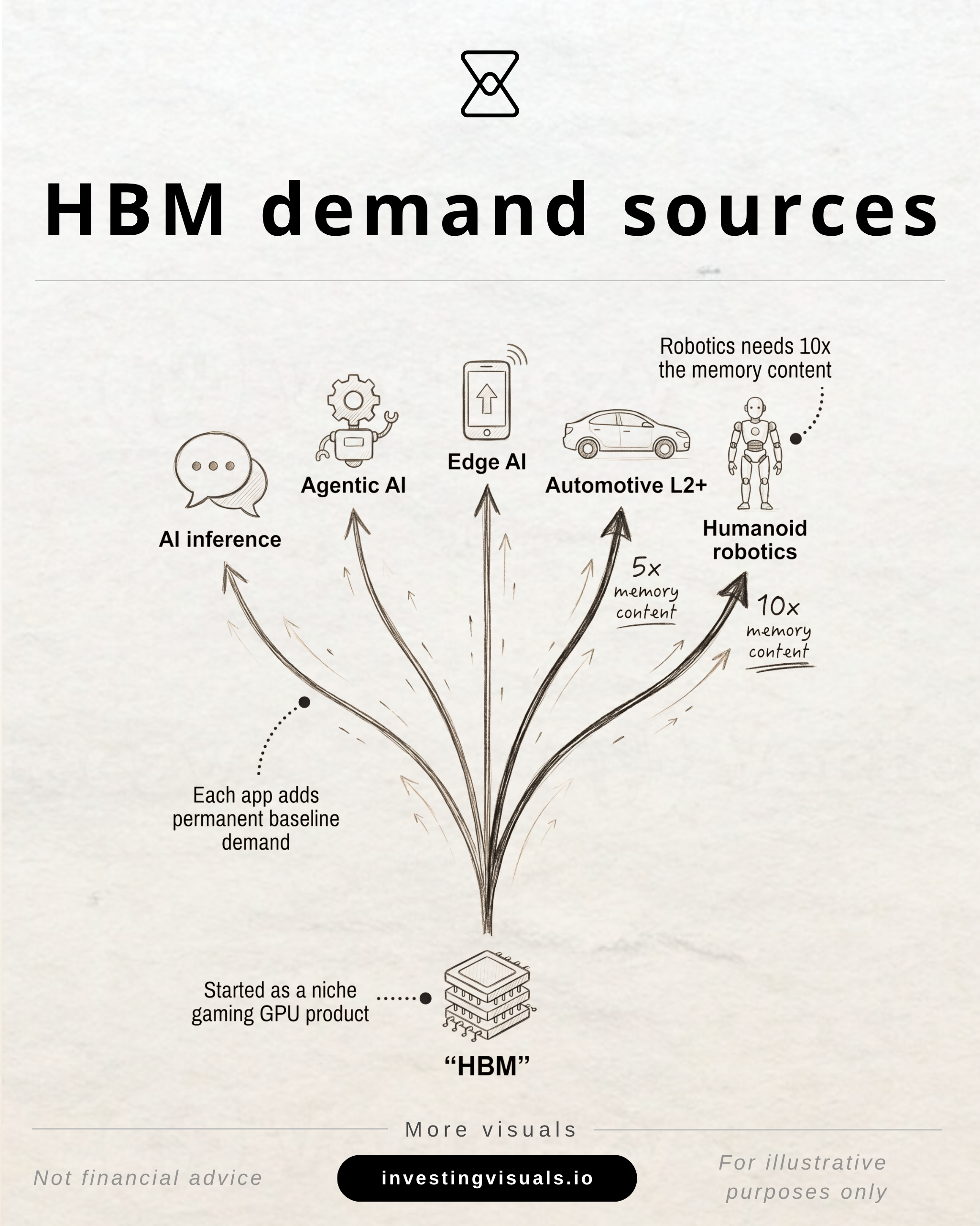
The demand sources are multiplying: HBM started as a niche product for high-end gaming GPUs. Then AI training took over and the demand side is widening:
- AI inference
- Agentic AI (systems that autonomously execute tasks in real time rather than just answering questions)
- Edge AI on devices
- Automotive systems requiring five times the memory versus a standard vehicle
- Humanoid robotics requiring ten times that
Each new application adds a permanent baseline of demand that does not disappear anytime soon.
SK Hynix's own management noted on the Q1 2026 call that as AI shifts from training to inference and toward agentic systems, memory becomes more critical, not less.
The supply cannot scale fast enough to catch up to demand: SK Group Chairman Chey Tae-won said in June 2026 that the global shortage of chip wafers is likely to last until 2030. Doubling wafer capacity, which is now the plan, requires four to five years of construction.
Bottom line: it will take a long time before supply catches up to demand.
4 - Sk Hynix vs Micron
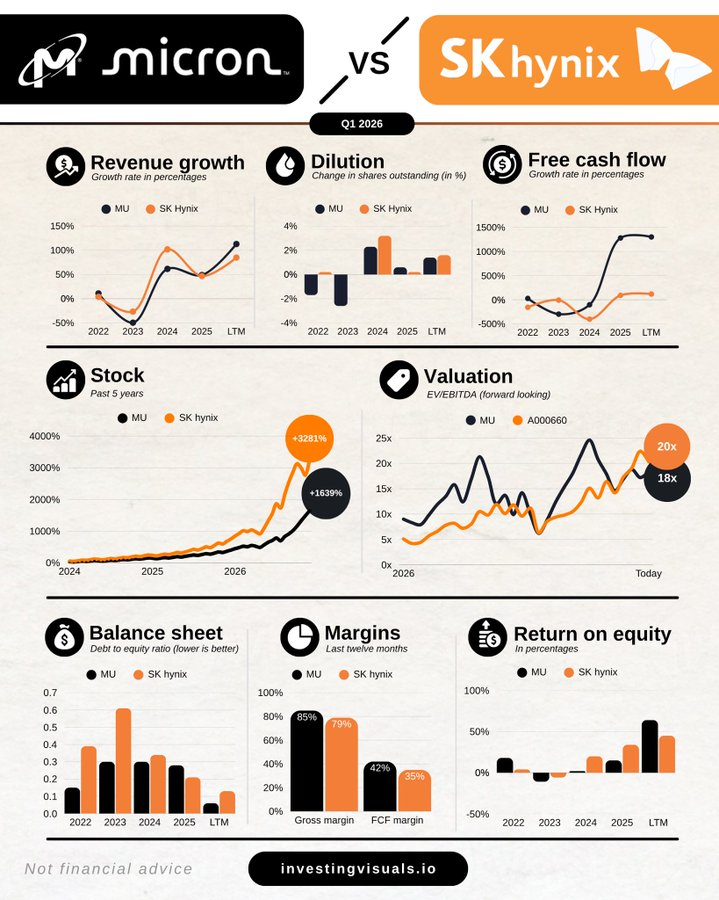
Micron, Samsung and SK Hynix control the HBM memory market with Micron and SK having the largest market share. Here's a side-by-side of Micron vs SK.
Important note: SK will report Q2 earnings on July 23, so these numbers are currently skewed in favor of Micron, which has already reported Q2. SK Hynix fundamentals will likely improve materially across all key metrics in Q2.
5 - One-pager stock analysis
6 - Earnings season incoming!
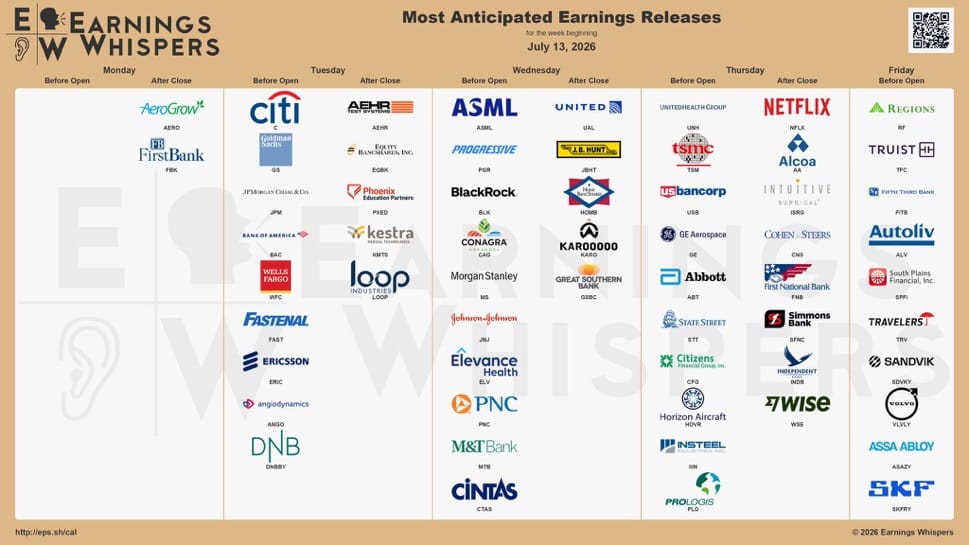
Next week, earnings season kicks off with ASML, TSM and Netflix reporting Q2 earnings. Really looking forward to it and I’ll cover all of them with freshly updated visuals throughout the week. Much more good stuff to come!
And that’s it for this week! Thank you for reading and as always, have a wonderful day!
Enjoy content like this?
Consider subscribing and gain access to all in-depth research, visuals, tech write-ups, my portfolio and our community.
Up and onwards

A weekly newsletter for visual learners to help you invest better

Member discussion