

AMD analysis
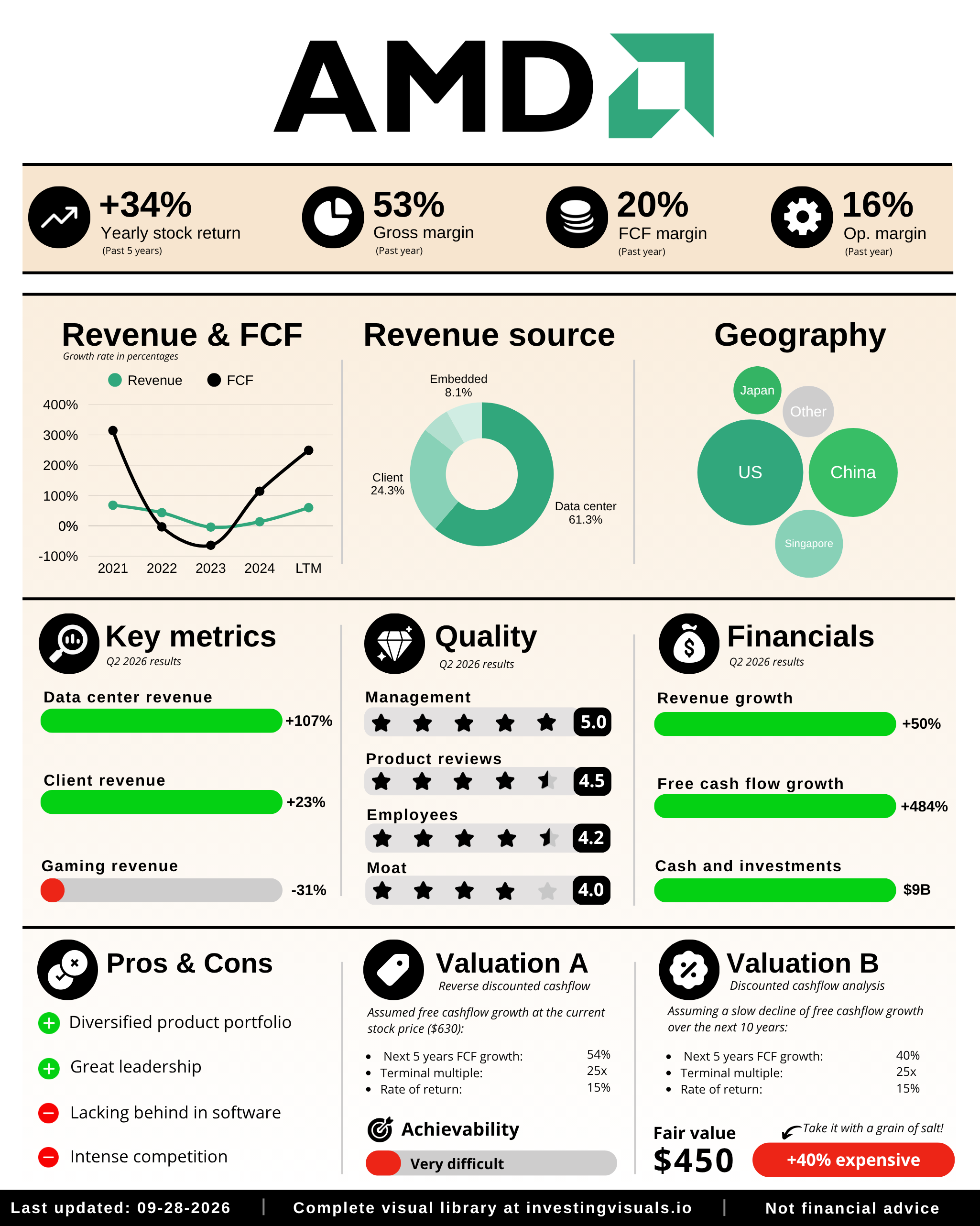
What AMD does
AMD is a semiconductor company that designs chips for computers, data centers, gaming, and embedded systems. It competes in markets ranging from consumer PCs to AI infrastructure. The business is organized around three core segments.
1 - Data Center
- EPYC processors: server CPUs used by cloud providers and enterprises to run workloads in data centers.
- Instinct accelerators: GPUs built for AI training, inference, and high performance computing.
- Radeon PRO V-series: data center graphics for virtualized environments.
- AI network interface cards: hardware that connects servers in AI clusters.
General purpose compute infrastructure: the full stack of chips and platforms AMD sells to hyperscale cloud providers like Microsoft, Google, and Amazon.
2 - Client and Gaming
Ryzen series
- Ryzen processors: CPUs for consumer desktops and laptops, AMD's flagship PC brand.
- Ryzen AI: processors with built in AI acceleration for next generation laptops.
- Ryzen PRO: business grade processors for enterprise PCs.
- Ryzen Threadripper and Threadripper PRO: high core count chips for professional workstations and content creators.
Radeon series
- Radeon graphics: standalone GPUs for gaming and general use.
- Radeon Pro graphics: GPUs for professional creative and engineering workflows.
Other
Semi-custom SoCs: custom designed chips for game consoles and other dedicated devices.
3 - Embedded
- Embedded processors: chips designed for industrial, automotive, networking, and edge computing applications.
- FPGAs: field programmable gate arrays, chips that can be reprogrammed after manufacturing for specific tasks. Sold under brands like Versal, Kintex, Artix, Virtex, and Spartan.
- Adaptive SoCs: programmable chips that combine processing cores with FPGA fabric, used in aerospace, defense, communications, and automotive. Includes the Zynq and Versal product families.
- System on modules: compact, ready to integrate computing boards for embedded applications.
- Vitis and Vivado: software development tools that help engineers program AMD's FPGAs and adaptive SoCs.
Who AMD serves
- Cloud providers: hyperscalers like Microsoft Azure and Amazon AWS that buy server CPUs and AI accelerators at scale.
- OEMs and ODMs: companies like Dell, HP, and Lenovo that build AMD chips into their products.
- System integrators and distributors: firms that assemble and resell AMD based systems.
- Enterprises: businesses that deploy AMD hardware in their own data centers.
Consumers: gamers, creators, and everyday PC users.
In short
AMD designs the processors, GPUs, and programmable chips that power everything from laptops to AI data centers. It makes money by selling silicon to cloud providers, PC makers, console manufacturers, and industrial customers, competing head to head with Intel in CPUs and Nvidia in AI accelerators.
Written by

Subscribe to keep up to date
Subscribe to get regular updates. No spam, unsubscribe anytime.




Member discussion