

members only
Nebius Q2 2026 recap: they could sell out 2027 today, but chose not to
Introduction
Nebius reported Q2 earnings last Wednesday, and it was everything you could have hoped for as an investor. To start, a quote from CEO Arkady Volozh:
"We could sell today our entire 2027 capacity on these terms if we wanted to. We are not doing this. We see that we can achieve higher value by retaining some capacity to serve shorter-term and immediate client needs"
More on this later. Let's start with the numbers and outlook.
1 - Key numbers
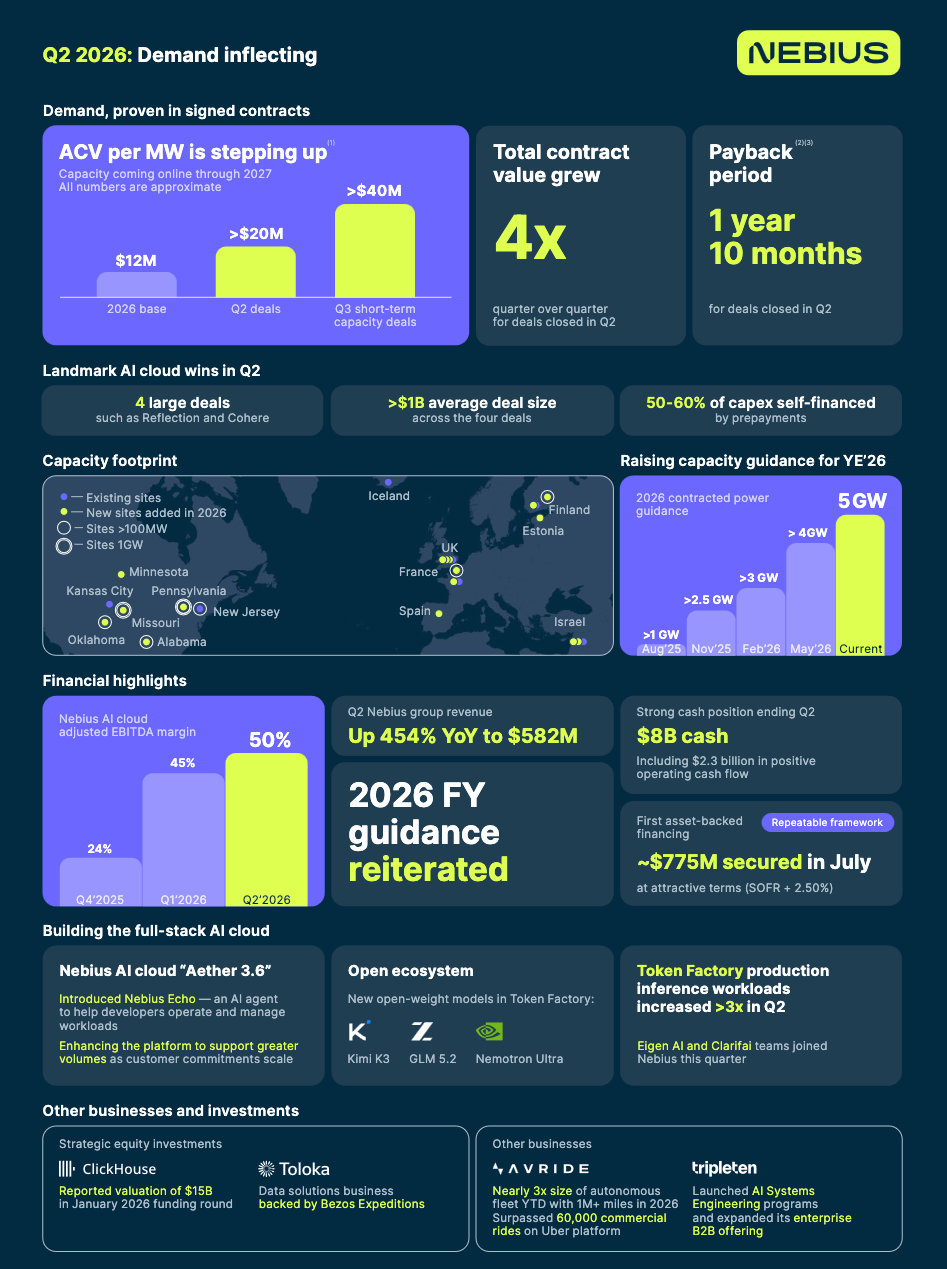
- Group revenue: $582 million, up 454% year over year, up 46% from Q1
- Nebius AI business revenue: $575 million, up 514% year over year, 98% of group revenue
- Annualized run rate revenue: $3 billion, up 598% year over year, up 56% from Q1's $1.9 billion
- Group adjusted EBITDA: $236 million, versus a $21 million loss a year ago
- Group adjusted EBITDA margin: 41%, up from 32% in Q1
- Nebius AI business adjusted EBITDA margin: 50%
- Operating cash flow: $2.3 billion
- Cash and cash equivalents: $8 billion
- Capital expenditures: approximately $5.7 billion
- Contracted backlog: $40 billion
2 - Outlook
- Full year 2026 annualized run rate revenue guidance reaffirmed: $7 to 9 billion
- Full year group revenue guidance reaffirmed: $3 to 3.4 billion
- Full year adjusted EBITDA margin guidance reaffirmed: approximately 40%
- Full year capital expenditures guidance reaffirmed: $20 to 25 billion
- Year end contracted power target raised to 5 GW
- Plans to build more than 1 GW of new capacity annually starting in 2027
CFO Dado Alonso reaffirmed every full year metric this quarter, and paired it with the raised contracted power target. On 2027 specifically, Alonso noted:
"The dynamics we expect across both capacity and pricing make us extremely excited about 2027, although we will provide a formal guidance later this year."
3 - Business highlights
The three tier deal structure
This is the first time Nebius mentions the tier structure for the contracts they close with customers. We can break them down into the following categories:
- Tier 1: mid term contracts of one to three years for the core AI cloud business, yielding $20-25 million per megawatt with upfront payments covering 50 to 60% of associated capex
- Tier 2: short term contracts up to six months priced at a premium in the $40-50 million per megawatt range
- Tier 3: long term contracts with investment grade customers that mainly exist to make financing cheaper and more reliable
I find it mind-blowing that they can charge $40 million to $50 million per megawatt on short-term contracts, roughly 2x the price of mid-term deals. Talk about pricing power.
New deals
Q2 brought four landmark mid term deals, with Reflection, Cohere, a scale US neolab, and a large US quant trading firm, each averaging more than $1 billion. CRO Marc Boroditsky:
"All of these wins were earned wins, not inbound walk ins. We had multiple engagement cycles before closing." One customer's feedback stuck with me: "One of them told us it was quite literally the best POC they have ever had."
Capacity auction
This is Nebius way to outsource price discovery to the market rather than guessing what the market would want to pay for a MW of capacity. Boroditsky:
"In a market where we have several buyers for every GPU, we let the market tell us directly."
The result was that the price they could charge, was 15% above any price Nebius had ever charged, and 20% above their existing Blackwell pipeline. Volozh called it "a strong signal on the value of this capacity in the market in real time."
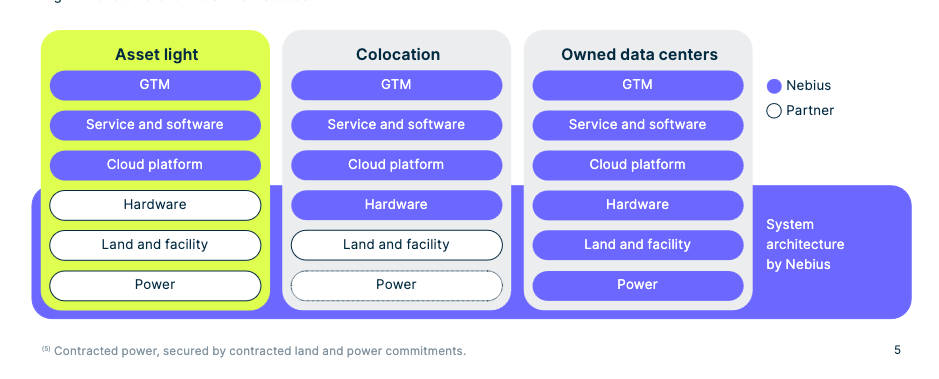
The asset light partnership model
Another interesting dynamic: outside partners finance and build the physical data centers while Nebius brings the platform, the software, and the customer relationships. Volozh: "we are still a startup, and we should be very mindful about where we invest our own capital." I think this is a very sensible way to keep scaling while remaining prudent with capital.
On funding, roughly 70% of Q2 deals included prepayments, contributing to what will be more than $9 billion in upfront customer funding this year. Combined with a $775 million asset backed debt facility secured against contracted cash flows, the company is financing its buildout with customer cash and contract backed debt well before it leans on dilutive equity. I'd love to see that as an investor.
Token factory
Token Factory is Nebius's inference and post-training platform, and management explicitly called it out as a contributor to both revenue and margin.
Co-founder Roman Chernin described Token Factory as the layer that turns raw infrastructure into something developers can actually build production systems on: "We help solve this with our suite of services, including Token Factory for reliable high-performance inference and post-training, and Tavily for grounding."
Chernin on open-source model support: "We see day-zero support for the major open model launches, measurable performance optimization post-launch, and independent benchmarks... continuing to rank us among the leading inference platforms."
"We want to serve customers across the full AI life cycle, from training and post-training to inference and grounding... and we are only getting started."
4 - Management commentary
During the earnings call, there were also a number of interesting exchanges with analysts that I'd like to spend a little more time on.
With analysts asking about new entrants like xAI selling compute at premium prices, Volozh noted: "new players coming to the market don't change the market for us. They actually just, I think, validate the market." His broader argument was about the size of the pie rather than the number of players at the table, pointing to an AI cloud market growing "from hundreds of billions of dollars per year to probably trillions."
"Probably trillions."
I don't see Arkady as the type to hype or overstate anything, which makes this even more impressive and shows how early he thinks we still are.
On financing discipline, an analyst from Wolfe Research asked whether Nebius would lean harder on debt given a more volatile market. Alonso's answer:
"Our approach is to match the right financing instrument with the right asset while remaining disciplined about three things: our cost of capital, minimizing shareholder dilution, and maintaining a strong and healthy balance sheet." He added Nebius currently has "almost no corporate level debt"
Boroditsky's on how they look at their different tier types: "our current emphasis is taking care of existing customers, followed by new logos, and then terms." He also noted they've "tactically shortened how far in advance we sell capacity," selling closer to deployment specifically to capture better pricing while still staying flexible.
On their Vineland location (which was a hot topic of speculation prior to Q2 earning), infrastructure chief Andrey Korolenko shared: "we delivered all the tranches that we were required to deliver under the contract up to date... with no significant impact expected on the project timeline." So in short; everything is on track according to management.
5 - My take
This was an amazing quarter from Nebius. They delivered on every key metric and reaffirmed guidance across the board.
- Contract tiers
- Live auction
- Token Factory
- Asset light business model
I genuinely think they have the potential to become the next hyperscaler: the AI-native, full-stack equivalent of AWS and Azure. And while building towards that, they remain very thoughtful about capital spending. I also think their live auction is an incredibly smart move given the supply constraint. They're managing an abundance of demand carefully so they don't leave money on the table.
One of the hardest parts of this industry is the capital needed to fund the buildout. The fact that the majority of their capex is funded directly by customer prepayments greatly de-risks Nebius's balance sheet and lets them grow at an unprecedented rate without straining it.
Nebius other businesses
It's easy to forget that NBIS also owns Avride and TripleTen, along with a stake in ClickHouse, which was valued at $15 billion as of Q2. Avride nearly tripled its autonomous mileage since 2025, reaching 1 million miles this year, and announced robodelivery launches in more than five new cities. Meanwhile, TripleTen continues to add new offerings, such as its AI systems engineering program. Each and every part of their business is firing on all cylinders.
All in all, I think this was one of Nebius's strongest quarters to date, and everything you might have hoped for as an investor and then some.
What I am watching next:
- Whether the asset light partnership model actually converts into new signed capacity deals
- 2027 formal guidance, expected later this year, and whether it remains in-line with current assumptions and outlook
- Contracted power progress toward the 5 GW year end target, and whether it converts to revenue on schedule
- Corporate level debt usage and the ATM program, since Nebius has not touched this lever yet
And that concludes the Q2 earnings recap. I hope you found it helpful!
As always, none of this is financial advice. This is simply my breakdown of the quarter and my thoughts on it. Always do your own due diligence before making an investment decision that fits your risk tolerance and time horizon.
Written by

Subscribe to keep up to date
Subscribe to get regular updates. No spam, unsubscribe anytime.



Member discussion