

Premium and Supporter tiers
I've been investing since 2016 and it's been an amazing ride so far. Some facts and figures over the years:
- I've held a total of 59 positions
- I currently have 12 positions, including cash
- I've had my portfolio drop over 30% five times
- My largest portfolio drawdown was 51% (2022)
- My compounding annual growth rate (CAGR) is 17% since 2019
- My CAGR over the past 3 years is 46%
Throughout the years, my portfolio has evolved significantly as I learned, improved, and got to know myself as an investor. It has been a bumpy ride, but I would not have missed any of it. The highs, the lows, especially the lows, were incredibly valuable and are the foundation of the investor I am today.
2016: How I started
I started my first job in tech as a software tester back in 2015. It was the first time I had some money to spare and because interest rates were very low, I decided to start investing. I had no clue where to start. I did not learn anything about investing in school, which I believe is a major flaw, and neither my parents nor close friends did anything with it.
So I started listening to podcasts, reading books, watching a lot of YouTube and at some point I began by putting about $100 per month into a managed fund.
My investment journey had officially begun!
2018: From funds to ETFs
After investing in managed funds for about two years, I realized there were quite some hidden costs. Some charged a 1% to 1.5% fee, which in the long term really adds up.
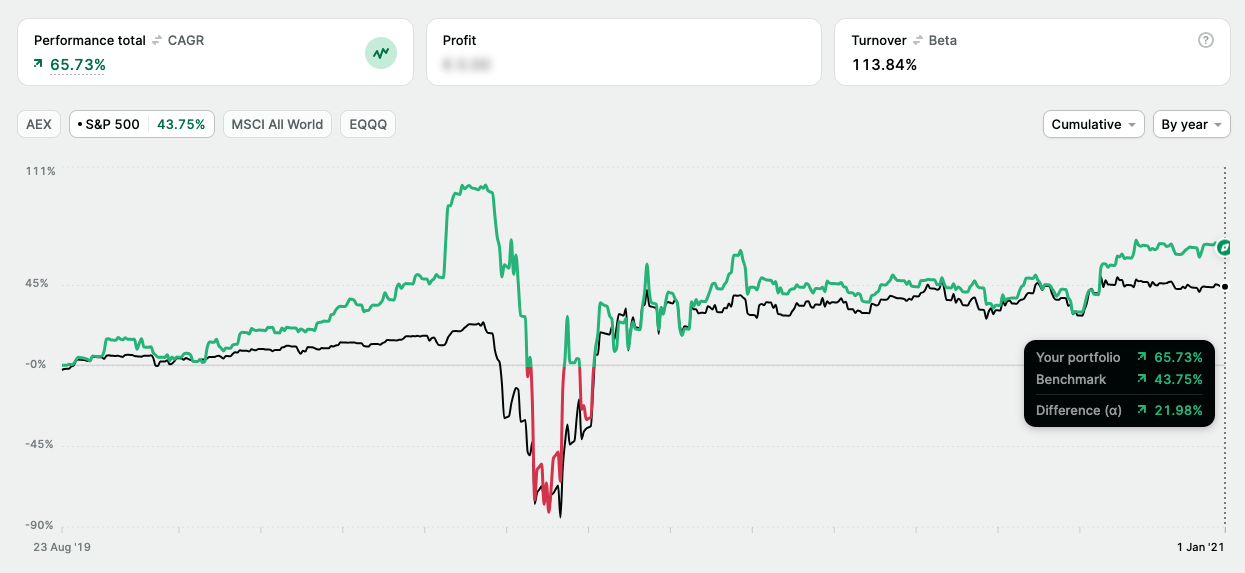
So I figured: why not do it myself? At this point I started to look into ETFs such as the MSCI All World. In August 2019, I started tracking my portfolio and bought my very first stock: Tesla.
Tesla will always have a special place in my investor’s heart. Not just because it was my first stock, it was also my first multibagger and my biggest mistake by selling too early. I sold after a roughly 400% gain thinking I was a genius, only for the stock to become a 25 bagger in the years after. I learned a valuable lesson there.
Throughout 2019 and 2020, the majority of my portfolio was still in ETFs. And then COVID came. My very first market crash. I remember how I went through an emotional roller coaster back then. Bewilderment, fear, denial, thoughts like “when will this end” and at some point a kind of calmness: “it is what it is, I'll just ride it out”.
It was at this point that I closed my managed funds and shifted to ETFs and multiple individual positions.
2021: Learning to pick stocks
Throughout 2021 and 2022, I started to learn more about picking stocks and how to do fundamental research. But I did not really have a specific focus, so I bought all sorts of businesses, often because others did as well. Biotech, China stocks, airlines, insurance businesses and what not.
In hindsight, I paid a lot of learning money by picking businesses I did not truly understand and did not have a real interest in in the first place. This continued throughout 2022 where at some point my portfolio reached 24 positions. It was hard to keep up with all of them and if I am being honest, my conviction in them was alright but not through the roof.
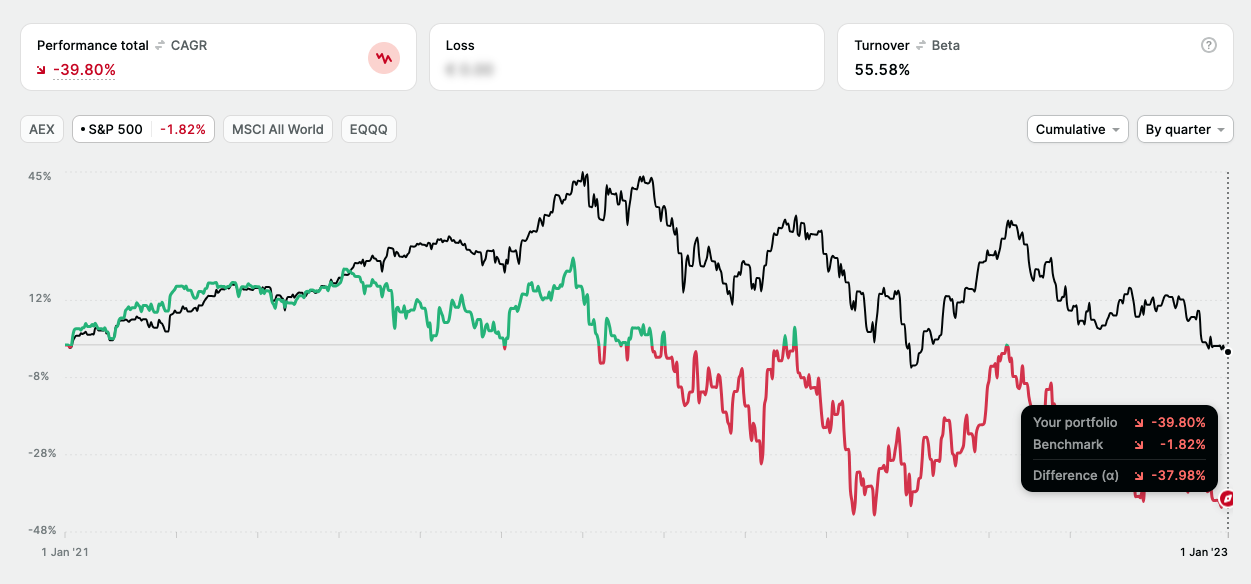
Then there was the 2022 bear market. The S&P 500 had its worst start of the year since 1970, the Nasdaq crashed over 35%, and inflation was out of control. My second market crash in less than two years.
As the year progressed, I saw all my stocks crash and burn. Goodbye returns I had made since the COVID crash. But if I learned anything from that period: this too shall pass. So I kept my course, continued to learn more about how to fundamentally evaluate a business and gradually got better at it.
I learned how to read balance sheets and income statements, but also how to assess business potential, runway for growth, competitive advantages and the overall quality of a business. Having an MBA really helped me in that process, because I already had practical and theoretical knowledge about how businesses operate and become successful.
If you're interested, you can read more about my background here.
2023 until today: Focus
Then came 2023 and due to personal reasons, I had to sell 40% of the portfolio I had built up until that point. At the near worst moment possible, right as the market started to recover from the 2022 bear market.
I never thought I would have to do something like that, because one of my golden rules was, and still is, “invest with money I do not need”. But life happened and I had to make some difficult choices. Because I had to sell 40% of my positions, I gave it a lot of thought which ones to keep, trim, or close entirely.
This really was a turning point for me personally and as an investor. I had to separate the wheat from the chaff and be very critical about every position. It forced me to focus and as a result, I reduced my number of positions from 20 to 14, including cash.
It also got me thinking about what my edge really was and how to use it in the best way I could. That is where my focus on tech really started. I threw out all businesses that did not fit in my tech basket and started with a renewed focus and a downsized portfolio.
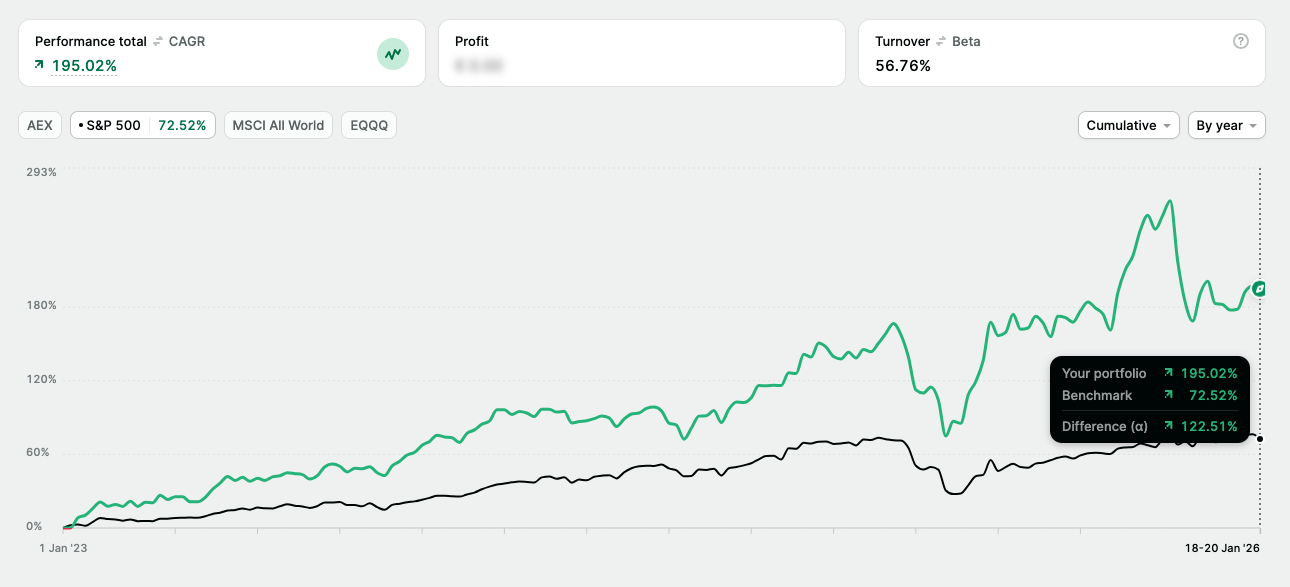
In 2024 and 2025, I kept improving my investment framework, learned how to analyze tech businesses and steadily moved toward an increasingly concentrated portfolio. As of today, I hold 12 positions including cash, down from 14 back in 2023 when I started my tech portfolio.
Finding your edge
Before wrapping up my investment journey, I would like to highlight the importance of finding your edge as an investor. Knowing this will truly make you a better investor.
But first of all: what exactly is an investment edge? Simply put, it is a specific reason you expect to do better than the average investor over time. It is a repeatable advantage in how you find ideas, value them, size them, and hold them.
It can stem from:
- Better understanding
- A better process
- A longer time horizon
- Better behavior
As I progressed throughout my investment journey, I realized I was not really focused on any kind of edge. To be honest, I did not even know what it was. Once I understood the concept, I started to build my personal edge.
Better understanding
It started with my experience in tech, the sector I have been working in since 2015. I realized I was not using my experience in the sector to guide my investment decisions. Which was pretty crazy, because I could see trends unfold before they reached the masses, I knew what made tech businesses tick and I could distinguish quality from mediocrity.
In short: working in tech helps me truly understand the industry and the dynamics at work.
On top of that, I am a tech nerd who loves to learn more about it as I go. Today, I am fully using my edge in tech to pick the best businesses and position my portfolio to benefit from important tech trends.
Better process
When I moved from ETFs to individual stocks in 2021, I honestly had no idea what I was doing. As I shared before, I bought insurance businesses, biotechs, airline businesses and more.
I was not doing fundamental research. I was basically copy pasting others. Over time, I learned what it meant to truly understand a business. I gradually built a tech focused investment framework to select the best businesses out there.
The powerful thing about a strong investment framework is that it helps me skew the odds in my favor. The investable universe is massive, yet only a few businesses significantly outperform the market. My framework helps me separate the great from the mediocre and has helped me buy multibaggers like Axon, CrowdStrike, Cloudflare, and Nebius.
I still make mistakes, but they are becoming less frequent and less costly. As I refine my framework, and continue to do so, my picks become better, my knowledge compounds and so do my positions.
A longer time horizon
This one is often overlooked but has rarely been as relevant as it is today. The average holding period for US stocks dropped from 8 years in 1960 to about 5.5 months in 2020.
Today’s market incentivizes investors to trade in and out of positions a lot, gamifying the stock market to pump volume and drive emotion based behavior. But results do not show up in months. They often take years.
A company can remain undervalued for a long time before the market recognizes its potential and it can compound far longer than the market might forecast. Think of NVIDIA. Patience is an investor’s biggest virtue in today’s fast paced markets.
Most mistakes stem from selling a position early instead of holding it too long. I can tell from experience with my Tesla position.
Better behavior
As you can see from my portfolio performance over time, it has not been smooth sailing whatsoever. I have seen my portfolio drop over 30% five times, for example during the COVID crash, the 2022 bear market and more recently the tariffs bust. On top of that, I was forced to sell about 40% of my portfolio and rebuild from there.
Those experiences make me humble and proud at the same time. I have weathered many storms and despite the drawdowns, my portfolio has compounded at a 17% CAGR over the past 6 years, which includes all the costly mistakes I made between 2019 and 2022.
In the years after, my CAGR improved dramatically. In part due to the bull market that followed 2022, but also as a result of better understanding, better behavior, a better process and a longer time horizon, resulting in a 42% CAGR over the past 3 years.
It is the result of hard work, a long term focus, trusting my process and continuous learning.
Final remarks
Wherever you are in your investment journey, know this: every step matters, and experiencing it firsthand is the best teacher. Looking back, I’m grateful for all of mine. Each either brought me success or taught me a valuable lesson and often both.
Thanks for reading and feel free to ask me anything!
As always, none of this is financial advice. This is simply me sharing my portfolio journey and experiences as an investor. Always do your own due diligence before making an investment decision that fits your own risk tolerance and time horizon.
Written by

Sign-up
And receive the latest visuals and articles straight to your inbox



Member discussion