
Premium and Supporter tiers
My investment framework: how I select winners
My 9 step framework I use to separate great businesses from the rest and stack the odds of finding multibaggers in my favor.

When I first started picking stocks back in 2019, I had no process at all to determine the quality of a business. Over time, I built a framework that allowed me to filter out the best and leave the rest. Having an investment framework like that helps to skew the odds of a successful investment in your favor. Over the years, it helped me pick many multibaggers. Some of these include:
- Cloudflare +581%
- Axon +504%
- Nebius +341%
- Crowdstrike +311%
💡
A multibagger is a stock that generates >100% returns on its initial cost.
Introduction
In this deep dive, I will break down the 9 steps of my investment framework that I’ve built over the years and still continue to refine. Overall, I can break down my process into two categories: the numbers and the story. The golden zone is when both reinforce each other. The numbers are focused on revenue growth, free cash flow growth, margins, balance sheet, key metrics, valuation, etc.
The story is focused on where the business could go in the future, driven by their mission, culture, industry positioning, moat, leadership team, customer happiness, expansion into adjacent markets, and so forth.
I’ll address each of them in the same order I’d like to analyze a business when I know nothing about it, which I’ve visualized below.
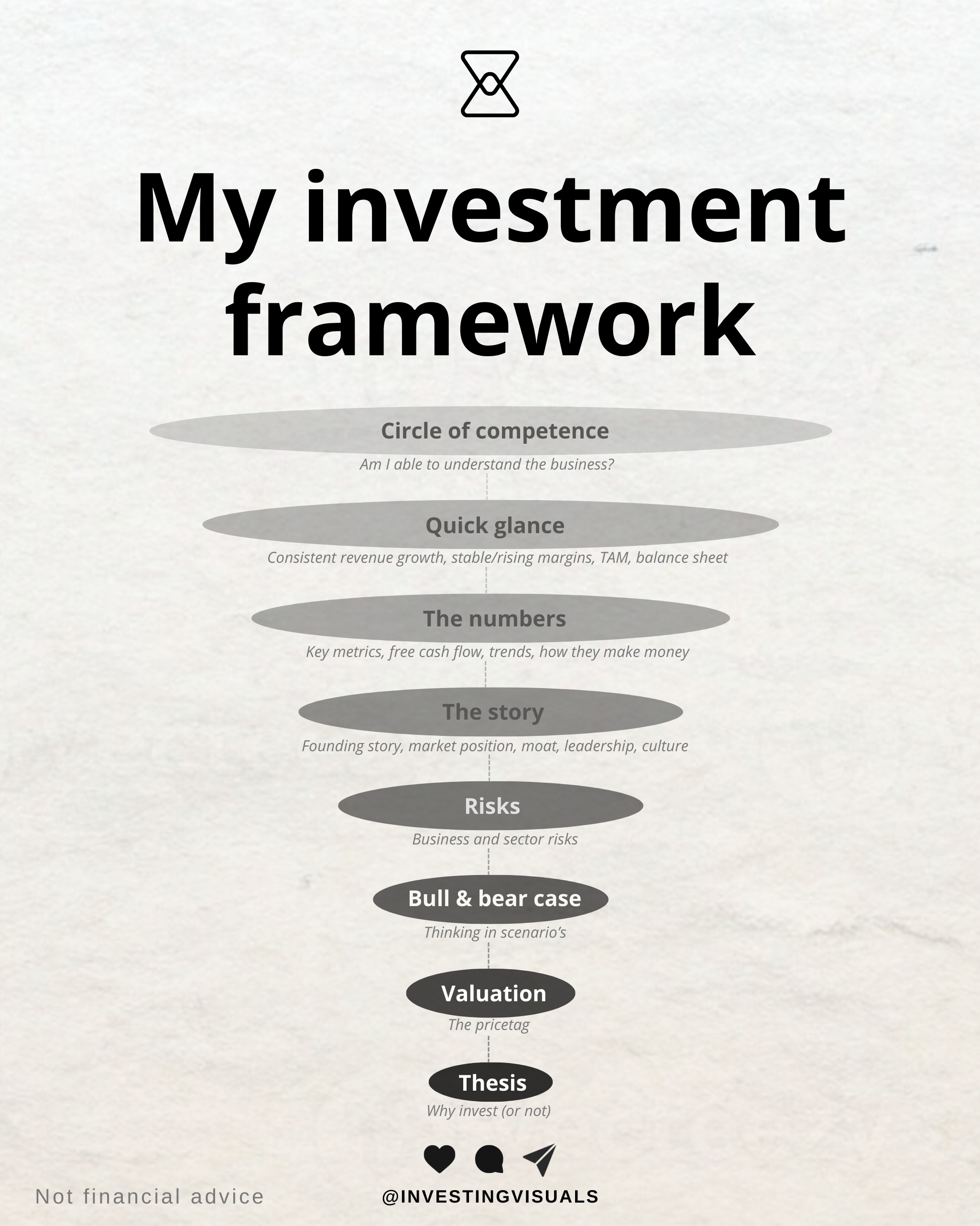
1 – Circle of competence
The first thing I ask myself is: "am I able to really understand this business?" If not, it directly goes into the “too hard” pile. That’s true for insurance businesses and banks, for example.
The next question I ask myself (I have a lot of internal conversations with myself) is: “Does the business interest me enough to keep tracking it?” If not, I’ll put it aside.
This is where the majority of businesses are already filtered out because my investable universe is solely focused on tech. When it does pass my circle of competence checks, I move on to the next step.
2 – Quick Glance
In this stage, I basically run a quick checklist:
- Is there consistent revenue growth → shows if there is sustainable demand
- Are margins stable or rising → signals a strong competitive position
- Are they free cash flow positive → can they scale profitably
- Is there a large and growing total addressable market → signals a long runway for growth
- Do they have a healthy balance sheet → can they weather a storm and come out on top
I treat this as a guide and not as hard knockout criteria. For example, I also invest in businesses that are not yet free cash flow positive, but where I do see a clear path to becoming free cash flow positive. There’s always some nuance to take into account.
The sections below go into much more detail on how I apply this framework in practice, including how I interpret data, assess risk, think about valuation, and track positions over time.
Parts of this framework were previously shared with paying members. To respect that support, the practical application and more detailed sections are available to subscribers.
3 – Deep dive: the numbers
This is where the real research begins, where I read quarterly reports, news articles, annual reports, research papers and use tools like TIKR and Fiscal to deep dive into the numbers. Things I look for:
This post is only for subscribers on the
Premium and Supporter tiers
Subscribe to continue reading
Written by