

ASML analysis
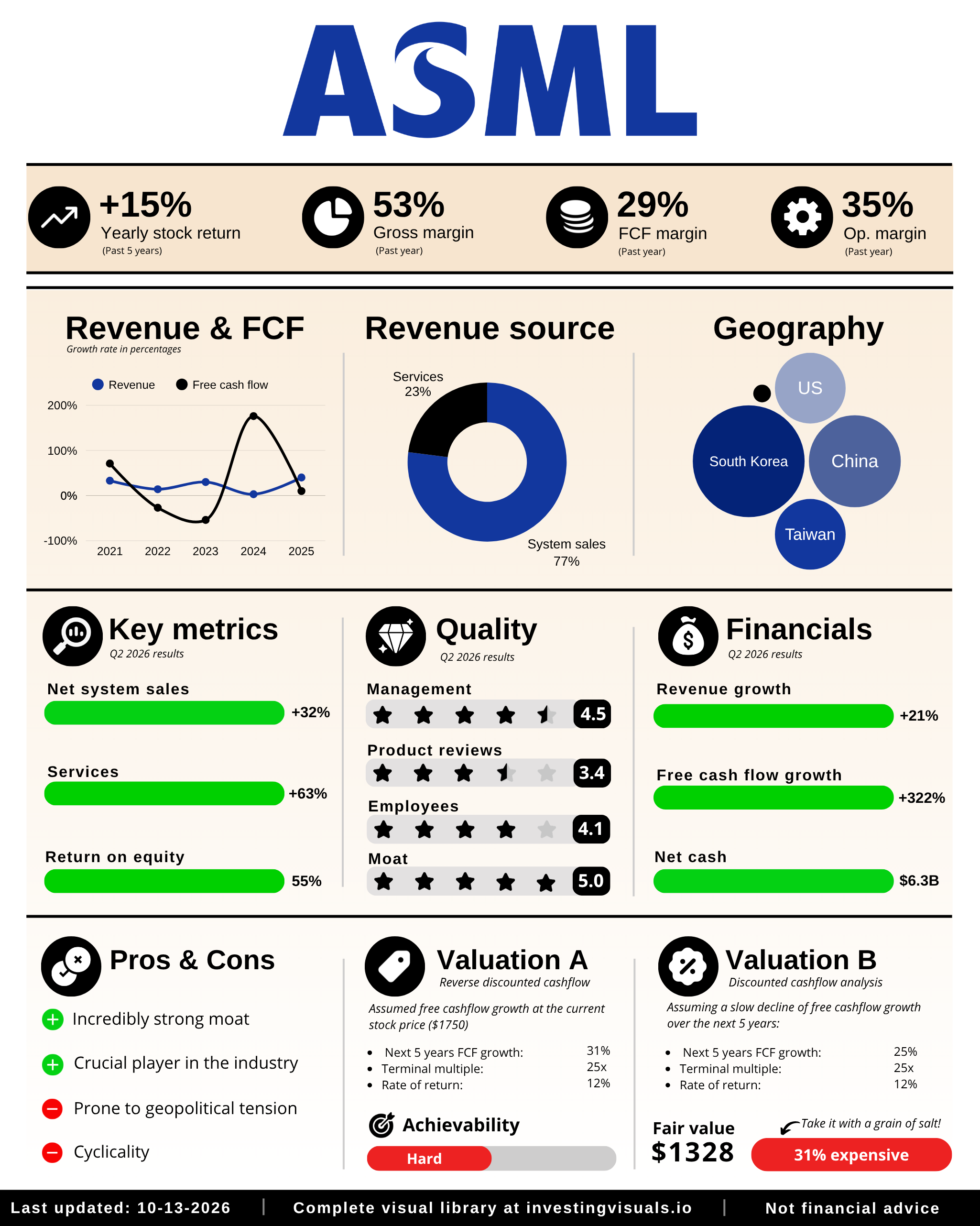
At today’s price, ASML already has a lot of growth priced in. Based on my reverse discounted cash flow analysis, the company would need to grow free cash flow by 31% annually over the next five years just to justify the current share price. That’s a tall order, even after management raised its revenue outlook.
Consensus estimates point to revenue growth of roughly 22% to 25% over the next three years. If free cash flow margins stay flat, 25% free cash flow growth seems reasonable given sustained growth due to the AI buildout. This assumption sits at the high end of current estimates, which is why I consider $1,328 a reasonable price.
What ASML does
ASML is a semiconductor equipment company that builds the machines chipmakers use to print circuit patterns onto silicon wafers. In simple terms, it provides the tools that make modern chips possible, especially the most advanced ones. The business is centered on lithography systems, supported by metrology, inspection, software, upgrades, and service.
1 - EUV lithography
- EUV systems: ASML's most advanced lithography machines, using extreme ultraviolet light to print the smallest and most complex chip features.
- High NA EUV: the next step in EUV, designed to push chip manufacturing to even smaller geometries with better precision.
This is the crown jewel of the business. EUV is essential for producing leading edge chips used in high performance computing, AI accelerators, advanced smartphones, and cutting edge servers. ASML is the only company in the world that can manufacture EUV systems at scale, which makes this one of the most important businesses in the entire semiconductor value chain.
2 - DUV lithography
- Immersion DUV systems: deep ultraviolet machines used for advanced and mature chip production, often for layers that do not require EUV.
- Dry DUV systems: lower complexity lithography tools used in mature nodes and specialty semiconductor applications.
While EUV is very exciting, DUV still matters enormously. It is used across a very wide range of chips, including automotive, industrial, analog, sensors, and many memory applications. Even advanced chips often require both EUV and DUV across different manufacturing steps, so DUV remains a large and durable part of ASML's earnings base.
3 - Metrology and inspection
- YieldStar: optical metrology systems that measure wafer patterns and help customers check whether chips are being printed correctly.
- HMI e beam systems: electron beam inspection tools used to find and analyze tiny defects on wafers.
Making a chip is a bit like printing a newspaper at atomic scale. It is not enough to print quickly. You also need to catch mistakes early. These tools help customers improve yield, which means a higher percentage of usable chips per wafer. That matters because tiny process improvements can be worth a fortune in advanced manufacturing.
4 - Software and computational lithography
- Computational lithography: software that helps customers model and optimize how patterns will print on wafers before production.
- Control software: tools that improve machine performance, alignment, overlay, and process consistency.
As chip features shrink, software becomes more valuable. At these scales, physics gets messy. Light behaves imperfectly, materials vary, and tiny errors compound. ASML's software helps customers squeeze better output from each machine, which makes the hardware more productive and the customer relationship more sticky.
5 - Installed base management and service
- Upgrades and refurbishments: improvements to older systems that extend their useful life or raise performance.
- Maintenance and support: ongoing service contracts, spare parts, and technical support for customers running ASML tools in production.
- Installed base management: services tied to the large global fleet of ASML systems already deployed in fabs.
This is about 25% of ASML's revenue. Once a machine is inside a fab, it tends to stay there for years and needs constant support. That creates a recurring revenue stream with attractive economics. It also makes ASML more resilient because revenue does not rely only on selling new tools each year.
Who it serves
- Leading edge chipmakers: companies like TSMC, Samsung, and Intel that need EUV to produce the most advanced logic chips.
- Memory manufacturers: companies making DRAM and NAND that use ASML systems across multiple process steps.
- Mature node manufacturers: fabs producing chips for cars, industrial equipment, communications, and consumer electronics.
In short
ASML sits at one of the most critical points in the semiconductor industry. It makes money by selling and servicing the lithography machines that chipmakers cannot do without, and its near monopoly in EUV gives it a uniquely important role in the long term buildout of AI, advanced computing, and the global semiconductor supply chain.
Written by

Subscribe to keep up to date
Subscribe to get regular updates. No spam, unsubscribe anytime.



Member discussion