
members only
AI: it's about survival
The bigger picture as to why I believe hyperscalers are spending hundreds of billions on AI.

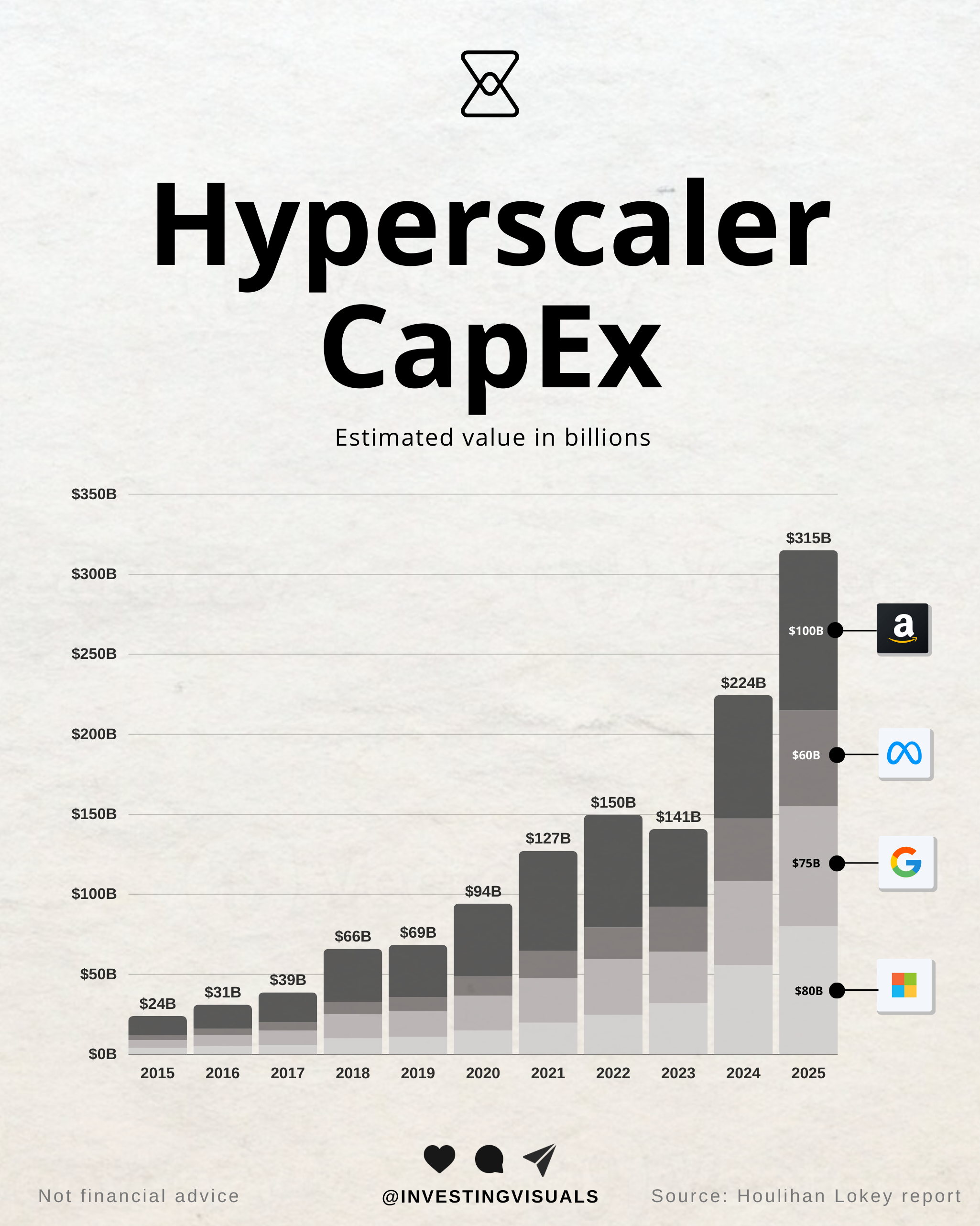
In 2025, the MAG7 Captital Expenditure (CapEx) is estimated to reach $315 billion. Most of it is related to the AI infrastructure build-out, with the market questioning if these enormous investments will actually pay off.
While that's a fair question, it misses the bigger picture. These investments are not just about near term return on investment (ROI). They are about surviving a paradigm shift and staying relevant and competitive over the long term.
AI is spreading faster than any technology I’ve ever seen in my 10 years in tech. I've seen cloud, blockchain, RPA and many other trends over the past years, but none them have spread as fast as AI has done so far.
It’s showing up in every industry, slipping into everyday workflows, and becoming a default layer across devices. Hundreds of millions of people already use tools like ChatGPT and Gemini every week, and honestly, it still feels early. General models improve at breakneck speed and I believe we’ve barely scratched the surface of what this can turn into.
In today’s tech driven world, businesses face a simple choice. Adapt or slowly fade into irrelevance. Most executives would rather overspend and stay ahead of the herd than wake up in a world that has moved on without them. The biggest fear is not just losing money. It is losing relevance.
So what exactly are they afraid of missing? Just look at what sector leaders are saying.
Andy Jassy (Amazon CEO)
“We happen to believe that virtually every customer experience will be reinvented using AI.”
Satya Nadella (Microsoft CEO)
“Cloud and AI are the essential inputs for every business to expand output, reduce costs, and accelerate growth.”
Bill McDermott (ServiceNow CEO)
“This is a breakthrough innovation elixir unlike anything we’ve ever seen in human history. People and AI together will create new businesses, new discoveries, and catalyze economic growth in every corner of the world.”
The best businesses focus on long term value creation, not just squeezing out next quarter’s profit. That is exactly how I see the hyperscalers today. They are willing to sacrifice short term margins to secure an edge for the next decade.
Mark Zuckerberg put it very clearly:
“If we end up misspending a couple of hundred billion dollars, I think that that is going to be very unfortunate, obviously. …but what I’d say is I actually think the risk is higher on the other side.”
Will they overspend? Maybe. It depends on how demand evolves. Right now, demand is as high as it gets. The real question is what happens next. This is where the Jevons Paradox comes in. When something becomes cheaper or more efficient, people do not use less of it. They use far more.
This is exactly what we are seeing with AI. Infrastructure keeps getting more efficient as chips, data center designs and power grids improve. The cost of intelligence is collapsing. Three years ago when ChatGPT launched, a million tokens of AI inference cost around $60. Today it is about six cents. That is a 99.9% cost decline.
When something this powerful becomes this cheap, it does not stay in the hands of a few players. It spreads through the entire economy. As AI becomes cheaper to run, demand will likely keep accelerating and the technology will continue to spread across every industry and workflow.
As someone working in the tech sector, I genuinely feel we are still early. I have never seen a technology scale this fast with so much runway ahead. New use cases keep appearing as the models become more capable.
At the same time, AI is not the flawless holy grail some people make it out to be. Research shows that while most AI generated content is factual, a meaningful share is not. The problem is that models often sound correct even when they are confidently wrong (I.e. 'hallucinating').
Even when you correct them with verified facts, they can fall back into the same mistakes. Hallucinations and AI's training on the wrong outputs of other AI's can create a feedback loop that degrades quality over time. This shows up in most mainstream models, whether it is OpenAI’s GPT, Anthropic’s Claude or Google’s Gemini.
The key difference is between these broad, general purpose models and more specialized models that are trained for very specific tasks. Those purpose built models tend to hallucinate much less and produce far higher quality output.
That is where I think the real value lies. The 99.9% cost collapse does not just mean we can run more chatbots. It means we can afford to run specialized agents for almost every niche you can think of. We are moving away from the era of the "general know it all bot" and into a world of cheap, highly specialized, industrial grade intelligence.
To summarize
In my view, the AI heavy CapEx is less about near term ROI but about staying relevant as every customer experience gets rewritten with AI. The hyperscalers are spending to make sure they are on the right side of that shift. The real risk is being left behind and loosing relevance instead of overspending.
Thanks for reading and I hope you found this write-up insightful. I'm curious to hear your thoughts on this and feel free to ask my any question you'd like!
Written by

Sign-up
And receive the latest visuals and articles straight to your inbox



Member discussion