
members only
AI and the future of software: who wins and who’s at risk?
Software is declared dead once again, and the market is selling the whole sector indiscriminately. In this write up, I’ll share the nuances the market is missing, which software businesses can benefit from AI, and which ones I believe are most at risk.

Introduction
Recently, software stocks are being pushed lower and lower into a drawdown I haven’t seen in a long time. Confidence in the sector feels near an all time low, with the market selling first and asking questions later.
The 'old' software story used to be quite straightforward: SaaS businesses lose money early to scale fast. Then flip the switch when operating leverage kicks in and become a predictable cash flow machine as they scale.
Today, the market is questioning whether some of these businesses will even exist 5-10 years from now. AI agents 1 and vibe coding are the two big threats being cited. The bear case: if AI agents take over the “user”, the seat based model gets pressured, retention could follow and SaaS businesses are no longer predictable cash flow machines.
💡
1 An AI agent is a system that takes a goal, breaks it into steps, uses tools to do the work, learns from the results, and keeps iterating until the task is done.
I’ve been investing in software businesses for many years, and in this write up, which is a follow up to this piece I wrote some time ago, I’ll lay out what I think is actually happening and how I’m segmenting software into likely winners and the ones that might genuinely be at risk.
1 - Why software stocks sold off
The spark that ignited the fire was Anthropic’s new AI agent, designed to handle complex workflows that many software and data providers sell as core products. It quickly shifted the market narrative from “coming someday” to “it’s here today.”

In the blink of an eye, it flipped the framing from “AI is a tailwind for software” to “AI is a headwind.”
I think there’s a lot more nuance than that though. But the reality is the market is baking in higher disruption risk right now. That part is fair. The future of software is more uncertain than it was 2 years ago, and higher uncertainty should translate into lower multiples.
The key point: not all software is created equal.
Before diving into that, let’s look at what some tech leaders are actually saying about software and AI.
2 - What tech CEOs are saying
On the Alphabet call, Sundar Pichai was asked directly about SaaS and what this moment means. He noted that the best SaaS companies are “incorporating Gemini deeply in critical workflows (…)” and added, “I think it is an enabling tool.”
Jensen Huang, CEO of NVIDIA stated something similar:
There's this notion that the tool in the software industry is in decline, and will be replaced by AI ... It is the most illogical thing in the world, and time will prove itself.
An analogy
Think of an AI agent like a foreman on a construction site.
You don’t need to swing the hammer yourself anymore. You tell the foreman what you want built, and they coordinate the work. But the foreman still needs tools and specialists to get anything real done. A hammer for nails. A drill for screws. A saw for cuts. A level to make sure it’s straight.
“But couldn’t you replace the hammer entirely?”
Well, sometimes you can. If the job changes, the toolset changes too. It's like replacing the hammer with nail guns, staplers and screw guns. But my point is: you still need tools.
In short
The dynamics in the software space are changing. The way software is build is changing, the seat based model is under pressure and the value proposition of SaaS businesses has to evolve.
3 - What this means for software businesses
I believe today's reality forces every management team to answer two questions:
- When the interface changes, do you still own the workflow? In a world where AI agents increasingly become the front end, the value moves away from “my UI is nicer” toward “my system is trusted, integrated, reliable and governs the actions."
Those who sit in the middle of the workflow, can benefit (a lot). Businesses that can be routed around, are much more exposed.
- Can you price AI without sacrificing your margins to compute: This is an under discussed part in my opinion. Many teams are adding AI features faster than they are redesigning pricing.
In the short term, that can create margin pressure even for the winners, simply because usage explodes before monetization catches up. This is in part why I think it takes longer for AI benefits to show up in actual results. Scaling takes time, and companies don’t overhaul pricing overnight.
4 - Breaking down the software segments
Software is currently slumped into one generic bucket. The truth is that the software industry is much more nuanced. To fully understand the impact of AI, you have to understand the different flavors of software.
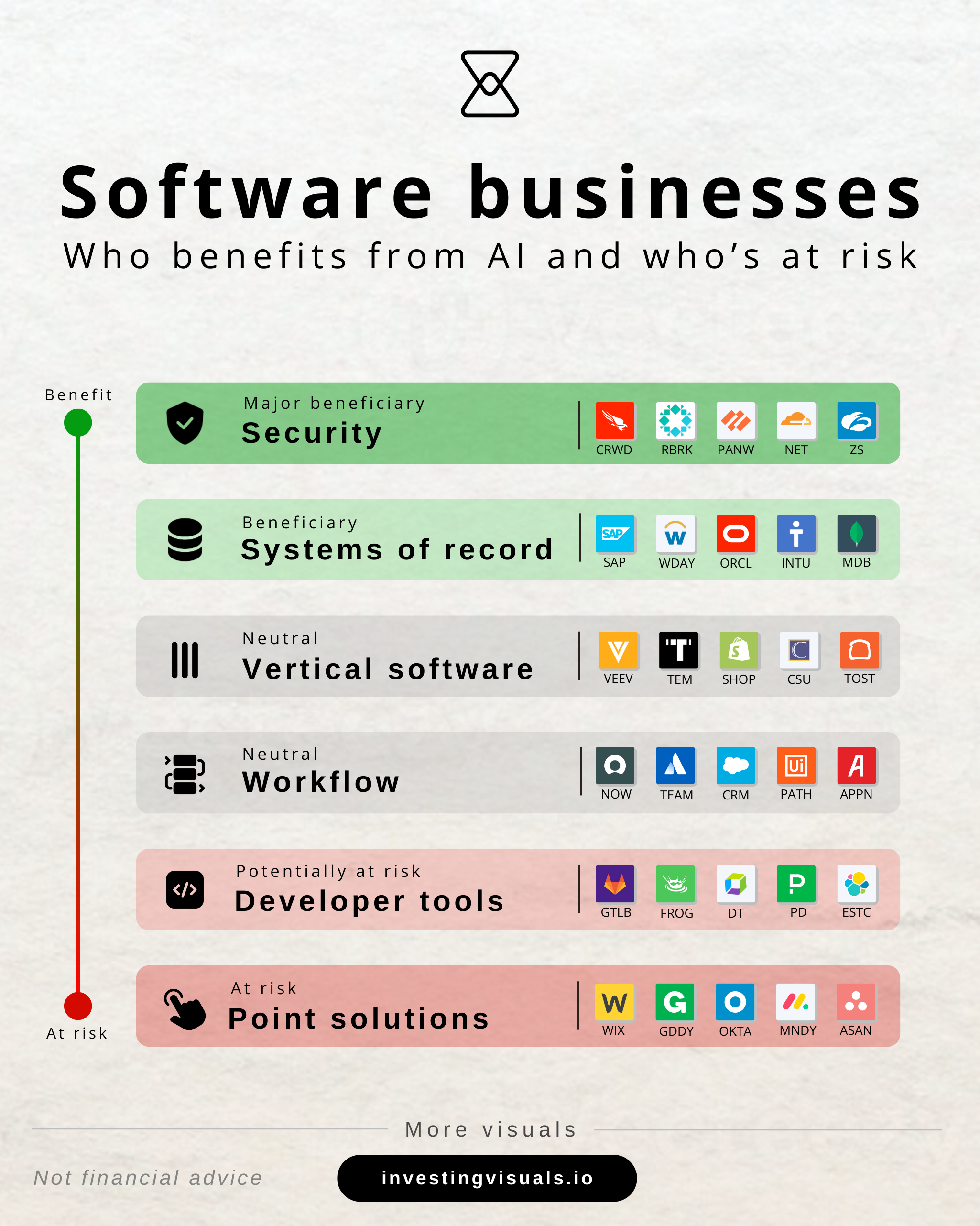
Here is how I segment it when looking at the main categories, ranking them from those who actually benefit from AI to those most at risk. With “risk” meaning that AI makes the product easier to bypass, weakens pricing power and increases churn over time.
Think of this more as a framework, instead of a definitive list. There’s still a lot of nuance per business. Some companies can thrive even in a higher risk bucket, while others can struggle in categories that I label as AI beneficiaries.
Categories ranked from biggest beneficiary to most at risk:
- Security (major beneficiary)
- Systems of record (beneficiary)
- Vertical software (neutral)
- Systems of workflow & orchestration (neutral)
- Developer tools and observability (potentially at risk)
- Point solutions (at risk)
4.1 - Security
Security tools protect identities, endpoints, networks, applications, and data. They detect threats, stop attacks, and help teams respond quickly. They sit as a horizontal layer across the entire enterprise stack. Security touches everything because everything can be attacked. Core players:
- CrowdStrike
- Rubrik
- Palo Alto Networks
- Cloudflare
- ZScaler

Impact of AI
More automation and more AI agents interacting with systems expands the attack surface. Security is a category companies may consolidate, but they rarely decide to spend less on protection overall.
Platforms that can ingest massive telemetry, correlate signals, and actively project data will benefit most. Rubrik is an example of a business that becomes increasingly important with the rise of AI agents.
4.2 - Systems of record
These are the systems that store the "authoritative state" of a business. They sit at the data and transaction layer and hold the facts of company. Think general ledger, payroll, employee records, customer master data, contracts, orders. Core players:
- SAP
- Workday
- Oracle
- Intuit
- MongoDB

Impact of AI
AI agents can make these systems easier to use and can automate data entries, reconciliation, approvals, and reporting. But these agents still need a trusted place to read and write data, with permissions and audit trails.
4.3 - Vertical software
Vertical software is built for a specific industry. They sit at the application layer, but tightly coupled to industry specific data and regulation. Think of it like a system of record inside a niche. They focus on industry workflows, compliance rules, data formats, and integrations that horizontal software usually does not cover well. Industries like lief sciences, insurance, construction, healthcare and the public sector. Core players:
- Veeva Systems
- Tempus
- Shopify
- Constellation software
- Toast

Impact of AI
If the vertical vendor owns high quality proprietary datasets and the workflow, it can build better domain specific AI than a general tool. For them, AI can be a big tailwind. Veeva and Tempus are great examples of vertical depth where domain context really matters.
4.4 - Systems of workflow and orchestration
If systems of record are the database with the facts, workflow systems focus on “how work gets done” across IT, operations, service, and internal processes. These systems route work. They move tasks through steps, enforce approvals, trigger actions, and connect many different systems together. Core players:
- ServiceNow
- Atlassian
- UiPath
- Appian

Impact of AI
Agents create more automation, and automation needs guardrails. Someone has to decide what an agent is allowed to do, when it can do it, what gets logged, what gets approved, and how failures get handled. That orchestration layer becomes more valuable when the pace of execution increases.
4.5 - Developer tools and observability
This category helps teams build and run software. They sit in the engineering layer that powers the rest of the software economy. Developer platforms help write, test, ship, and deploy code. Observability helps you see what is happening in production through logs, metrics, traces, and incident workflows. Core players:
- GitLab
- JFrog
- Dynatrace
- PagerDuty
- Elastic

Impact of AI
AI agents put pressure on seat based pricing in dev tools and observability because they break the link between revenue and user count. If an agent can write code, triage incidents, and pull insights from logs, teams can ship more with fewer people needing a license. So you end up with a weird mismatch where product value can go up, but “seats” don’t.
That’s why I think this category naturally shifts toward usage or outcome based pricing. More machine activity, more value, and pricing needs to follow that reality.
4.6 - Point solutions
These are tools that mainly provide a user interface for a narrow job. They sit at the surface layer where humans click, organize, and collaborate and have a very specific and narrow focus. They can be useful and loved, but they often do not own the underlying data of record or the end to end workflow. Their differentiation is user experience, templates, and convenience. Core players:
- Wix
- GoDaddy
- Okta
- Monday
- Asana

Impact of AI
If the user’s interface and narrow workflow tools get replaced by an AI agent, the value of these businesses compress. A lot of what these tools do can be replicated by an agent that can call APIs, generate documents, schedule tasks, and update systems without a dedicated UI. Effectively bypassing them. They either have to focus more on workflow and data or become a distribution winner with a strong ecosystem.
5 - Conclusion
I believe the market isn’t wrong to be nervous. AI agents and vibe coding do change the software landscape as we speak. They challenge the seat based model, compress UI differentiation, and make it easier for new competitors to ship something good enough.
But the market is getting one thing wrong by treating software like a single bucket. What I see isn’t software dying, it’s software being reinvented. And the market is still trying to figure out how to price it.
Systems of record still matter because the data has to live somewhere, with permissions, audit trails, and accountability. Workflow and orchestration can actually become more valuable because more automation means more need for guardrails and controlled execution. Security becomes increasingly important because the attack surface expands and deep vertical software with proprietary data can more effectively build AI agents themselves than a general purpose model can.
In my opinion, the pressure is most real where the moat is (to a large extend) the interface. Point solutions and light workflow tools are easier to bypass when the interface becomes an AI agent.
Closing remarks
This selloff is being driven by uncertainty about where SaaS goes next. I believe the winners will be the companies that adapt their product and pricing to this new reality, where the seat based model likely shifts toward consumption based pricing, or a hybrid of both.
The losers will be the ones unwilling or unable to evolve the seat based model in a world where seats gradually get replaced by agents. Over the past months, I’ve positioned my portfolio to increase exposure to the businesses I believe will be major beneficiaries of AI, and that have become increasingly attractive (or even outright bargains) during this selloff.
To wrap it up, I think every investor should be able to answer one key question before investing in a software business:
"When AI agents do the work, does the work still run through this software business, or can it run around it?"
Thank you for reading, I hope you found this helpful and feel free to drop a comment! As always, none of this is financial advice. This is simply my view on the software sector. Always do your own due diligence before making an investment decision that fits your own risk tolerance and time horizon.
Written by

Sign-up
And receive the latest visuals and articles straight to your inbox



Member discussion